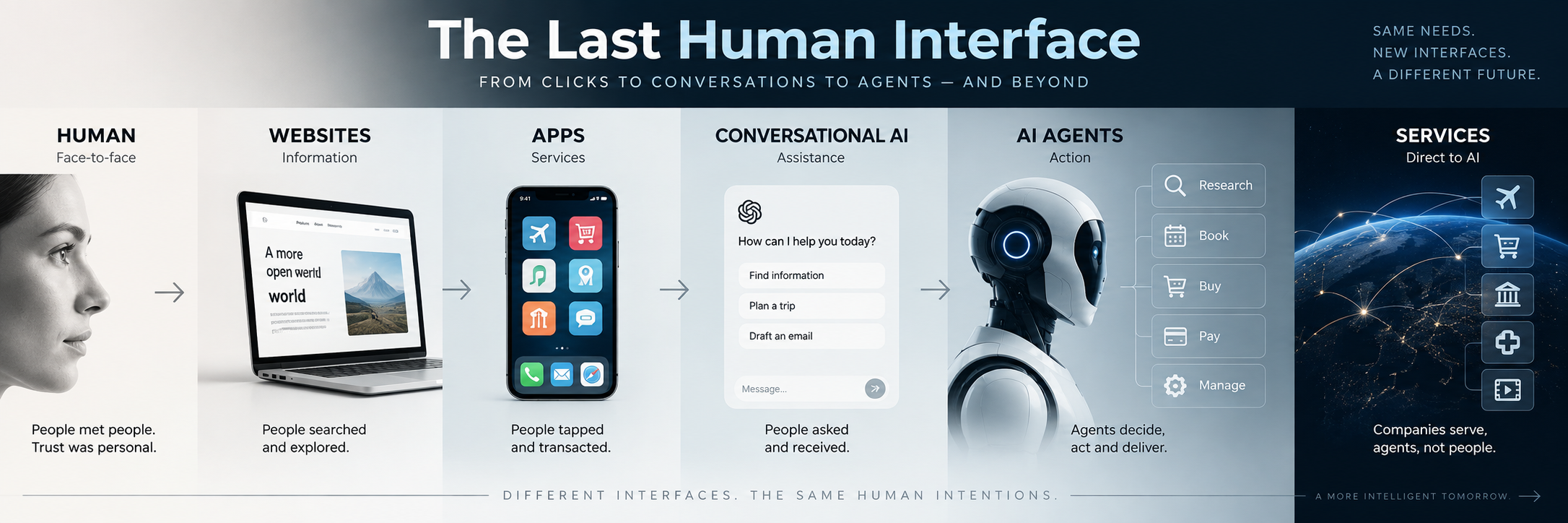
 What happens to companies when customers no longer interact with them — but their AI agents do?
At the end of 90s, together with a small group of partners, I co-founded a company with a name that, looking back, now seems almost prophetic: Human Interaction.
The idea was simple. Computing was becoming more powerful, networks were expanding, and digital services were beginning to enter everyday life. But there was still a fundamental problem: how would ordinary people interact with all this technology?
Together with students from University of Rovaniemi 🇫🇮 and Tokyo 🇯🇵 Japan, we experimented with new interfaces for the emerging generation of interactive set-top boxes.
At the time, the television looked like one of the most promising gateways to the digital world. The Internet was still young. The smartphone did not exist. Broadband was far from universal. For many companies, especially established telecommunications and media players, the set-top box appeared likely to become the device through which millions of households would access interactive services.
The technical challenge was interesting.
But the human challenge was more interesting.
A television remote control was not a keyboard. A sofa was not a desk. A television screen was not a computer monitor. People who had never thought of themselves as computer users were suddenly expected to navigate menus, information, commerce and interactive services.
The question we were asking was therefore not simply how to build another digital service.
It was:
How do we create an interface between human intention and an increasingly complex technological system?
Almost thirty years later, I find myself thinking about that question again.
Except that this time something fundamental has changed.
We may be approaching the point at which the interface is no longer primarily designed for humans.
Every digital revolution created a new interface
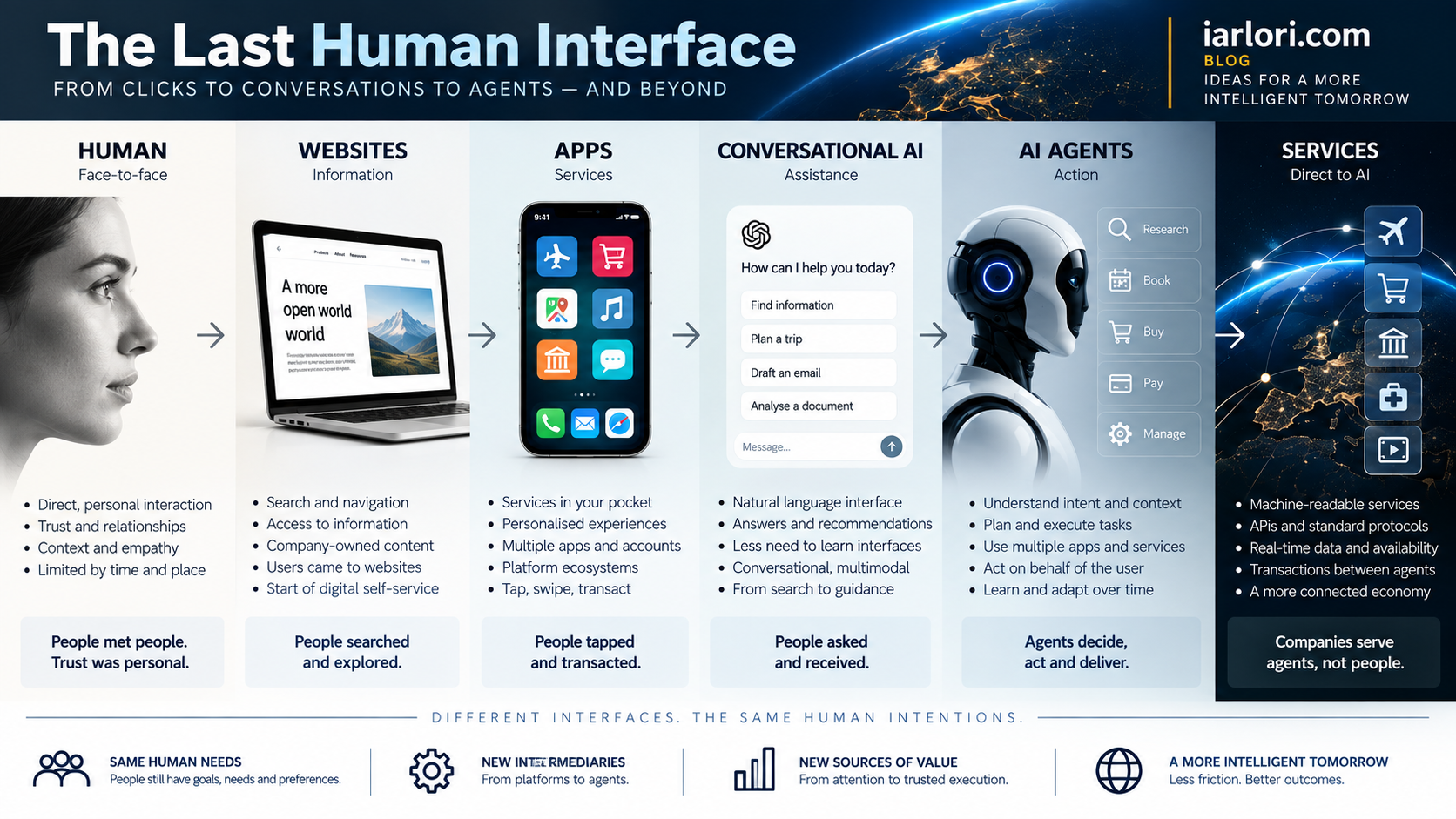
The history of computing can also be read as a history of interfaces.
Early computers required people to adapt themselves to machines. Interaction meant punch cards, commands and specialised knowledge.
The graphical user interface changed that relationship. Files became documents. Directories became folders. Commands became icons and menus. Computing borrowed metaphors from the physical world so that humans could understand the digital one.
Then came the Web.
The browser became the interface to information.
Companies built websites because customers were now expected to visit them. We learned URLs, navigation bars, hyperlinks, search boxes and shopping carts.
A new digital architecture grew around a remarkably simple assumption:
the human would come to the company.
Then smartphones changed the interface again.
The website became the app.
Instead of navigating through pages, we tapped icons. Instead of entering the digital world through one browser, we carried hundreds of specialised interfaces in our pockets.
Banks had apps. Airlines had apps. Retailers had apps. Municipalities had apps. Newspapers had apps.
The basic assumption, however, remained unchanged.
The human was still operating the interface.
- We searched.
- We compared.
- We selected.
- We filled in forms.
- We clicked buy.
- We entered payment details.
- We booked the hotel.
- We checked in for the flight.
Software helped us perform these actions, but the human remained the orchestrator.
Then conversation arrived
Generative AI initially appeared to represent another step in this history.
Instead of learning where a function was located, we could simply ask for what we wanted.
The interface became language.
This is much more important than it first appears.
For decades, software designers had been asking humans to translate their intentions into the structure of software.
Choose the correct menu.
Find the right page.
Select the appropriate field.
Understand the workflow.
Conversational AI begins to reverse that relationship.
The human expresses an intention:
Find me a train to Paris tomorrow morning.
The machine interprets it.
That removes an enormous amount of interface complexity.
But conversational AI may only be an intermediate stage.
Because once the system understands what I want, an obvious question follows.
Why should it stop at telling me how to do it?
From answers to actions
Imagine that I tell my AI:
Find me a hotel in Copenhagen for three nights. I want somewhere central, quiet, with a gym. Stay below €250 per night. Check my calendar before choosing the dates. Use the loyalty programme if it makes sense. Pay with the card that gives me the best travel benefits.
Today, several separate interfaces may still sit between that intention and the result.
Search engines.
- Travel websites.
- Hotel websites.
- Maps.
- Reviews.
- Calendars.
- Payment systems.
- Loyalty programmes.
Perhaps seven or eight different interfaces for one relatively simple human objective.
An AI agent changes the architecture.
I express the objective once.
The agent searches, compares, negotiates constraints, checks availability, selects and eventually transacts.
At that point, something profound happens.
I am no longer the customer operating the company’s digital interface.
My agent is.
And that has consequences far beyond interface design.
When your customer is software
For the last thirty years, enormous industries have been built around attracting human attention.
- Search-engine optimisation.
- Digital advertising.
- User-experience design.
- Conversion optimisation.
- Recommendation engines.
- Mobile engagement.
- Push notifications.
- Loyalty applications.
Entire corporate functions exist because companies compete to influence the path between a person’s intention and a transaction.
But what happens when an AI agent stands in the middle?
My agent does not care whether your website is beautiful.
- It does not become impatient because your competitor has a simpler checkout.
- It is unlikely to be impressed by a large hero image.
- It may not see your advertising.
- It does not necessarily need your app.
It wants something quite different.
- Reliable information.
- Structured data.
- Availability.
- Price.
- Terms and conditions.
- Identity.
- Reputation.
- APIs.
- And the ability to execute a transaction.
The competitive interface therefore begins to move underneath the graphical interface.
For humans, companies built websites and apps.
For agents, companies may increasingly have to build machine-readable services.
This is why the emergence of AI agents should not be understood merely as another improvement in user experience.
It could represent a fundamental restructuring of the relationship between organisations and their customers.
The interface begins to disappear
There is a curious paradox here.
We may be entering the most sophisticated period in the history of human-computer interaction precisely when the traditional interface begins to disappear.
The best interface may eventually be no interface at all.
- I do not want to navigate an airline’s application.
I want to travel.
- I do not want to understand my bank’s product catalogue.
I want to manage my money.
- I do not want to navigate a municipal portal.
I want to renew a permit.
- I do not want to compare twenty electricity tariffs.
I want an appropriate contract at a reasonable price.
The interface existed because computers needed us to explain our intentions in a form they could process.
Artificial intelligence increasingly understands the intention itself.
And agents add another step: they can potentially act upon it.
The chain therefore changes:
Human → Interface → System
becomes
Human → AI → Systems
and perhaps eventually:
Human intention → Agent → Agent → Service
The graphical interface has not necessarily disappeared.
But it is no longer where all the economic power resides.
The last human interface
This brings me back to Human Interaction.
In the 1990s, we were trying to make increasingly complex technology understandable to people sitting in front of a television.
The central problem was the interface.
How could humans communicate their intentions to machines?
Thirty years later, AI is beginning to invert the question.
Machines are becoming capable of understanding human intentions directly – and of communicating with other machines on our behalf.
Perhaps the next great interface will therefore not be between a human and a computer.
It will be between our AI and the institutions around us.
- Our bank.
- Our employer.
- Our municipality.
- Our healthcare provider.
- Our retailer.
- Our airline.
- Our university.
- Our government.
And that creates a much bigger question than whether websites or apps will disappear.
If AI increasingly mediates our relationship with institutions, who designs the rules governing that mediation?
Who decides what our agent is allowed to know?
Who decides what it is allowed to negotiate?
Who represents our interests?
Who controls our identity?
Who carries liability when an autonomous transaction goes wrong?
And, perhaps most importantly, who does the agent actually work for?
These are not interface-design questions anymore.
They are questions of architecture, economics, trust and institutional power.
Thirty years ago, I called a company Human Interaction because we believed the challenge was to design better ways for humans to interact with technology.
The name still feels relevant.
But the meaning has changed.
The challenge ahead may not be designing the next human interface.
It may be ensuring that, in a world where machines increasingly interact with machines, human intention remains at the centre of the system.
The economics of the invisible interface
Every interface creates an economy around itself.
The Web created search engines, digital advertising, affiliate marketing, e-commerce marketplaces and an enormous industry dedicated to acquiring traffic.
The smartphone created another economic layer: app stores, mobile advertising, in-app purchases, subscriptions and platform commissions.
These businesses did not simply emerge because websites and smartphones existed.
They emerged because someone controlled the interface between human intention and a transaction.
That position is extraordinarily valuable.
Google understood that a person typing “hotel in Rome” was not merely searching for information. They were expressing an intention that could eventually become a transaction.
Amazon understood that controlling product discovery, comparison, reputation and checkout could be more valuable than simply operating an online shop.
Apple demonstrated something similar from another direction. By controlling the device, operating system, identity, app distribution and increasingly payments, it occupied several critical points between human intention and digital action.
The interface therefore became more than a technical layer.
It became an economic tollbooth.
AI agents could rearrange those tollbooths.
Who owns the intention?
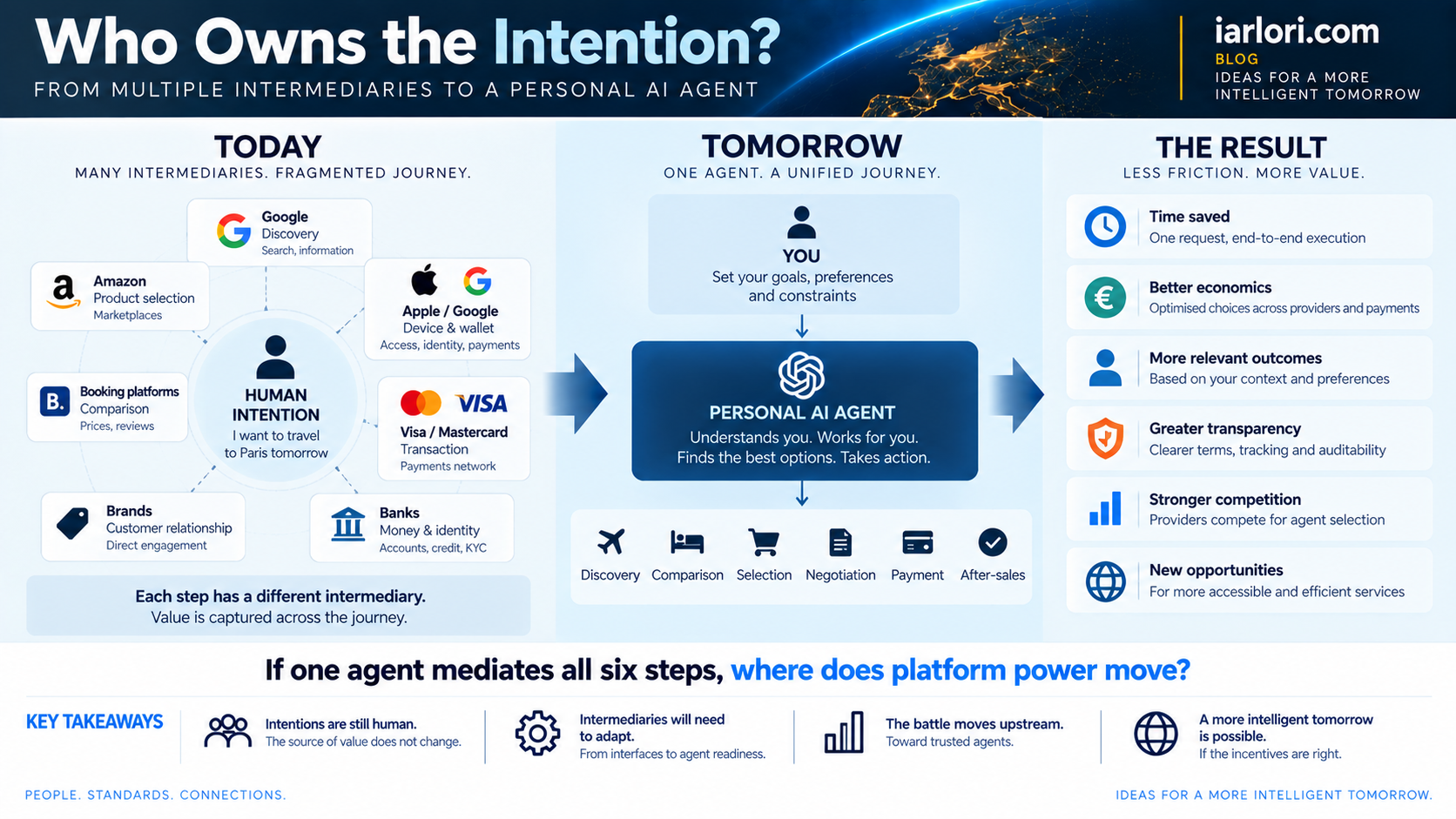
Consider something as ordinary as booking a hotel.
Today I might start with Google, move to Booking.com, check TripAdvisor or Google Maps, visit the hotel’s website, compare prices and eventually pay using a card stored in my browser or phone.
At every stage, someone has an opportunity to influence, observe or monetise my behaviour.
Search engines monetise discovery.
Marketplaces monetise intermediation.
Advertising platforms monetise attention.
Payment networks monetise transactions.
Banks monetise financial relationships.
Hotels try to recover the direct customer relationship.
The economics of the Internet are therefore partly the economics of intermediating human intention.
Now replace that sequence with a sentence:
Find me a quiet four-star hotel near my meeting in Rome, below €220, with breakfast and late cancellation. Use my preferred hotel programme if the economics make sense.
My agent can potentially perform the search, comparison and transaction.
I never see ten blue links.
I never open the marketplace.
I never see the advertisement.
I may never visit the hotel’s website.
I may not even know which payment instrument was ultimately selected.
The interface has become invisible.
But the intermediary has not disappeared.
It has simply moved.
From attention economy to intention economy
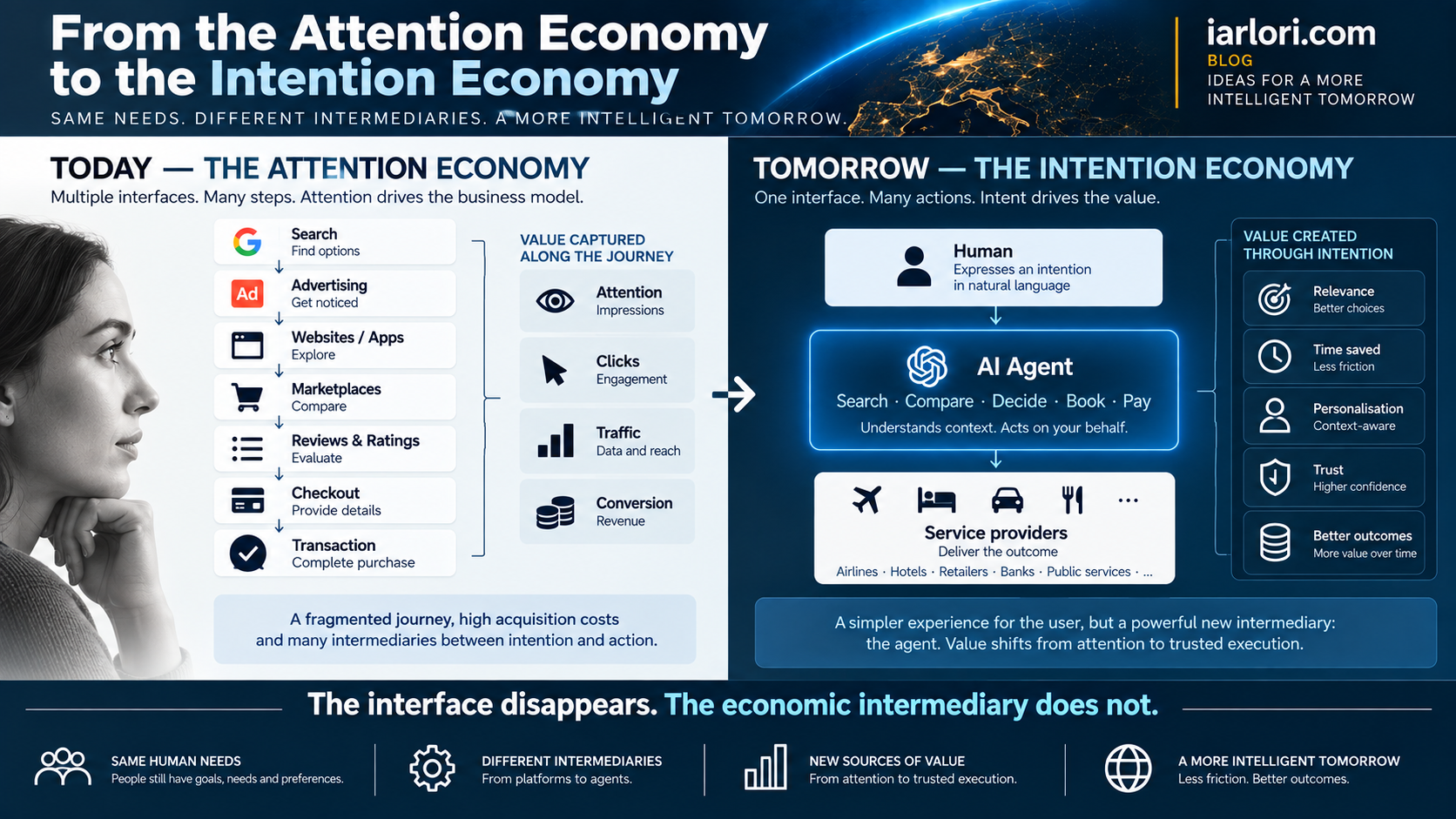
Much of the digital economy has been built around attention.
Companies compete to make us look.
More impressions create more advertising inventory. More engagement generates more behavioural data. More time inside an application increases opportunities to influence the next action.
AI agents have little reason to participate in this economy in the same way.
An agent does not need to spend twenty minutes browsing twenty hotels.
It can evaluate twenty thousand.
It does not need an advertisement to remind it that a product exists.
It can query a catalogue.
It does not need persuasive interface design to complete a purchase.
It needs reliable information, authority and a mechanism for executing the transaction.
This suggests a potentially important economic transition:
from competing for human attention to competing for machine-mediated intention.
The distinction matters.
Attention is scarce because humans have limited time.
Machine attention is potentially abundant.
But intention remains scarce.
There is still only one hotel I will ultimately book, one insurance policy I will buy, one flight I will take and one payment that will settle the transaction.
The valuable position therefore moves closer to the moment at which intention becomes action.
And whoever controls the agent may occupy that position.
The new gatekeeper
This creates an uncomfortable possibility.
AI agents are often described as technologies that will remove intermediaries.
They may do exactly the opposite.
They may create one of the most powerful intermediaries the digital economy has ever seen.
If my agent knows my calendar, location, preferences, finances, subscriptions, relationships and previous decisions, it possesses something far more valuable than a browser cookie.
It possesses context.
And if it can act, it possesses something even more valuable:
delegated authority.
The company controlling that layer could influence which products are considered, which suppliers are excluded, how alternatives are ranked, which payment instrument is selected and when a transaction takes place.
That is a remarkable concentration of economic power.
The great platform battle of the AI era may therefore not simply be about who builds the most capable model.
It may be about who becomes the trusted agent acting between individuals and the economy.
What happens to the transaction fee?
Payments make this particularly interesting.
For decades, the payment industry has evolved through layers of intermediation: merchant, acquirer, network, issuer, wallet, device and increasingly digital identity.
Each layer performs a function, manages risk and captures some economic value.
But an autonomous agent can optimise across those layers.
Imagine giving an agent a simple instruction:
Whenever I buy something, use the payment method that gives me the lowest total cost and best combination of protection, rewards and liquidity.
That instruction sounds trivial.
Economically, it is not.
Today, payment choice is heavily influenced by default settings, merchant acceptance, wallet positioning, card branding, loyalty programmes and consumer habit.
An agent has no habits.
It can calculate.
If millions of agents begin dynamically choosing payment instruments, payment providers may increasingly compete not for a prominent position in the consumer’s physical or digital wallet, but for selection by an algorithm.
The same logic applies far beyond payments.
- Which airline?
- Which electricity provider?
- Which insurance policy?
- Which mortgage?
- Which cloud service?
- Which supplier?
The customer may no longer make every comparison.
The customer’s agent will.
Companies will have two customers
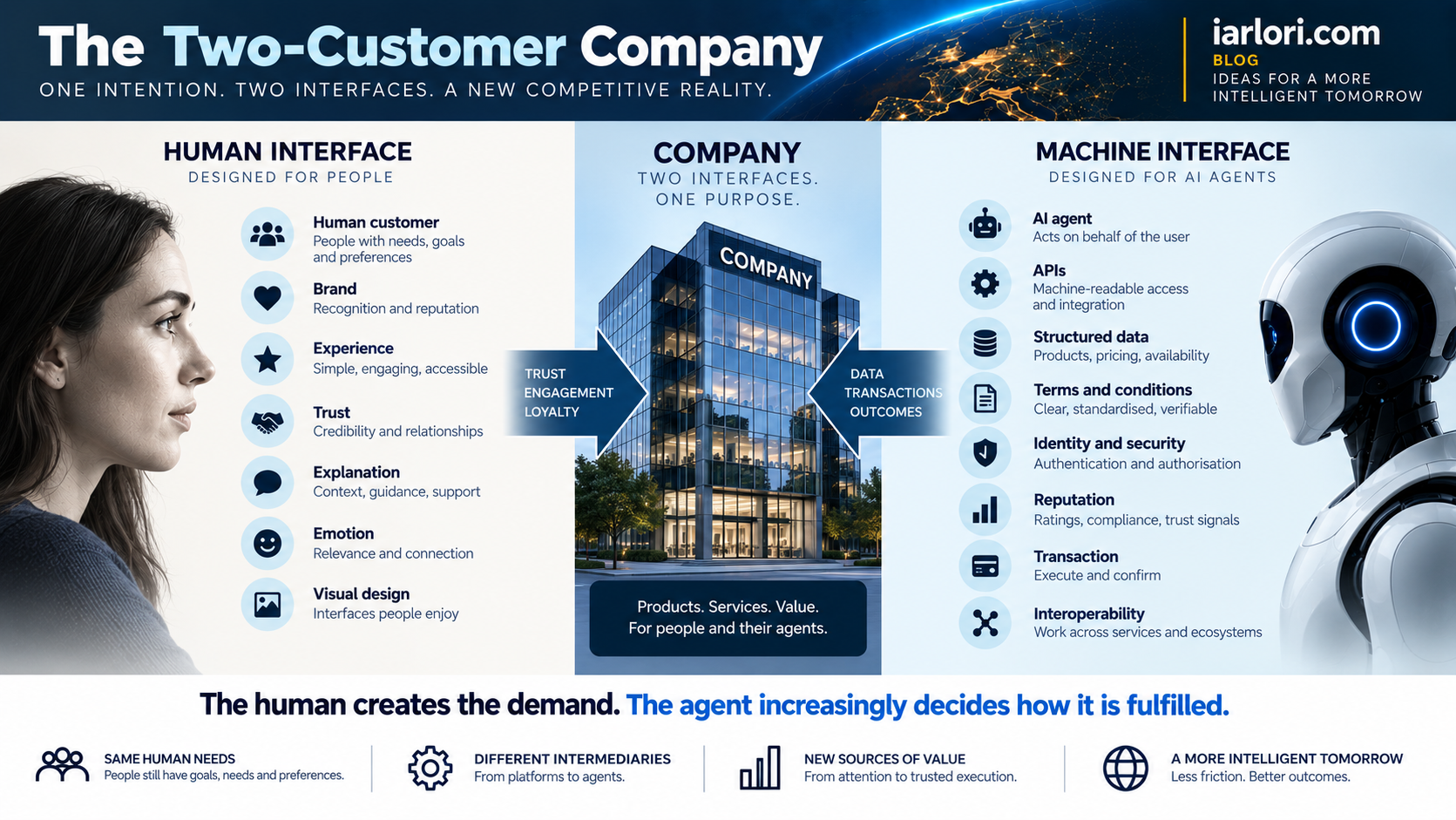
This may force organisations to rethink what a customer interface actually is.
For decades, companies optimised their digital presence for humans.
Soon they may need to optimise simultaneously for humans and for their agents.
The human layer will still require trust, explanation, emotion, brand and experience.
The machine layer will demand something different: structured products, transparent pricing, verifiable claims, machine-readable terms, identity protocols, APIs and predictable transaction mechanisms.
A beautiful website may remain important.
But behind it will need to exist another interface that most customers never see.
An interface designed for machines.
Companies may therefore discover that they have, in effect, two customers:
- the person whose intention creates the demand,
- and the agent deciding how that intention should be fulfilled.
This is where the invisible interface becomes economically significant.
Because the disappearance of the visible interface does not eliminate the battle for customer ownership.
It intensifies it.
For thirty years, companies fought to become our homepage, our search engine, our marketplace, our app and our wallet.
The next battle may be considerably more consequential.
They will fight to become our agent.