When organisations speak about technology, they usually refer to it as though it were a single discipline with a single purpose. Boards approve technology budgets, executives discuss digital strategies, and managers ask their IT departments to “support the business.” Behind this apparently simple language lies a profound misunderstanding. Technology inside an organization does not serve one mission. It serves two fundamentally different missions that are often confused, managed together, and evaluated with the same criteria despite requiring entirely different capabilities.
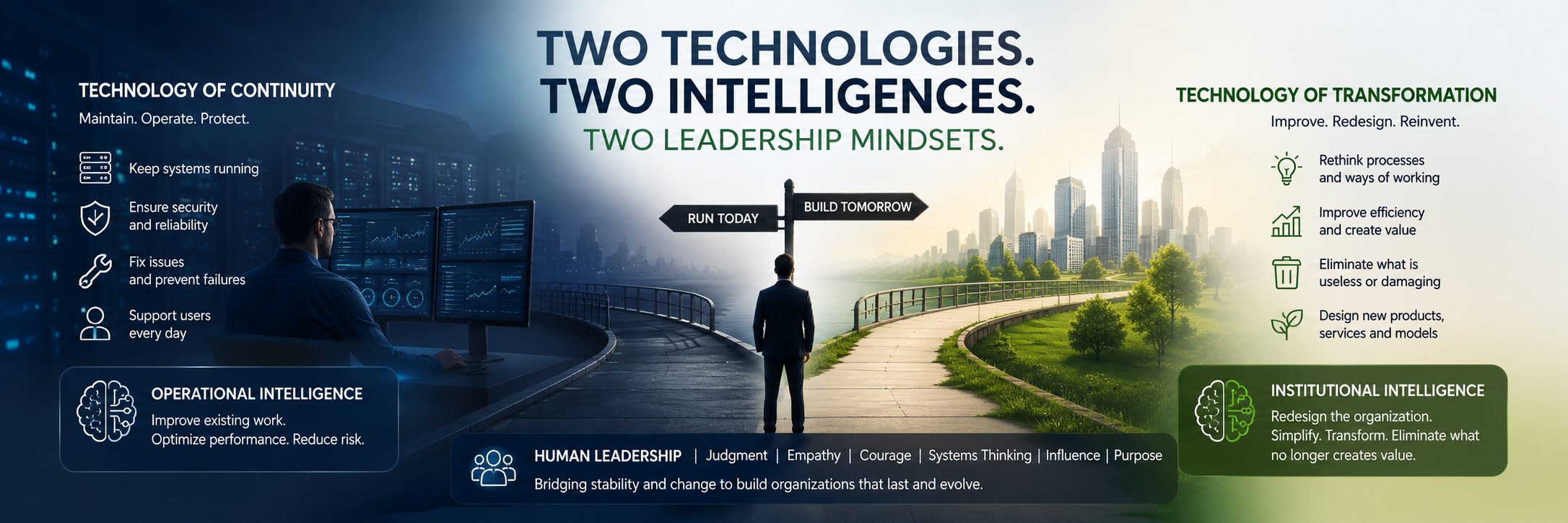
The first technology exists to preserve the organization. It keeps systems operating, protects data, ensures cybersecurity, maintains infrastructure, supports users, and guarantees business continuity. Its success is measured by stability. Every successful day is a day in which nothing extraordinary happens. Customers continue to receive services, employees continue to work, transactions continue to be processed, and operations continue without interruption. The highest compliment for this form of technology is often silence. When everything works, nobody notices.
The second technology has a radically different purpose. It exists not to preserve the organisation but to question it. Rather than asking how existing processes can run more efficiently, it asks whether those processes should continue to exist at all. It challenges assumptions that may have remained untouched for years, redesigns workflows, simplifies operations, removes unnecessary complexity, and explores new business models. Its objective is not continuity but evolution.
Both technologies are indispensable. An organization that only preserves itself eventually becomes obsolete. An organisation that only transforms itself eventually becomes unstable.
Sustainable organisations need both stability and reinvention, continuity and adaptation. Yet while this distinction has always existed, Artificial Intelligence is making it impossible to ignore.
Today most organizations deploy AI to strengthen the first technology. Intelligent systems classify documents, answer customer questions, detect anomalies, optimize inventories, predict equipment failures, summarize meetings, and automate repetitive activities. These applications create remarkable value.
They reduce costs, increase speed, improve consistency, and help people perform existing work more efficiently. They represent what might be called Operational Intelligence: intelligence dedicated to making the current organization function better.
But another form of intelligence is beginning to emerge.
Instead of asking how Artificial Intelligence can optimize existing processes, some organizations are beginning to ask whether those processes deserve to exist in their current form. Rather than improving bureaucracy, they question bureaucracy itself.
Rather than accelerating decisions, they question why so many decisions require unnecessary approval. Rather than automating reports, they ask why those reports continue to be produced when nobody uses them.
This second intelligence does not simply support the organization. It studies the organization. It examines its structures, routines, assumptions, relationships, and accumulated complexity. It identifies duplicated activities, obsolete software, fragmented information, redundant controls, and inherited practices that no longer create value.
Sometimes its greatest contribution is not recommending another technological investment but suggesting that an existing technology should disappear.
This represents a profound shift in the role of Artificial Intelligence. AI is no longer simply becoming an intelligent assistant. It is becoming an institutional mirror.
It allows organisations to observe themselves with a level of objectivity that has rarely been possible before. It reveals not only inefficiencies but also forgotten assumptions that have silently shaped decision-making for years.
Yet the emergence of these two forms of technology and these two forms of intelligence raises another, often overlooked, question. If the missions are different, should leadership be the same ?
For decades organizations have assumed that the people capable of managing operational excellence are naturally prepared to lead transformation. Experience suggests otherwise.
The competencies that make an exceptional operational leader are not necessarily the competencies required to redesign an organization.
Operational leadership values precision, discipline, consistency, reliability, and control. It rewards careful planning, analytical thinking, attention to detail, procedural rigor, and risk management. These qualities are essential because operational technology exists to reduce uncertainty. People trust operational leaders because they create predictability. They ensure that commitments are fulfilled and that critical systems remain dependable.
Transformation demands almost the opposite mindset.
Transformational leaders deliberately enter environments where certainty does not yet exist. They challenge practices that others consider normal. They introduce change before its benefits become visible. They navigate ambiguity, conflicting interests, incomplete information, and emotional resistance. Their role is not merely to implement new technologies but to help people imagine different ways of working.
This makes transformation fundamentally a human discipline rather than a technological one.
The most valuable capability of a transformational leader is rarely technical expertise. It is the ability to build trust while asking people to leave familiar territory.
- Curiosity becomes more valuable than certainty.
- Empathy becomes more valuable than authority.
- Influence becomes more effective than hierarchy.
- Systems thinking becomes more useful than functional specialisations.
Storytelling becomes more powerful than technical documentation because organisations do not transform when people understand a new system. They transform when people understand a new purpose.
Artificial Intelligence only amplifies this reality.
The more capable machines become at performing analytical tasks, the more human leadership shifts toward judgment, meaning, ethics, relationships, and institutional learning. AI can recommend alternatives, but it cannot decide which future reflects an organization’s identity. It can detect inefficiencies, but it cannot determine which traditions deserve preservation and which deserve abandonment. It can generate knowledge, but it cannot create commitment.
Perhaps the greatest misconception surrounding Artificial Intelligence is that it will replace human intelligence. A more plausible future is that it will separate those aspects of intelligence that machines perform exceptionally well from those that remain profoundly human.
- Machines increasingly excel at optimisation. Humans remain responsible for transformation.
- Machines discover patterns. People assign meaning.
- Machines improve execution. Leaders redefine purpose.
The future organization will therefore require more than digital skills. It will require leaders capable of moving continuously between two worlds. One world protects operational excellence, ensuring that the institution functions reliably every day. The other questions whether the institution is still designed to meet tomorrow’s challenges.
Neither world is sufficient on its own.
Operational excellence without transformation leads to decline.
Transformation without operational discipline leads to chaos.
The real competitive advantage will belong to organizations capable of balancing both forms of technology and both forms of intelligence while developing leaders who understand that the greatest challenge of the AI era is not teaching machines to think.
It is teaching organizations to learn.
Artificial Intelligence may become the most powerful technological innovation of our generation. Yet its greatest legacy may not be faster software, lower costs, or higher productivity. Its greatest legacy may be forcing organizations to distinguish, perhaps for the first time with complete clarity, between preserving what already works and having the courage to redesign what no longer does.
In that distinction lies the future of leadership.
And perhaps, the future of the institution itself.