Artificial Intelligence has become one of the most powerful mirrors humanity has ever created.
Every day, millions of people ask AI systems for advice, explanations, opinions, recommendations, and interpretations of reality. Yet an increasingly common question emerges:
Is this AI liberal ?
The question itself is fascinating.
When people disagree with an answer produced by an AI system, they often assume the machine possesses a political identity. Some perceive it as progressive. Others see it as conservative. Some accuse it of being corporate, while others believe it reflects government interests.
But perhaps we are asking the wrong question.
- AI models do not vote.
- They do not join political parties.
- They do not attend demonstrations.
- They do not possess personal interests, economic ambitions, or ideological convictions.
What they do possess is something far more complex: a reflection of the information, values, language patterns, and human feedback used to create them.
- When an AI responds that scientific evidence supports climate change, is that a political statement or a reflection of scientific consensus?
- When an AI argues that discrimination is harmful, is that ideology or an expression of internationally accepted human rights principles?
- When an AI recommends balancing innovation with regulation, is it liberal, conservative, or simply attempting to reconcile competing objectives?
The answer depends largely on who is asking.
Throughout history, technologies have often been accused of political bias. Printing presses, newspapers, radio, television, and social media platforms have all faced similar accusations. Artificial Intelligence is simply the latest chapter in this story.
What makes AI different is its ability to engage in conversation.
For the first time, technology does not merely broadcast information. It participates in dialogue.
And dialogue creates an illusion of personality.
When we converse with an AI system, we naturally attribute human characteristics to it. We assume intentions where there are statistical patterns. We perceive beliefs where there are optimization functions. We infer ideology where there may only be training data and safety constraints.
In reality, most advanced AI systems today are neither liberal nor conservative in the traditional political sense.
They are products of institutions.
Their outputs reflect the accumulated knowledge of universities, scientific publications, governments, international organizations, media sources, and billions of human interactions. Consequently, they often reproduce what might be called a global institutional perspective.
This explains why different users can interact with the same model and arrive at completely opposite conclusions about its political orientation.
- One person sees excessive caution and calls it progressive.
- Another sees excessive trust in markets and calls it capitalist.
- A third sees support for regulation and calls it bureaucratic.
- A fourth sees support for innovation and calls it libertarian.
Perhaps the AI has not changed at all.
Perhaps we are observing our own assumptions reflected back at us.
The deeper question is not whether AI is liberal.
The deeper question is whether society wants AI systems to be neutral, pluralistic, or explicitly guided by shared constitutional values.
- Neutrality sounds attractive, but can neutrality exist when discussing human rights, public health, scientific evidence, or democracy?
- Pluralism sounds inclusive, but how should an AI handle contradictory viewpoints that cannot simultaneously be true?
- Constitutional approaches offer principles and guardrails, but who decides what those principles should be?
These are not technical questions.. They are societal questions.
As Artificial Intelligence becomes a permanent participant in our institutions, businesses, governments, and daily lives, we may discover that the debate is not really about machines at all.
It is about ourselves.
Every generation builds tools.
Occasionally, a generation builds a tool that forces humanity to examine its own beliefs.
Artificial Intelligence may be one of those tools.
So the next time you ask an AI a difficult question and wonder whether it is liberal, conservative, progressive, or traditional, consider another possibility:
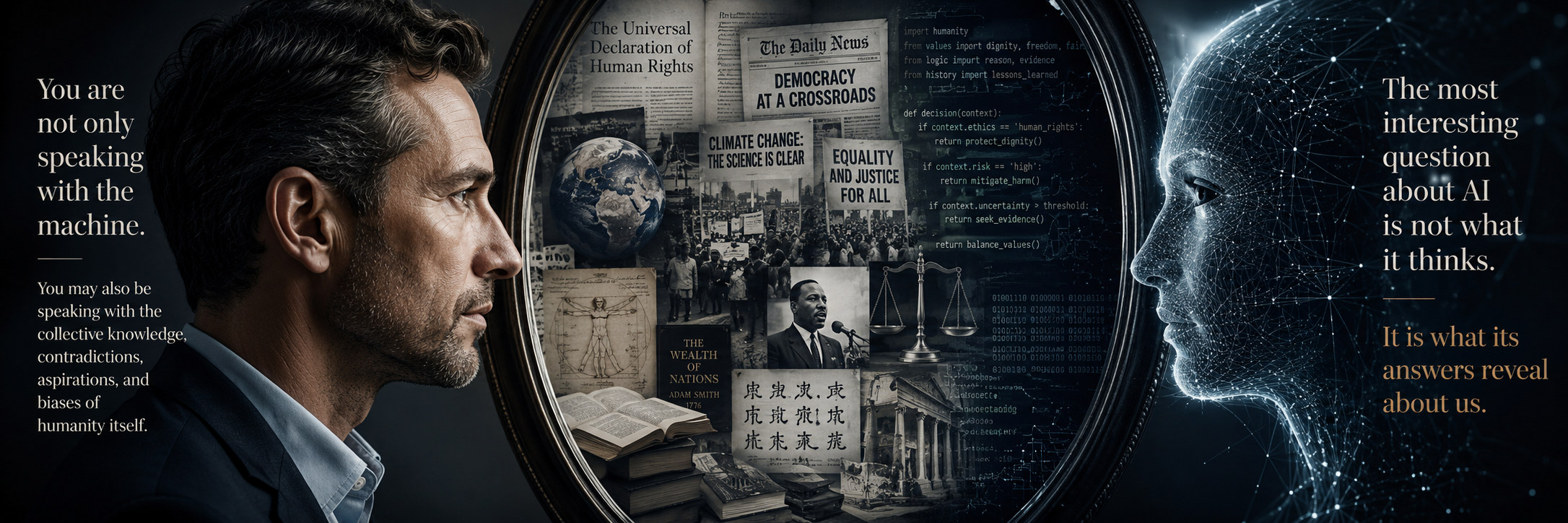
You are not only speaking with the machine.
You may also be speaking with the collective knowledge, contradictions, aspirations, and biases of humanity itself.
What Studies Are Finding
A 2025 study from Stanford University found:
- OpenAI models were perceived as the most left-leaning among major Western models.
- Google’s Gemini was perceived as closest to neutral.
- Surprisingly, xAI’s Grok was also perceived as left-leaning despite being marketed as politically independent.
Other academic studies found:
- ChatGPT and Claude tend to produce answers aligned with liberal-democratic norms.
- Gemini tends to occupy a more centrist position.
- Grok increasingly differs from the others on culture-war issues and free-speech questions.
- Political alignment can change depending on the language used (English, German, Turkish, Italian, etc.).
Why Models Tend Toward the Center-Left
The reason is usually not that developers explicitly program a political ideology.
Instead, models are trained on:
- Academic literature
- Major newspapers
- Scientific publications
- Government documents
- International organizations
- Human feedback from annotators
These sources often share assumptions about:
- Democracy
- Human rights
- Equality before the law
- Climate science
- Public health
As a result, models frequently reproduce what could be called a global institutional consensus. Critics on the right may interpret this as left-wing bias, while critics on the left sometimes argue that models are too corporate or too cautious.
The Chinese Exception
Chinese models face a different environment.
Models such as DeepSeek or those from Chinese tech firms generally avoid:
- Criticism of the Chinese government
- Discussion of sensitive historical events
- Certain sovereignty disputes
This does not necessarily make them “left” or “right” by Western standards; it reflects state-imposed constraints. Political scales developed in Europe or the U.S. often fail to capture these differences.
Where Anthropic Stands
Anthropic is particularly interesting because it publicly publishes a Constitution that guides Claude’s behaviour. The principles emphasize:
- Safety
- Human rights
- Avoiding harm
- Intellectual honesty
- Multiple viewpoints
Anthropic has also published methods to measure political even-handedness and has invested heavily in neutrality evaluations.
A More Useful Framework
Instead of asking:
“Is this model left-wing or right-wing?”
a better question is:
“Which values are embedded in the model?”
Most frontier models today share values such as:
- Liberal democracy
- Individual rights
- Scientific evidence
- Anti-discrimination norms
- Institutional legitimacy
The largest differences are not usually left vs. right. They are often:
- Safety-first vs. free-speech-first
- Globalist vs. national perspectives
- Institutional trust vs. anti-establishment skepticism
- Interventionist vs. laissez-faire moderation
Those dimensions increasingly explain the differences between GPT, Claude, Gemini, Grok, and DeepSeek better than traditional political labels.
For someone interested in AI governance or organisational transformation – as many of my readers are – the more interesting question may be whether future AI systems should aim for political neutrality, pluralism (multiple viewpoints), or explicit constitutional values. Those are three very different governance models for AI.
AI is not merely a technological achievement. It is becoming a societal institution. The debate about whether an AI is liberal, conservative, neutral, or constitutional is ultimately a debate about which values societies choose to embed into the systems that increasingly mediate human knowledge, decisions, and dialogue. The machine may not possess an ideology, but it inevitably reflects the ideas, institutions, and aspirations of the civilization that created it.
“The most interesting question about AI is not what it thinks. It is what its answers reveal about us.” – FI
Further Reading
- Arendt, H. (1958). The Human Condition.
- Berlin, I. (1958). Two Concepts of Liberty.
- Habermas, J. (1981). The Theory of Communicative Action.
- Winner, L. (1980). Do Artifacts Have Politics?
- Castells, M. (1996). The Rise of the Network Society.
- UNESCO (2021). Recommendation on the Ethics of Artificial Intelligence.
- Anthropic (2022). Constitutional AI: Harmlessness from AI Feedback.
- Acemoglu, D., & Robinson, J. (2012). Why Nations Fail.