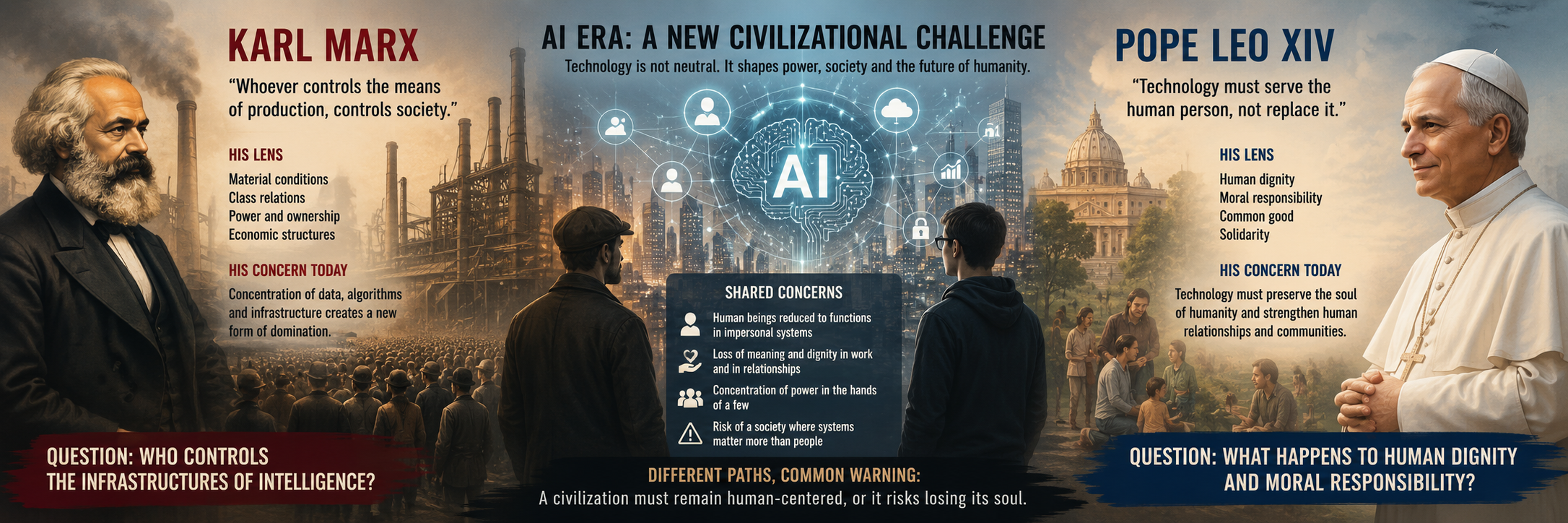
Karl Marx and Pope Leo XIV would probably stand on opposite sides of many philosophical questions, yet they would recognize some of the same fractures emerging in modern society – especially in the age of artificial intelligence, automation, and concentrated technological power.
Marx looked at society from the perspective of material structures. He believed that economics, ownership, and power relationships shape institutions, culture, and even human consciousness. When he observed industrial capitalism in the 19th century, he saw workers gradually transformed into components of a machine: individuals detached from the meaning of their labor, dependent on systems they did not control.
Today, if Marx were observing AI-driven societies, he might argue that something similar is happening again – but at the cognitive level rather than only the industrial one. The worker is no longer simply alienated from physical production, but increasingly from interpretation, creativity, decision-making, and even language itself. The factory has become informational. The assembly line has become algorithmic.
Pope Leo XIV, while coming from an entirely different spiritual and theological tradition, appears increasingly attentive to a parallel concern: that technological systems must never reduce the human person to a functional element inside an optimized machine. Where Marx would frame the issue in terms of ownership and class power, Leo XIV would frame it in terms of dignity, moral responsibility, and the preservation of humanity itself within technological civilization.
This is where the comparison becomes intellectually fascinating.
Marx would likely ask:
“Who controls the infrastructures of intelligence?”
Leo XIV may instead ask:
“What happens to the human soul, to moral responsibility, to human relationships, when intelligence becomes industrialized?”
These are not the same questions, but they converge around a common anxiety: the fear that human beings may gradually lose agency inside systems too large, too centralized, and too opaque to meaningfully influence.
In many ways, both perspectives emerge from moments of historical acceleration.
Marx witnessed the Industrial Revolution, where machines transformed labor, cities, family structures, and political power. Pope Leo XIV is confronting another civilizational transition, one where AI systems increasingly mediate communication, education, governance, work, and even emotional interaction.
The difference lies in the proposed response.
Marx believed structural conflict was inevitable. For him, concentrated ownership of productive systems would naturally produce domination. The solution therefore required transformation of economic structures themselves.
A Marxian reading of AI society might look like this:
Data + Infrastructure + Algorithms → Concentrated Cognitive Power
In this framework, whoever owns the computational infrastructure shapes reality at scale.
Leo XIV, however, would likely resist reducing humanity to economic categories alone. Catholic social thought traditionally insists that society cannot survive purely on efficiency, productivity, or technical optimization. Human beings are not merely workers, consumers, or data points. They possess intrinsic dignity independent of economic value.
A more Leo XIV–style concern might therefore be expressed as:
This does not reject technology. It questions its orientation.
One of the most interesting parallels between Marx and contemporary Catholic thought is that both are suspicious of systems that become so powerful they begin to shape humanity invisibly. Marx criticized the hidden mechanisms of capital. The Church increasingly warns about technocratic systems that subtly redefine what it means to be human.
Both would probably be deeply uncomfortable with a world where:
- attention is continuously manipulated,
- human relationships become transactional,
- labor loses meaning,
- culture becomes algorithmically optimized,
- and individuals become cognitively dependent on infrastructures they neither understand nor govern.
The modern AI debate therefore reopens an old question in a new form:
Can technological civilization remain human-centered once intelligence itself becomes industrialized?
Marx would answer through the language of power and ownership.
Leo XIV would answer through the language of ethics, community, transcendence, and human dignity.
Yet both, in different ways, are warning against the same danger:
a civilization where systems become more important than the people they were meant to serve.