 For years, organizations have spoken about digital transformation with the language of engineering and procurement. The discussion has often revolved around platforms, cloud migrations, workflow systems, dashboards, portals, mobile applications, and more recently, artificial intelligence. Entire strategies have been built around acquiring technologies that promised modernization, acceleration, efficiency, and innovation.
Yet despite decades of investment, many institutions still struggle with the same fundamental weaknesses they faced long before the digital era fully emerged. Decision-making remains fragmented. Knowledge disappears when experienced individuals leave. Departments operate in silos. Processes become digitized without becoming truly coherent. Technology layers accumulate while organizational clarity becomes increasingly difficult to maintain.
This is perhaps the central misunderstanding of digital transformation: most transformation initiatives were never truly transformational. They changed interfaces more than structures. They modernized appearances more than institutional logic.
A citizen portal may look modern while the underlying organization remains bureaucratically fragmented. A company may deploy advanced analytics while internally suffering from poor coordination and institutional memory loss. An AI assistant may answer questions quickly while being connected to inconsistent or incomplete knowledge bases. In these situations, technology does not resolve structural weakness. It simply accelerates it.
The problem is not that technology failed. The problem is that organizations often misunderstood what technology was actually changing.
For much of the last thirty years, digital transformation was treated as a process optimization exercise. The objective was speed. Faster services, faster communication, faster transactions, faster reporting. Efficiency became the dominant metric through which modernization was evaluated. But institutions were never built solely for efficiency. Organizations exist to preserve continuity, legitimacy, accountability, coordination, and collective memory over time. These are not merely technical functions. They are cognitive and social functions.
Artificial Intelligence changes this discussion profoundly because AI is not simply another software layer added to existing infrastructures. Traditional software automated procedures. AI increasingly participates in interpretation itself. It retrieves knowledge, identifies patterns, summarizes complexity, supports decisions, and in some cases begins to shape organizational reasoning. This introduces a transition that is far deeper than digitization.
We are moving from process automation toward cognitive transformation.
Historically, organizations evolved around human limitations. Human beings have limited memory, limited processing capacity, limited attention, and limited coordination capabilities. Entire bureaucratic structures emerged as mechanisms to compensate for these constraints. Hierarchies, procedures, reporting chains, archives, committees, and administrative systems were all ways of organizing limited human cognition at scale.
AI changes some of those assumptions for the first time in history. Institutional memory can potentially become persistent and searchable. Expertise can become distributable. Knowledge retrieval can become contextual rather than static. Decision support can operate continuously across vast informational environments that no individual could realistically navigate alone.
But this evolution also creates tension. Many organizations are attempting to integrate advanced AI systems into institutional structures that were not designed for this level of cognitive complexity. The result is often confusion disguised as innovation. AI tools are deployed while governance models remain unclear. Automation expands while accountability becomes blurred. Information increases while understanding does not.
This is why the future of digital transformation may depend less on technological sophistication and more on institutional maturity.
The organizations that will adapt successfully to the AI era are unlikely to be those simply purchasing the largest number of AI tools. They will be the organizations capable of redesigning themselves around intelligence as infrastructure. They will understand that knowledge flows matter as much as software architecture, that governance matters as much as automation, and that institutional coherence matters as much as computational power.
This becomes especially important in environments where structural fragility already exists. Public institutions, large enterprises, educational systems, healthcare organizations, and even media ecosystems increasingly operate under conditions of cognitive overload. Expertise turnover is accelerating. Decision cycles are shortening. Information environments are becoming more fragmented. Political and economic pressures reward immediacy rather than long-term institutional learning.
In this context, AI becomes both an extraordinary opportunity and a significant risk. It can strengthen institutional resilience by preserving knowledge, supporting coordination, and augmenting decision-making. But it can also amplify dysfunction if deployed inside weak governance structures. Technology magnifies both intelligence and disorder.
The real challenge of the coming decade is therefore not simply technological adoption. It is learning how human institutions should evolve in a world where cognition itself becomes scalable.
This is no longer a conversation about digital tools alone. It is a conversation about how societies organize knowledge, authority, responsibility, and meaning in the age of intelligent systems.
Digital transformation was never really about technology.
It was always about the architecture of human intelligence itself.
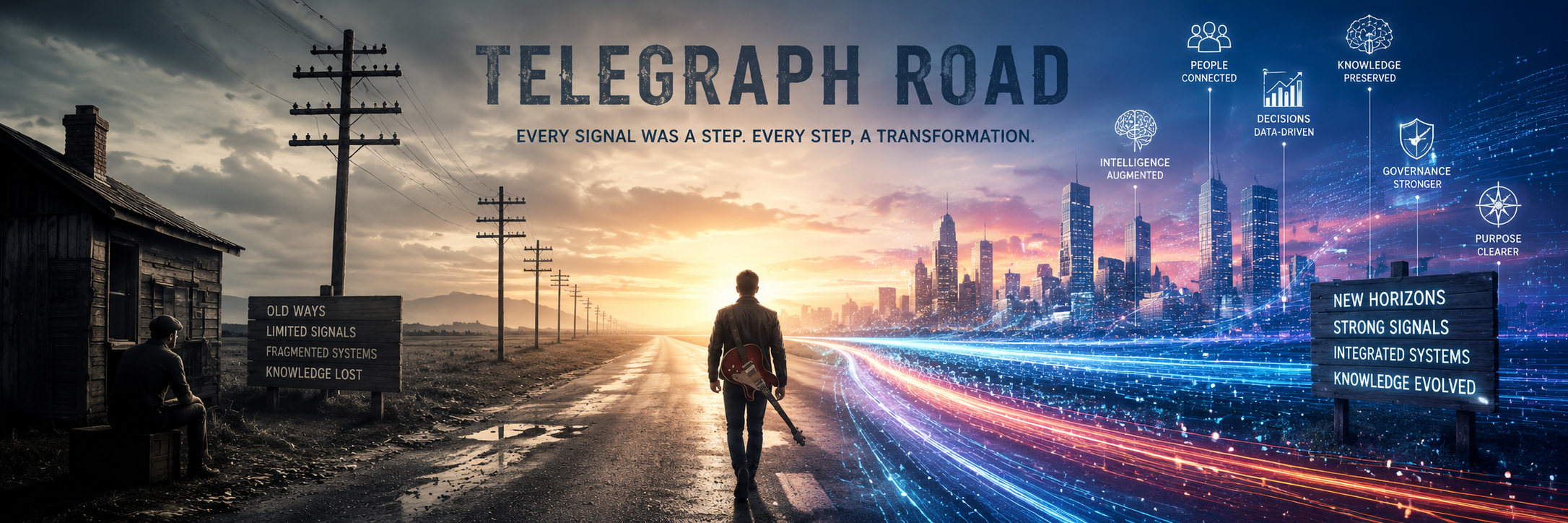
Why the image ?
“Telegraph Road” by Dire Straits was never only about a road.
It was about civilization itself.
The song begins with emptiness – a simple line through untouched land – and slowly evolves into complexity: industry, ambition, noise, commerce, inequality, speed, and eventually disillusionment. What starts as progress becomes overload.
In many ways, digital transformation follows the same path.
At first, technology appears as possibility. Then systems multiply. Information accelerates. Organizations expand. Signals become constant. Infrastructure grows faster than understanding. And eventually, institutions risk losing the very human meaning they were meant to preserve.
Today, Artificial Intelligence represents another “Telegraph Road” moment.
Not simply a technological transition, but a civilizational one.
The real question is not whether we will build faster systems.
We already are.
The real question is whether human institutions, governance, culture, and collective intelligence can evolve fast enough to give direction and meaning to the road ahead.
As Mark Knopfler’s masterpiece reminds us, progress is never only about movement. It is about where the road ultimately leads …