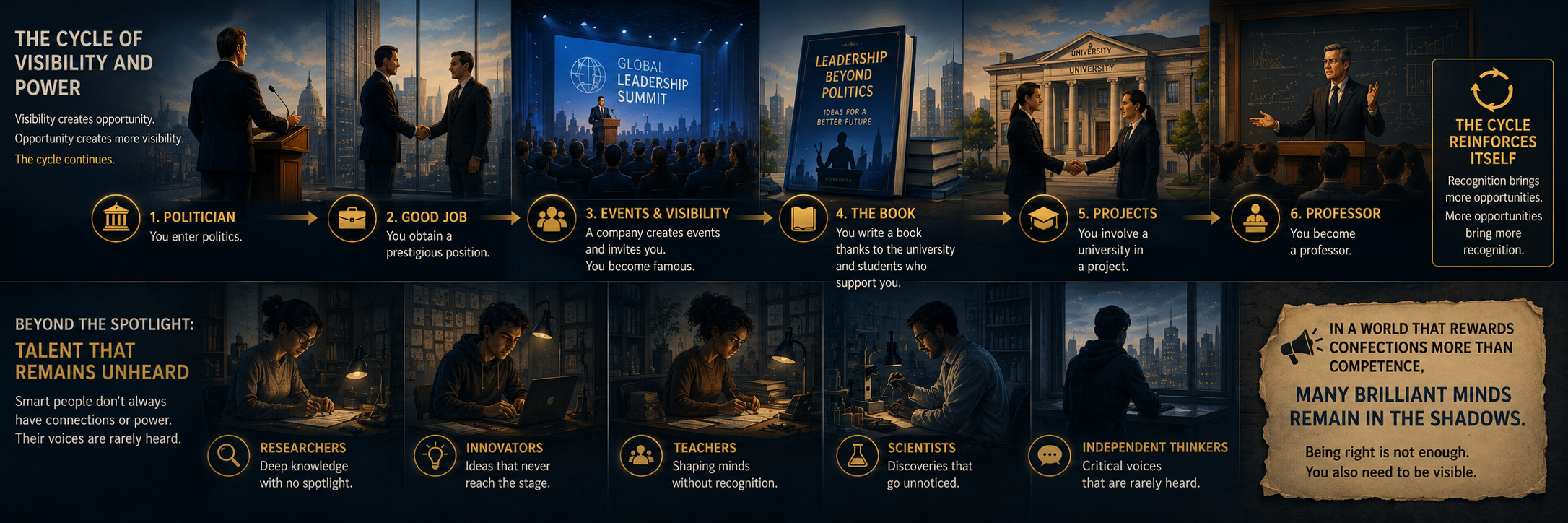
In many modern democracies, power no longer operates only through formal institutions. It increasingly moves through networks of visibility, reputation, influence, and reciprocal legitimization. Politics, academia, media, consulting, conferences, think tanks, publishing, and corporate ecosystems often reinforce one another in ways that are subtle, socially acceptable, and sometimes almost invisible from the outside.
A politician finishes a mandate and immediately obtains a prestigious position inside a corporation, a foundation, a strategic consultancy, or a large institution. Shortly afterward, that same institution organizes conferences, panels, and public events where the former politician is invited as keynote speaker. Media visibility grows. Interviews follow. The individual becomes associated with “thought leadership.”
Then comes the book.
The book is promoted through institutional channels, universities, business schools, publishers, media outlets, and conferences that already orbit within the same ecosystem. Universities invite the author to speak to students. Students become audiences. Audiences become followers. Visibility becomes authority.
Soon, collaborative projects emerge between universities, institutions, corporations, and public actors. The same figure becomes adjunct professor, senior advisor, visiting fellow, strategic board member, innovation ambassador, or public intellectual.
None of this is necessarily illegal.
Often, none of it is even formally coordinated.
Yet the cumulative effect can create a closed prestige economy where legitimacy circulates internally among interconnected actors.
The problem is not that experienced people contribute after politics. Societies benefit when expertise moves between institutions. The problem emerges when access to visibility becomes structurally unequal.
Because outside these networks there are thousands of highly competent individuals — researchers, engineers, analysts, teachers, scientists, administrators, innovators, independent thinkers — whose voices are rarely amplified. They may possess deeper technical understanding, stronger intellectual rigor, or greater ethical independence, yet they remain largely unheard because they lack the machinery of institutional visibility.
In contemporary societies, being right is often less important than being visible.
And visibility itself increasingly depends on proximity to power.
A conference invitation creates recognition.
Recognition creates credibility.
Credibility creates publication opportunities.
Publications create academic legitimacy.
Academic legitimacy creates teaching roles.
Teaching roles create influence over new generations.
Influence attracts funding, partnerships, and media exposure.
The cycle reinforces itself.
Meanwhile, independent expertise struggles to survive outside these circuits.
This creates a dangerous distortion in democratic and intellectual ecosystems. Public discourse begins to favor individuals who are institutionally connected rather than necessarily the most competent, original, or critical. Debate risks becoming performative instead of genuinely pluralistic.
The phenomenon is amplified by modern communication systems.
Social media platforms reward recognizability over depth.
Television favors familiar faces.
Panels repeatedly invite the same personalities because institutional reputation reduces perceived risk.
Publishers prefer authors who already possess visibility.
Universities increasingly compete for public attention and external partnerships, making recognizable figures strategically attractive.
Over time, influence becomes self-reinforcing.
The consequence is not merely unfairness toward talented individuals excluded from these circuits. The deeper risk is systemic intellectual narrowing. Societies begin hearing only voices already validated by existing power structures. Alternative perspectives, independent expertise, unconventional thinkers, and structurally critical analyses struggle to emerge.
This is particularly dangerous in the age of artificial intelligence.
AI systems increasingly amplify existing visibility patterns. Algorithms recommend already popular voices. Search engines prioritize recognized entities. Large language models are trained on digitally dominant narratives. The informational ecosystem itself risks becoming recursively concentrated around already visible actors.
A society where prestige, media exposure, institutional access, and influence continuously circulate among interconnected elites may eventually confuse visibility with competence itself.
But history repeatedly shows that innovation, critical thought, and genuine intellectual breakthroughs often emerge from the margins rather than from the center of institutional consensus.
Many brilliant individuals never become influential not because they lack ideas, but because they lack amplification infrastructures.
Their voices remain local.
Their research remains unread.
Their critiques remain unheard.
Their knowledge remains economically invisible.
And societies lose more from this than they realize.
Because when systems primarily reward network proximity instead of intellectual substance, institutions slowly become less capable of self-correction. They risk becoming echo chambers of mutual validation.
The challenge for modern democracies is therefore not only economic or technological. It is epistemic.
How do societies ensure that visibility does not entirely replace merit?
How do institutions remain open to independent competence?
How do universities preserve intellectual autonomy while navigating political and corporate ecosystems?
How do media systems avoid recycling the same legitimized personalities indefinitely?
How do we prevent AI-driven information ecosystems from further concentrating influence?
These questions matter because the health of a democracy depends not only on freedom of speech, but also on the real possibility of being heard.
And today, for many intelligent and capable individuals, that possibility is becoming structurally unequal.
The Message
The message to younger generations should therefore not be one of cynicism, resignation, or passive hostility toward institutions. The goal is not to teach young people to reject universities, politics, research centers, companies, or professional ecosystems. Human civilization advances through cooperation, institutions, and collective structures.
But young people should understand something fundamental:
Never confuse visibility with value.
A society constantly exposed to curated prestige can create the illusion that influence automatically equals intelligence, that followers equal wisdom, or that institutional recognition necessarily reflects originality or competence. This is not always true.
Human progress has often depended on individuals who continued thinking even when nobody initially noticed them.
The future needs young people capable of building substance before recognition.
People able to study deeply without immediate rewards.
People capable of independent reasoning even when dominant narratives become fashionable.
People willing to develop real expertise instead of merely optimizing personal branding.
Because humanity does not advance only through highly visible personalities.
It also advances through silent researchers, difficult thinkers, ethical engineers, honest teachers, independent scientists, rigorous analysts, and creative minds working outside the spotlight.
The danger of contemporary systems – amplified by social media and increasingly by artificial intelligence – is that many young people may begin optimising themselves for visibility rather than knowledge.
To become “seen” instead of becoming competent.
To become viral instead of becoming rigorous.
To produce reactions instead of understanding.
To build audiences before building intellectual foundations.
But civilizations cannot survive long on superficial visibility alone.
AI will make this even more important.
As artificial intelligence automates information production, summarizes knowledge, generates content, and amplifies dominant narratives, the real strategic value of humanity may increasingly depend on independent thinking, critical reasoning, ethical judgment, creativity, scientific rigor, and deep understanding.
The world will not need fewer intellectuals.
It will need stronger ones.
And not only institutionally manufactured intellectuals, but also self-built minds capable of thinking autonomously.
Young people should therefore be encouraged to:
- study beyond trends,
- build real competencies,
- preserve curiosity,
- challenge intellectual conformity,
- read difficult books,
- understand history,
- develop technical depth,
- protect their independence of thought,
- and resist the temptation to measure personal worth only through visibility metrics.
Because the “brain of humanity” is not preserved by algorithms alone.
It is preserved by generations capable of producing authentic thought.
Every society that stops valuing deep knowledge eventually becomes dependent on those who still produce it elsewhere.
And perhaps one of the greatest responsibilities of our time is ensuring that the next generation still believes that building knowledge, even slowly and invisibly, remains one of the highest contributions a human being can offer to civilization.