From the Four-Party Model to Apple Pay – and Why the Digital Euro Could Change the Economics of Payments
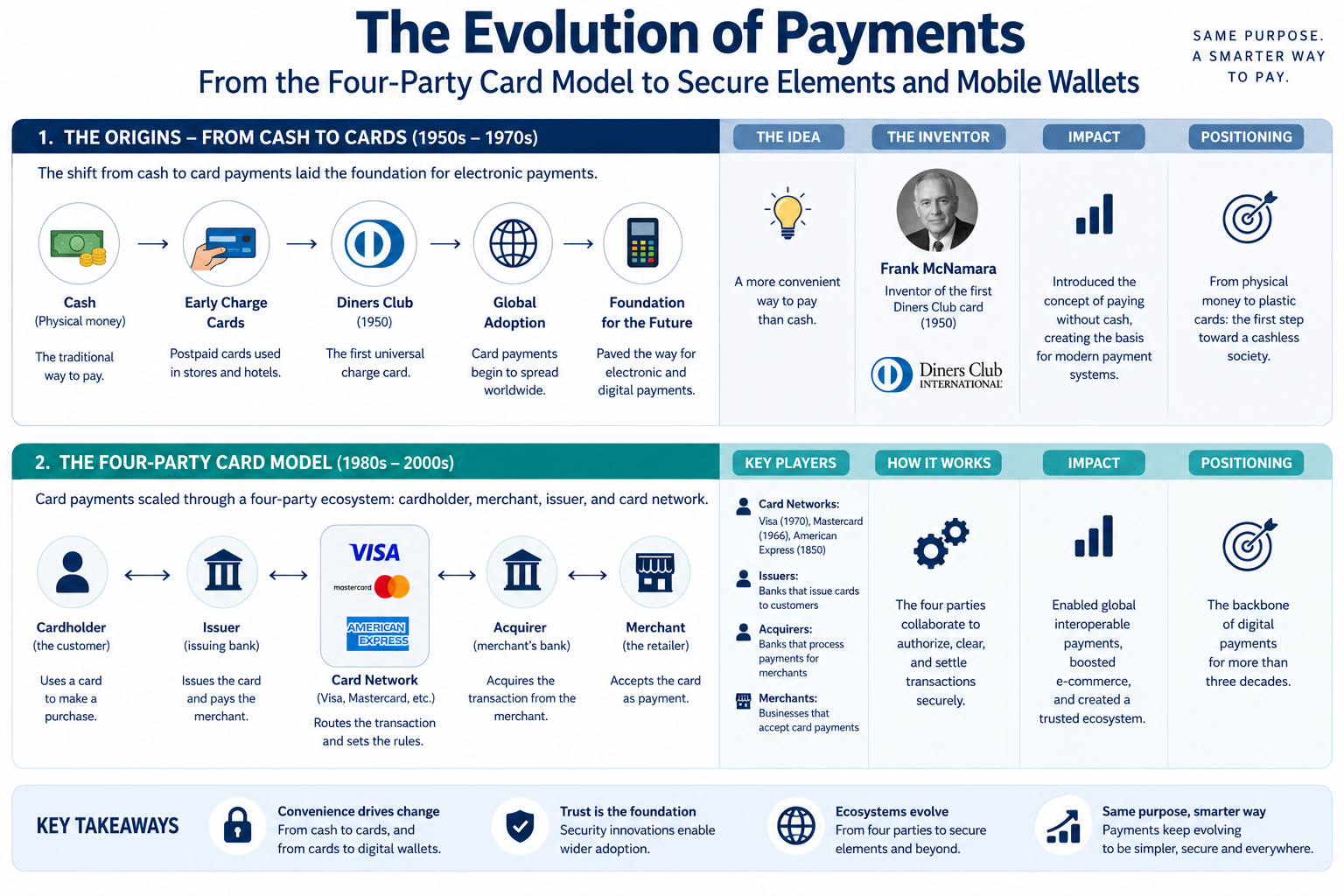
For more than a decade, I worked closely with the payments industry.
What fascinated me was never simply the technology.
Payments are one of those infrastructures that become almost invisible precisely because they work so well. We tap a card, place a phone near a terminal or click a button on a website. A few seconds later, the transaction is complete.
At least, that is what we see.
Behind that apparently simple gesture lies one of the most sophisticated commercial infrastructures ever built: banks, acquirers, card networks, processors, technology providers, security systems, wallets and increasingly digital platforms.
And every time money moves, something else moves with it.
Fees.
Understanding the evolution of payments therefore requires looking at two parallel histories.
One is the history of technology.
The other is the history of who controls the payment relationship — and who captures part of its economic value.
The four-party model: an extraordinary machine
For decades, the architecture of card payments has been built around what the industry calls the four-party model.
Its basic structure is remarkably elegant.
A customer has a card issued by a bank.
A merchant accepts that card through an acquiring bank or payment service provider.
Between them sits the card network, providing the rules, standards and infrastructure that allow institutions that may never have had any direct relationship with one another to trust the transaction.
In simplified form:
Cardholder → Issuer → Card Network → Acquirer → Merchant
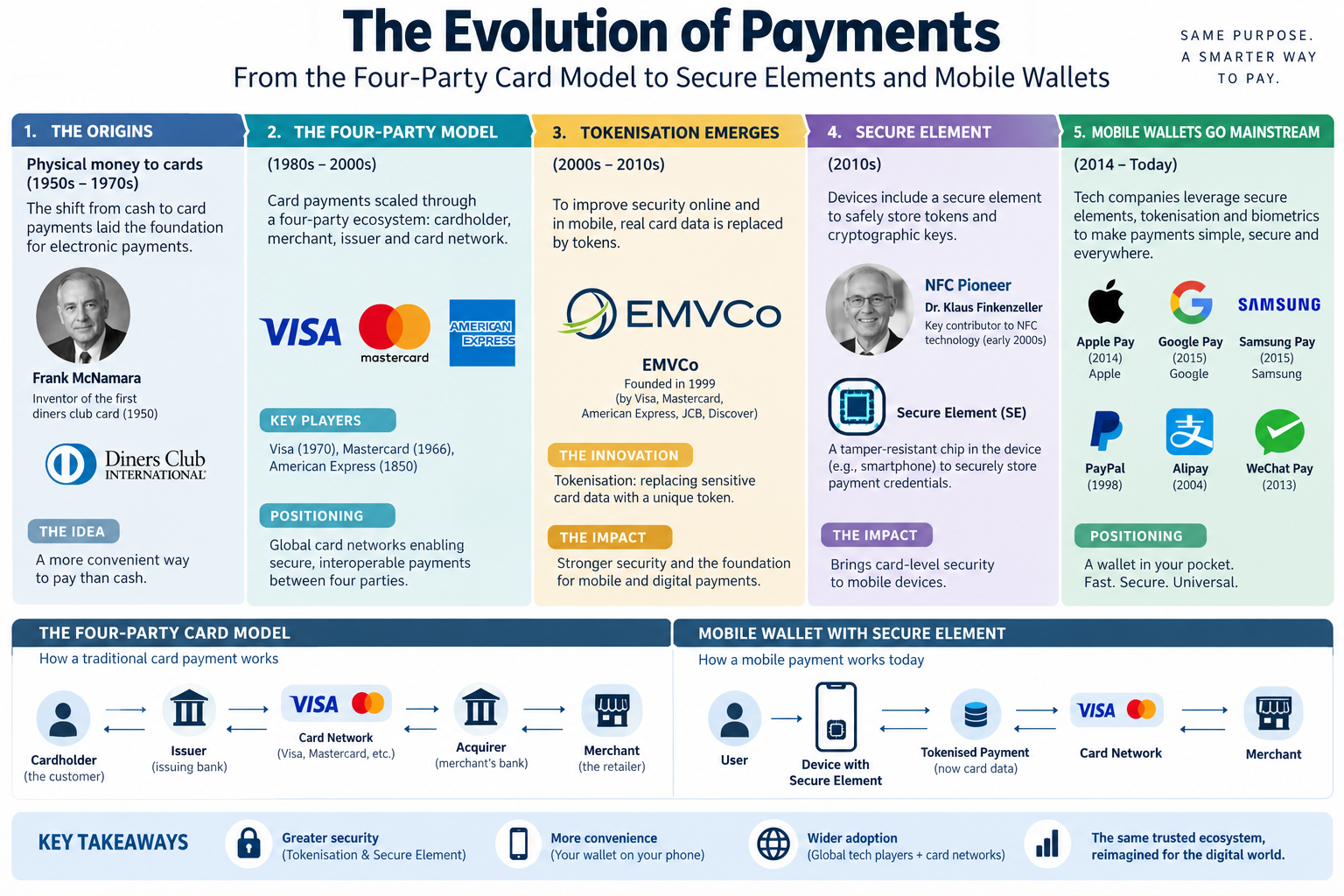
Strictly speaking, the four parties are the cardholder, issuer, merchant and acquirer; the scheme or network provides the infrastructure connecting the two sides.
That distinction matters because the network became one of the most strategically important positions in the architecture.
The genius of the model was interoperability.
A customer of one bank could walk into a merchant served by another bank, perhaps in another country, and make a payment almost instantaneously.
The participants did not need to know one another.
They only needed to trust the network.
That was revolutionary.
But trust has an economic architecture.
Follow the money
Suppose I buy something for €100.
The merchant does not necessarily receive exactly €100.
There are several economic relationships behind the transaction.
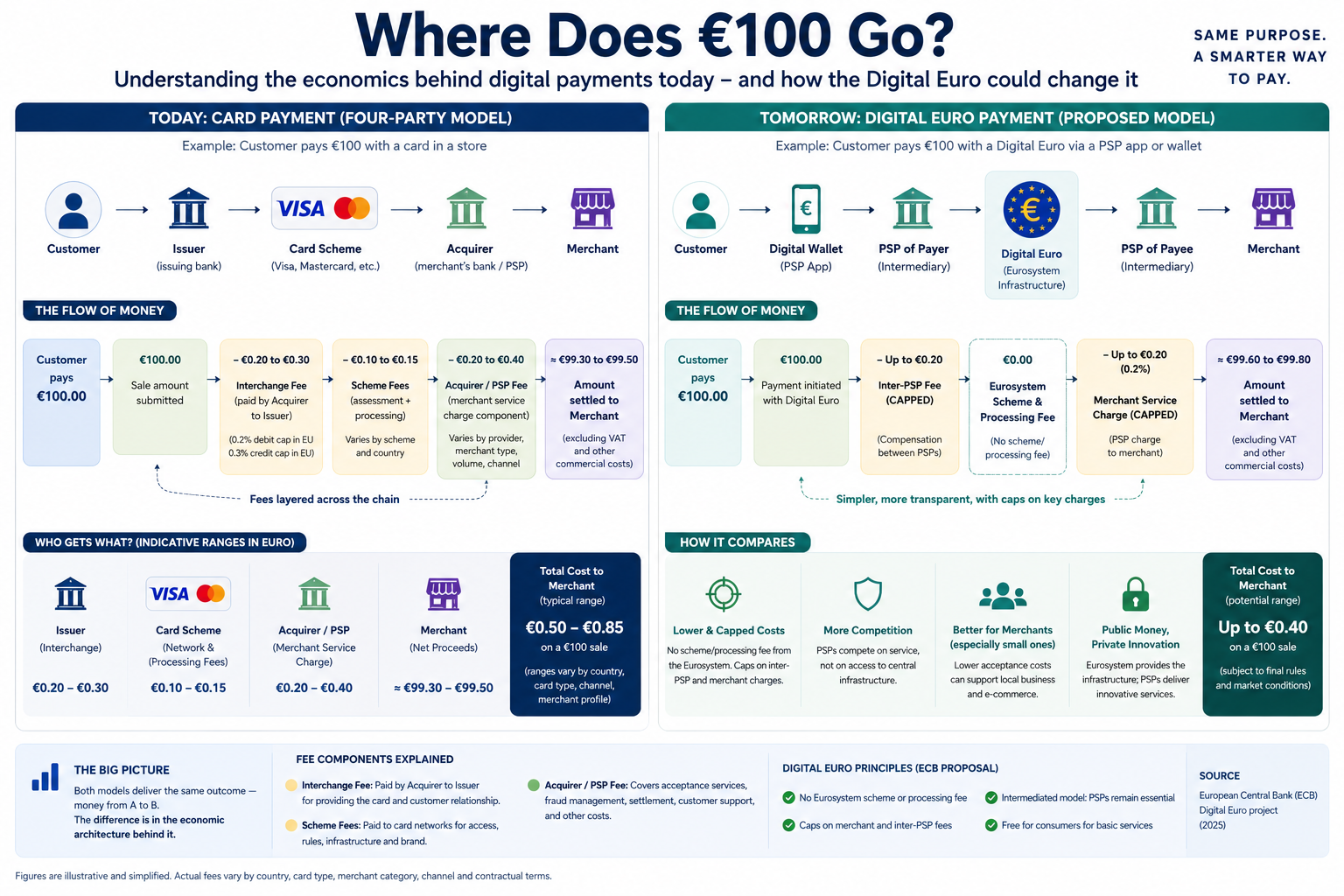
The merchant normally pays its acquiring bank or payment service provider a Merchant Service Charge (MSC).
Part of the economics of that payment can compensate the cardholder’s issuing bank through the interchange fee.
The card scheme and processors may receive their own fees for providing the network, processing, rules, security and other services.
The exact economics vary enormously according to country, card type, merchant, transaction channel, contractual arrangements and scheme.
In Europe, regulation has already intervened in one important part of this structure. For many consumer card transactions, interchange fees are capped at 0.2% for debit cards and 0.3% for credit cards.
But interchange is only one component of the merchant’s overall cost of accepting a payment.
This distinction is important.
When people discuss “the card fee”, they often talk as if there were a single fee.
There isn’t.
There is an economic chain.
And every participant in that chain needs a reason to participate.
The issuing bank provides the customer relationship, account and payment instrument.
The acquirer provides acceptance to the merchant.
Processors provide infrastructure.
The scheme provides interoperability, standards, governance and global reach.
The merchant receives a payment.
The consumer receives convenience, protection and increasingly rewards and services.
The remarkable success of cards came because this economic model created incentives for all these actors simultaneously.
Then the card disappeared
The next great transformation was not really the disappearance of the card network.
It was the disappearance of the physical card from the user’s experience.
The smartphone changed everything.
When Apple Pay appeared in 2014, many people interpreted it as the beginning of the end of traditional card payments.
It was almost the opposite.
Apple did not need to replace the card ecosystem.
It could build on top of it.
That is one of the most interesting lessons in the history of technology: disruption does not always destroy infrastructure. Sometimes it creates a new layer above it.
The plastic card became software.
But the payment credentials still had to be protected.
And this brought another important technology into the story.
The Secure Element: putting a vault inside the device
A smartphone is a general-purpose computer.
A payment credential is something we would rather not treat like ordinary application data.
The industry therefore developed mechanisms for isolating sensitive credentials and cryptographic operations from the rest of the device.
One approach was the Secure Element: effectively a tamper-resistant environment capable of protecting sensitive information and cryptographic keys.
Combined with NFC, it helped transform the phone into a trusted payment device.
But another innovation became even more important.
Tokenisation.
Instead of exposing the actual card number — the Primary Account Number, or PAN — the payment ecosystem can substitute a different value: a payment token.
That token can be constrained to a particular device, merchant or payment context.
EMVCo describes the objective very clearly: removing the PAN from the transaction reduces the usefulness of payment information if it is stolen or compromised.
The industry had discovered something powerful.
Instead of protecting the secret everywhere, stop moving the secret around.
Apple Pay changed the experience, not the underlying economics
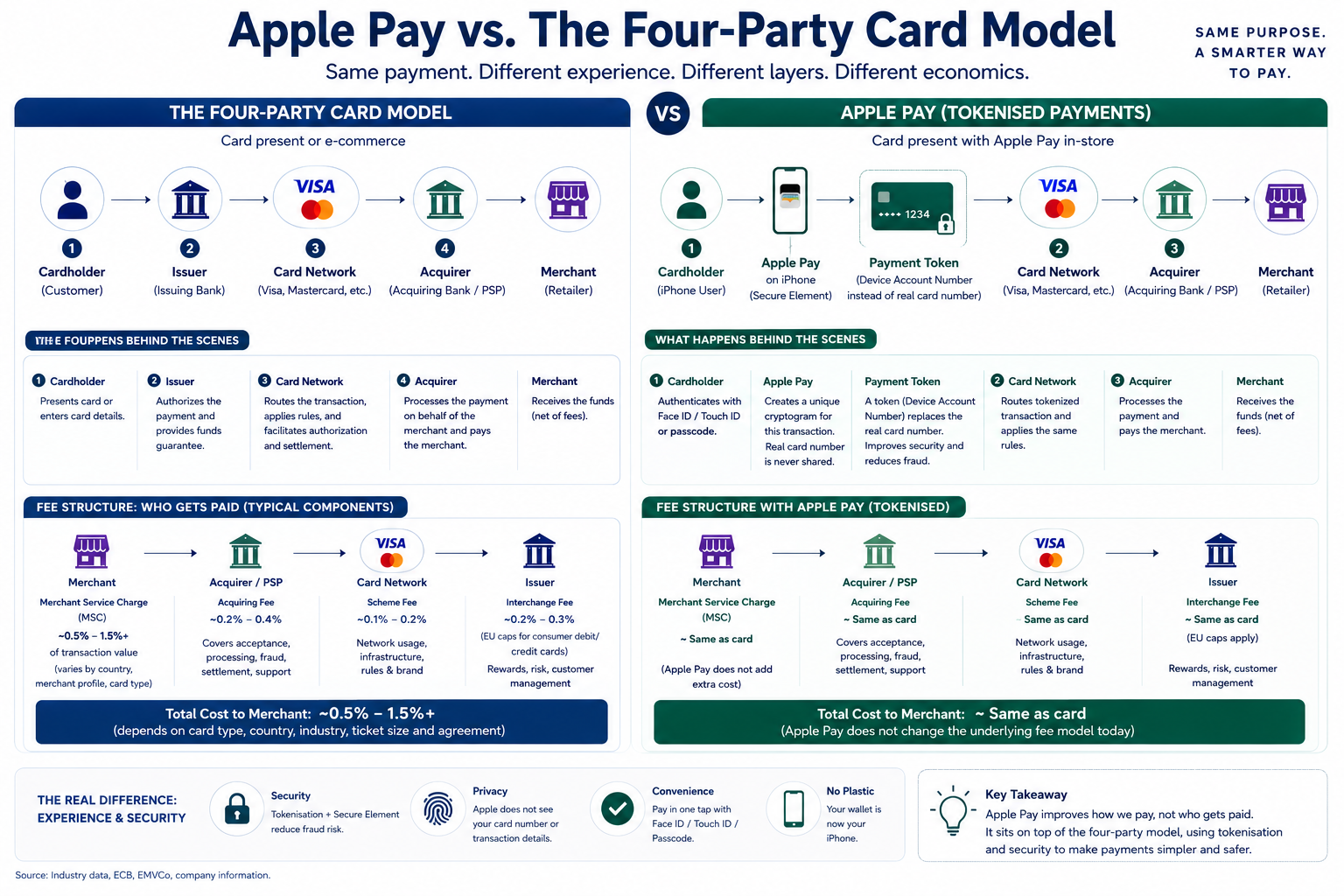
This is where the evolution becomes particularly interesting from a business perspective.
When I tap an iPhone today, it feels nothing like using the embossed plastic cards of decades ago.
Biometric authentication replaces a signature.
A token can replace the actual card number.
The Secure Element or equivalent secure technologies protect credentials.
The phone provides the interface.
The transaction takes seconds.
Yet underneath this extraordinary technological transformation, much of the traditional payment architecture remains recognisable.
There is still an issuer.
There is still an acquiring side.
There is still a payment network.
There is still a merchant.
And there are still fees.
Apple Pay, Google Pay and similar wallets therefore created an important new position in the payment value chain:
the wallet layer.
The strategic battle was no longer simply about who issued the card or processed the transaction.
It became a battle for the interface.
Who owns the moment when the customer decides to pay?
The bank?
The card network?
The merchant?
Or the operating system in the customer’s pocket?
That question is much larger than payments.
Whoever controls the interface can potentially influence identity, authentication, data, loyalty and eventually the wider commercial relationship.
Payments had become a platform business.
From four parties to an ecosystem
This is why I find the expression “four-party model” increasingly insufficient to describe modern payments.
The economic transaction may still rely on that model underneath.
But above it we have accumulated additional layers:
Cardholder
↓
Device / Wallet
↓
Tokenisation & Authentication
↓
Issuer
↓
Card Network
↓
Processor / Acquirer
↓
Merchant
Not every transaction follows exactly this architecture, of course.
But the direction is clear.
We have made payments dramatically easier by creating increasingly sophisticated infrastructure behind them.
From the consumer’s perspective, complexity disappeared.
From the system’s perspective, complexity increased.
That is one of the paradoxes of digitalisation.
The simpler the interface becomes, the more infrastructure may be required behind it.
And infrastructure has economics.
The €100 question
This leads to the question I believe consumers rarely ask:
When I spend €100, how much does it cost the merchant to receive my €100?
For consumers, electronic payments often appear free.
But payments are not free.
Their cost is simply distributed elsewhere in the system.
The merchant may pay the acquiring and acceptance costs.
The issuer may receive interchange or other revenues.
Networks charge for their infrastructure and services.
Technology platforms may have their own commercial arrangements.
Processors, gateways, fraud systems and other providers need to be compensated.
Eventually these costs become part of the economics of commerce.
This does not mean that fees are inherently bad.
Infrastructure costs money.
Security costs money.
Fraud prevention costs money.
Availability costs money.
Innovation costs money.
The more interesting question is different:
How many intermediaries are necessary to move digital money from A to B, and what economic value does each one provide?
Once we formulate the question that way, the Digital Euro becomes much more interesting.
The Digital Euro is not simply another payment app
A Digital Euro is often described as if it were a European alternative to PayPal, Apple Pay or a bank wallet.
I think that understates its significance.
The Digital Euro would be central bank money in digital form.
That makes it conceptually closer to cash than to a commercial wallet.
Cash has a remarkable property.
If I give you a €20 banknote, the payment does not require Visa, Mastercard, Apple or another commercial payment scheme to create the monetary settlement between us.
The €20 itself is the money.
The challenge is to reproduce some of that property in the digital world without losing the convenience, security and scalability we have gained from modern electronic payments.
The current Eurosystem design does not eliminate banks or payment service providers. Quite the opposite: supervised PSPs would remain the main interface through which consumers and merchants access Digital Euro services.
But the economics could be different.
The ECB’s proposed model has three particularly interesting characteristics.
Consumers would receive basic Digital Euro services free of charge.
Merchant charges and inter-PSP compensation would be subject to caps.
And the Eurosystem would not charge scheme and processing fees in the way commercial card schemes do.
The ECB argues that the absence of these scheme fees could reduce costs for payment providers and merchants. It has also suggested that smaller merchants could see particularly significant savings compared with their current digital-payment acceptance costs.
That changes the discussion.
From payment scheme to public infrastructure
Imagine the evolution in three stages.
The first era was:
Bank → Card → Merchant
The second became:
Bank → Card Network → Token → Wallet → Device → Merchant
The next could potentially become:
Central Bank Money → Regulated PSP → Digital Wallet → Merchant
Not because intermediaries disappear.
They do not.
But because the economic centre of gravity changes.
The infrastructure that defines the monetary asset and core scheme would no longer necessarily belong to a private global payment network.
It could become European public monetary infrastructure on which private banks and payment companies compete to provide services.
This distinction is fundamental.
A Digital Euro does not need to eliminate private-sector innovation.
It could separate infrastructure from innovation.
The public sector provides the common monetary rail.
Banks, fintechs and payment providers compete on customer experience, value-added services, identity, financing, analytics, integration and innovation.
That is potentially a very different market structure.
And this is where Europe has a strategic problem
Payments are not only a convenience.
They are infrastructure.
Europe has world-class banks, fintech companies, processors and payment technology.
Yet a significant part of everyday European retail payments depends on international card schemes and increasingly on digital interfaces controlled by large non-European technology platforms.
The ECB explicitly identifies this dependency as one of the strategic arguments for the Digital Euro.
This is not simply an argument about sovereignty in the political sense.
It is also an industrial question.
Who owns Europe’s payment infrastructure?
Who defines its rules?
Who controls its interfaces?
Who receives its fees?
Who controls the data generated around the transaction?
Those questions become increasingly important as money itself becomes programmable, machine-readable and embedded into digital environments.
And the next participant in a payment may not even be human.
AI agents will increasingly initiate transactions on behalf of people and organisations. Cars will pay charging stations. Software agents will purchase services from other software agents. Machines will negotiate access to computing, information and infrastructure.
In that world, payment becomes less of an action and more of a protocol.
The Digital Euro could therefore solve a problem larger than payments
I spent years watching the payments industry add layer after layer of technology.
Cards solved acceptance.
Networks solved interoperability.
EMV solved important security problems.
Contactless reduced friction.
Secure elements protected credentials.
Tokenisation reduced exposure of card data.
Apple Pay and Google Pay transformed the interface.
Each innovation solved a genuine problem.
But almost every innovation was built upon the previous infrastructure.
The result is an extraordinarily capable ecosystem — but also an increasingly layered one.
The Digital Euro offers Europe an opportunity to ask a different question.
Not:
How can we make the existing payment chain slightly better?
But:
If we were designing digital money for the next fifty years, what should the underlying architecture look like?
The answer should not be a system in which the state replaces banks, card companies or fintechs.
That would destroy much of the innovation that made electronic payments successful.
The more interesting architecture is one in which public money provides a common digital foundation and private actors compete above it.
Banks remain important.
Fintechs remain important.
Wallets remain important.
Merchants remain important.
Innovation remains private and competitive.
But the fundamental payment infrastructure becomes more open, European and potentially less expensive.
The real evolution of payments
Looking back, I no longer see the history of payments simply as a progression:
cash → cards → contactless → smartphones → digital currencies.
I see something deeper.
It is the history of our attempts to solve three problems simultaneously:
trust, convenience and economics.
Cash offered direct settlement but limited digital scalability.
Cards created global interoperability.
EMV and cryptography strengthened trust.
Tokenisation protected credentials.
Smartphones transformed convenience.
Digital wallets captured the customer interface.
And now central bank digital money asks the next question:
Can we retain all that convenience while simplifying the economic architecture underneath it?
Perhaps that is the real promise of the Digital Euro.
Not a better credit card.
Not a European Apple Pay.
Not the abolition of banks or payment companies.
But something much more fundamental:
a digital equivalent of public money that can become infrastructure for a new generation of private payment services.
After decades in which innovation added new intermediaries to make payments easier, the next innovation may come from reconsidering the infrastructure underneath them.
And that could change not only how we pay.
It could change who gets paid when we pay.