Artificial Intelligence, Organisation and Human Meaning
September 1, 2026
My new book is now available
After years of working with artificial intelligence, organisations and technological transformation, I wanted to step back and ask a question that is becoming increasingly important:
What happens when intelligence is no longer something that belongs only to humans?
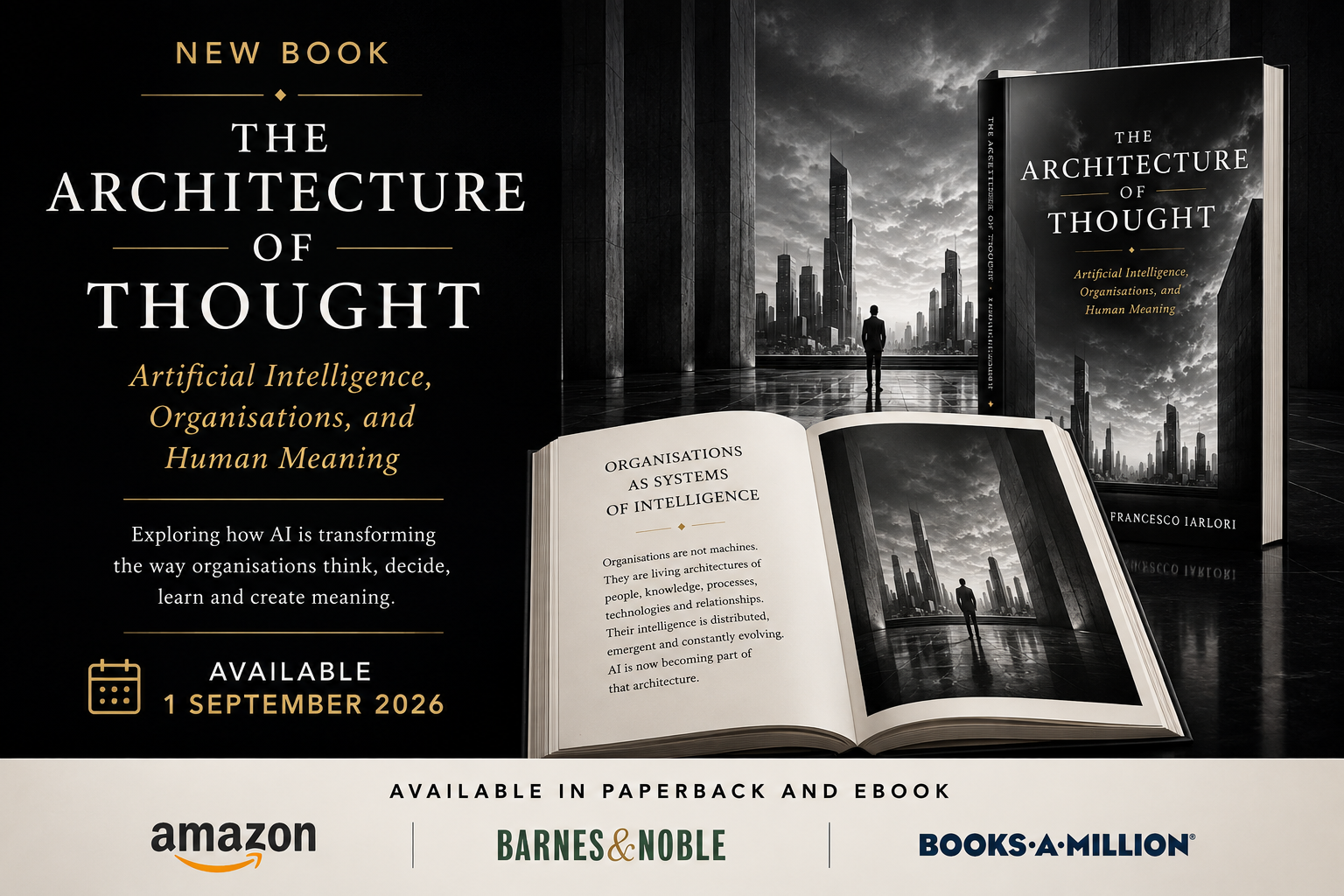
The Architecture of Thought: Artificial Intelligence, Organisation and Human Meaning is my attempt to explore that question.
This is not a book about the latest AI tools, nor a prediction of which model or technology will dominate the next few years. Technologies will continue to change, probably faster than any of us expect.
The deeper transformation is elsewhere.
Artificial intelligence is beginning to change how organisations think, how decisions are made, how knowledge circulates, how authority is distributed and, ultimately, how we understand the relationship between human and machine intelligence.
Beyond AI adoption
For many organisations, the conversation about AI still begins with technology: which platform to adopt, which processes to automate, which productivity gains can be achieved.
But I believe we need to ask a different set of questions.
What happens to an organisation when part of its reasoning is performed by machines?
Where does knowledge reside when humans and AI systems increasingly work together?
How do we preserve judgement, responsibility and meaning while delegating more cognitive activities to artificial systems?
And what kind of organisation should we design for this new environment?
These questions are at the heart of The Architecture of Thought.
Organisations as systems of intelligence
One of the central ideas of the book is that intelligence should not be understood simply as an individual capability.
Organisations themselves can be seen as systems of distributed intelligence — networks of people, knowledge, processes, technologies, decisions and relationships.
Artificial intelligence is now entering this architecture.
The challenge, therefore, is not simply to introduce AI into existing organisations. It is to understand how the architecture itself may need to evolve.
The book explores this transformation through the lenses of artificial intelligence, organisational theory, knowledge, governance and human meaning, bringing together ideas that have accompanied much of my professional and intellectual journey.
A book about AI – but ultimately about us
Perhaps the most important question raised by artificial intelligence is not how intelligent machines will become.
It is what their intelligence will reveal about our own.
About the way we think.
About the organisations we build.
About the knowledge we create and share.
And about those distinctly human capacities – judgement, responsibility, imagination, purpose and meaning – that may become more important, rather than less, in an age of increasingly capable machines.
That is the territory I wanted to explore in The Architecture of Thought.
I hope the book can contribute to the conversation among leaders, researchers, technologists, students and anyone interested not simply in what AI can do, but in what its emergence means for the organisations and societies we are building.
The Architecture of Thought
Artificial Intelligence, Organisation and Human Meaning
By Francesco Iarlori
Available in paperback and ebook, through major international booksellers.
Available from 1 September 2026.