How Computing, Communications and Money Became One System
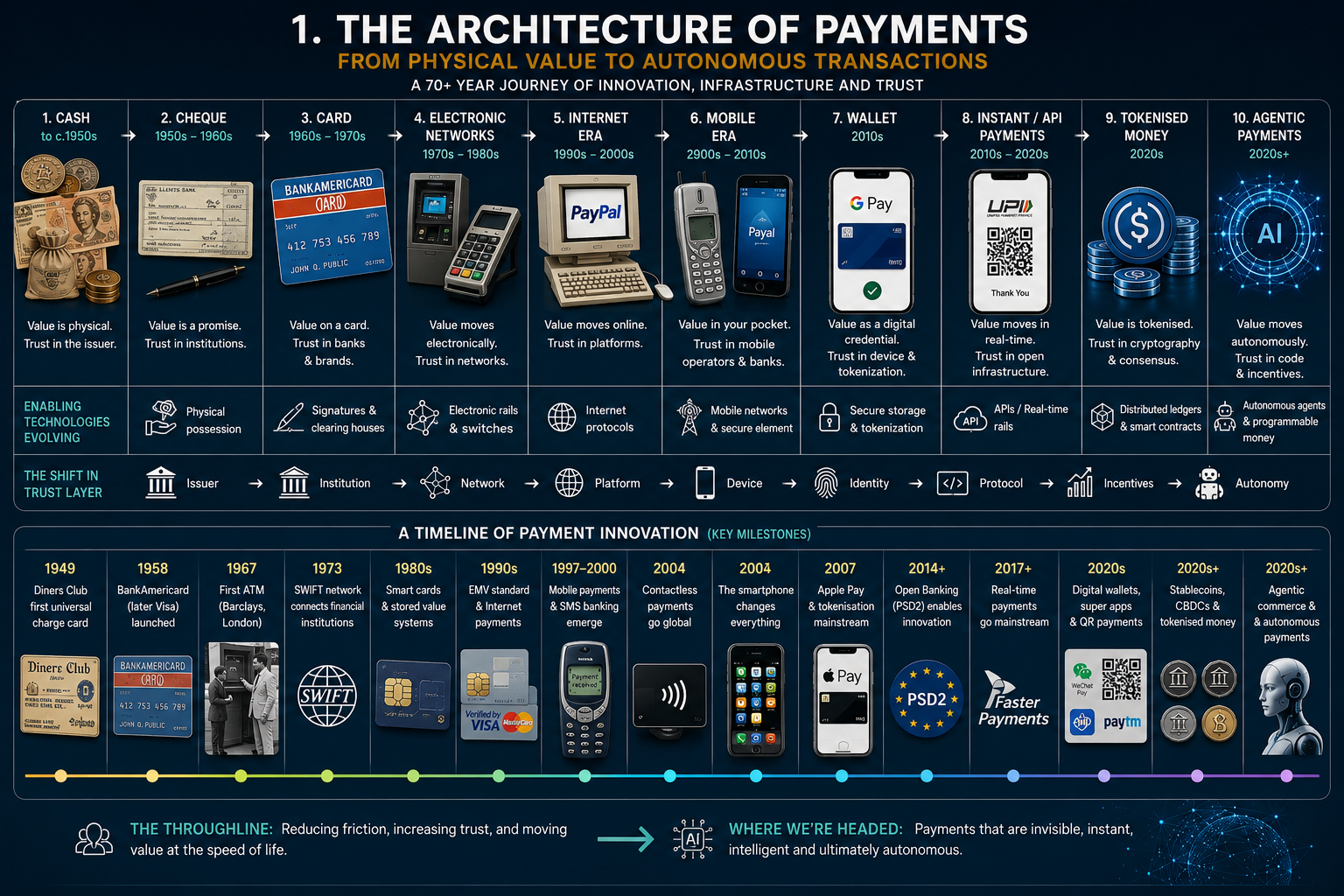
From physical value to autonomous transactions: more than seventy years of innovation, infrastructure and changing architectures of trust.
For most of human history, paying meant moving something. A coin passed from one hand to another, a banknote changed possession, a cheque carried a written instruction. Payment had a visible form and, in its simplest expression, the movement of value could be observed in the movement of the instrument itself. Money was something we could hold, hand over, receive and store.
Over the course of the twentieth century, however, that apparently straightforward relationship between money and its physical representation began to change. We progressively stopped moving money itself and started moving information about money. The transformation was much deeper than the replacement of cash by cards or paper records by electronic ones. What changed was the architecture through which economic value could be represented, authorised and transferred.
This evolution cannot be understood through the history of banking alone. It developed alongside two other technological transformations: computing and telecommunications. Mainframes gave financial institutions the capacity to process enormous volumes of information; telecommunications allowed that information to travel across distance; electronic networks connected institutions that had previously operated through slower and largely physical processes. Later, the Internet connected commerce itself, while mobile networks and smartphones brought computing, connectivity and identity into the hands of individuals.
Today, APIs allow financial capabilities to be embedded directly into software, while artificial intelligence introduces the possibility that software may not only execute transactions but increasingly participate in the decisions that precede them.
Seen from this perspective, each generation of payment technology has done more than improve the speed or convenience of a transaction. It has changed where trust resides and how that trust is expressed. With cash, trust is closely associated with the authenticity of the physical object and the authority of its issuer. With cheques, institutions and clearing systems become essential. Cards introduce another architecture involving credentials, banks and payment networks. Digital payments add cryptography, devices and software; contemporary infrastructures increasingly incorporate digital identity, real-time data and programmable interfaces.
The visible payment instrument has consequently become less important even as the infrastructure surrounding it has become more sophisticated. What was once a physical object became an instruction; the instruction became an electronic message; the card became a credential; the credential moved into a device; and the device increasingly became a means of establishing identity. At each stage, something that had previously been visible to the person making the payment moved into an infrastructure operating largely out of sight.
Artificial intelligence may now extend this process one step further. If a device can authenticate us and software can initiate a transaction, an intelligent agent may eventually be able to interpret an objective, evaluate alternatives and transact within authority delegated to it. In that world, the payment instrument does not simply become digital. The explicit act of paying may itself begin to recede from view.
The history of payments is therefore not simply a history of money or of increasingly convenient ways to spend it. It is also a history of information, connectivity, identity and institutional design. Above all, it is the history of how societies have repeatedly redesigned the mechanisms through which they establish enough trust for value to move.
In that sense, the history of payments is the history of trust becoming computational.
From moving value to moving information
Cash remains an extraordinarily elegant payment architecture. The instrument and the value are effectively bound together: possession provides the ability to spend, settlement occurs directly between the parties, and neither a network connection nor a remote authorisation system is required.
That simplicity, however, is also a constraint. Physical money travels only as quickly as people can move it. It is difficult to use across distance, expensive to transport and protect at scale, and largely disconnected from the information systems surrounding modern economic activity.
The cheque introduced an important abstraction. Instead of transferring value itself, the payer transferred an instruction concerning value held somewhere else. The paper mattered, but what really gave it meaning was the institutional architecture behind it: the account, the signature, the banks, the clearing process and eventual settlement.
Money could remain represented on a ledger while information concerning its ownership travelled through another system. That separation between value and the message describing the movement of value would become one of the foundations of modern payments.
The card pushed the abstraction further. The plastic itself was not money; it was increasingly a credential connecting a person and a merchant to accounts and institutions through an increasingly sophisticated network. Embossed cards and paper vouchers gave way to magnetic stripes, electronic authorisation, POS terminals, switching infrastructures and international card networks.
What appeared to the customer as a simpler transaction was therefore becoming, underneath, a much more elaborate institutional and technological process. This apparent contradiction has accompanied almost every subsequent generation of payment innovation:
The simpler the payment becomes for the user, the more sophisticated the architecture behind it becomes.
To understand why this happened, however, payment technology alone is not enough. We need to follow two other histories that were developing alongside it — and that would eventually become inseparable from it: computing and telecommunications.
Three histories, one convergence
The modern payment system cannot be understood solely through the history of banking. It is simultaneously a history of computing and telecommunications, because each of these technologies progressively removed a different constraint on the movement of value.
Computing gave financial institutions the ability to maintain and process increasingly complex ledgers and transaction records. Telecommunications allowed those computers to communicate across distance. Payments gave that communication an economic purpose: information could now travel through networks in order to cause value to move elsewhere.
For several decades these histories developed along largely separate trajectories. Mainframes enabled banks and large organisations to process enormous numbers of records centrally; client/server architectures distributed some of that processing; the Internet subsequently connected systems that had previously remained inside institutional boundaries. Cloud computing would later transform infrastructure into a service, while smartphones placed substantial computing power in the hands of billions of individuals.
Telecommunications followed a parallel transformation. Fixed telephone networks had connected people; data networks began connecting machines. Mobile networks made connectivity portable, while 3G and 4G transformed the mobile phone into an Internet device. With smartphones and increasingly ubiquitous connectivity, being connected gradually ceased to be an activity in itself and became an assumed condition of everyday life.
Payments evolved alongside both. Cash and cheques belonged primarily to the physical and paper world; cards and ATMs emerged with the first generation of large electronic networks; e-commerce followed the Internet; mobile payments developed alongside mobile communications; digital wallets exploited the capabilities of the smartphone; and instant and API-based payments belong increasingly to an environment in which software systems are continuously connected to one another.
The important point is not simply that these developments occurred at approximately the same time. Each made the others more powerful. Computing without connectivity could process financial information but could not move it efficiently between distant participants. Connectivity without computing could transmit information but could not easily support the complexity of modern financial systems. Payments brought the two together around one of society’s most fundamental activities: the exchange of economic value.
By the 1990s and early 2000s, these three technological histories were visibly converging:
Computing. Telecommunications. Payments.
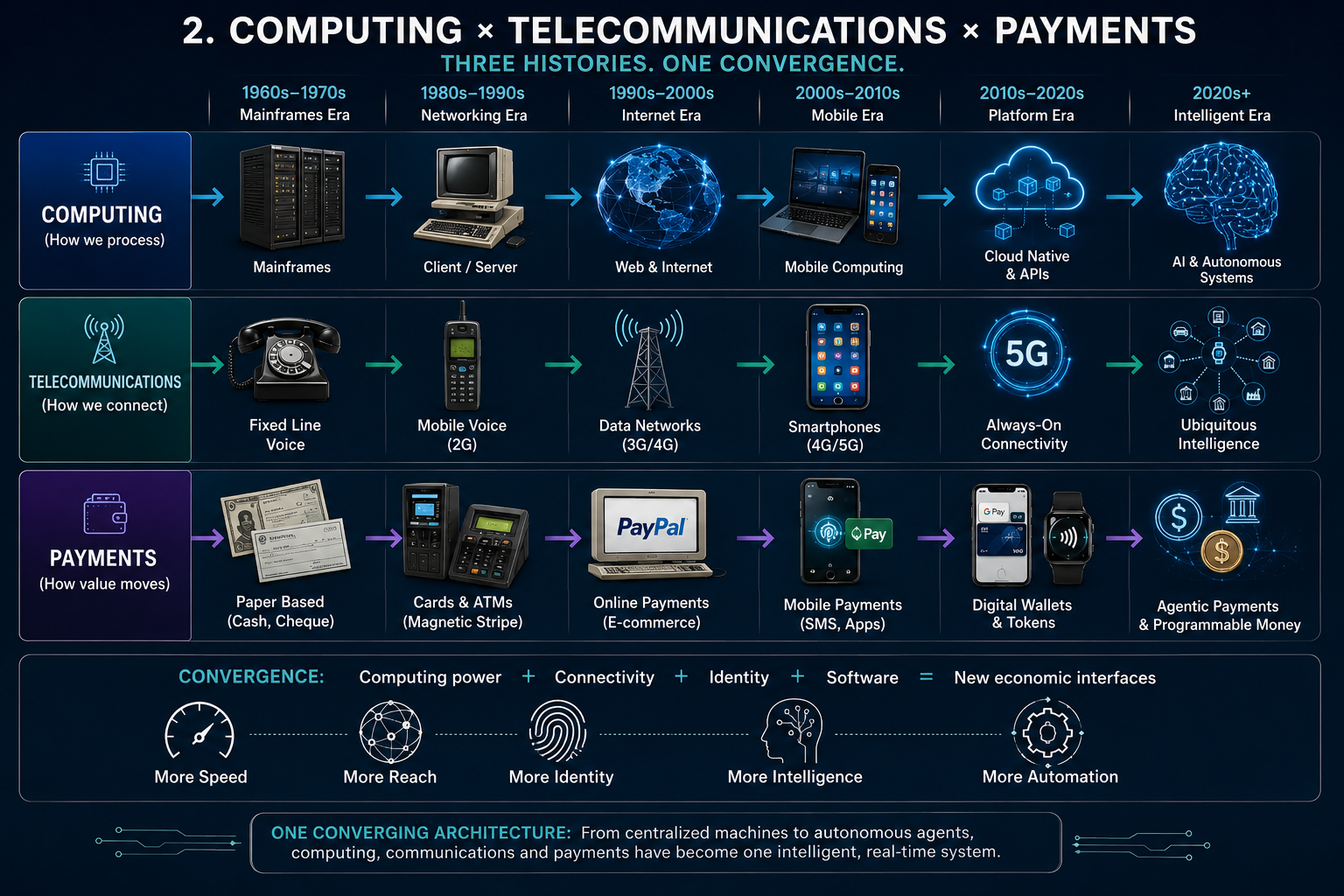
Three histories, one convergence: computing provides processing, telecommunications provides connectivity, and payment systems provide the mechanisms through which economic value moves.
I had the privilege of working inside this convergence rather than simply observing it retrospectively. My professional journey through telecommunications and payments, including work with mobile operators such as Vodafone and Telenor and later across mobile commerce and payment ecosystems, coincided with the period when the mobile phone was beginning to be understood as something much more significant than a telephone.
The possibility that fascinated many of us was not simply that people would eventually use their phones to pay. The more consequential question was what might happen when millions — and eventually billions — of people carried a personal, identifiable and continuously connected computing device.
Today, after the smartphone transformed everyday life, the answer can appear almost obvious.
At the time, it was anything but.
When the telephone became an economic interface
Before the smartphone, mobile payments were already emerging through SMS, SIM-based applications, premium services, operator billing and early forms of mobile commerce. These experiments were important because the mobile network possessed characteristics that were unusually relevant to payments: it provided connectivity, maintained a relationship with an identifiable subscriber and, crucially, already possessed a mechanism through which that subscriber could be billed.
For a period, this combination made it plausible that telecommunications operators might become major participants in the payment value chain. The SIM was particularly interesting. It was not merely the component that allowed a telephone to connect to a network; it was also a secure element associated with a subscriber identity and managed within an infrastructure capable of operating at enormous scale.
This created possibilities that, at the time, appeared genuinely transformative. Mobile identity could potentially become part of financial identity; the SIM could protect payment credentials; operator billing could support micropayments; and the mobile phone could become an interface through which people interacted with transportation, parking, commerce and other everyday services.
My own work during this period brought me directly into these discussions around mobile commerce, micropayments and the emerging European mobile ecosystem. What became increasingly apparent was that the most difficult questions were rarely purely technological. The technology might make a new service possible, but it did not determine who should provide it, who should control the customer relationship, where credentials should reside or how the economic value generated by the transaction should be distributed.
That distinction between technical possibility and ecosystem architecture would become a recurring theme throughout the evolution of mobile payments.
From experimentation to everyday services
The significance of mobile payment became much clearer when these ideas moved beyond demonstrations and into ordinary life.
Projects such as SostaMilano, where mobile technology became part of the parking-payment experience, illustrated a deceptively important change. A payment no longer necessarily required a dedicated payment instrument. The telephone could become part of the service itself, linking an individual, a transaction and an urban infrastructure through a device the user was already carrying.
My work around innovative products and mobile ticketing at ATM Milano offered another perspective on the same transition. Public transport is an unusually demanding environment for payment technology: transaction times must be extremely short, volumes can be enormous, infrastructure has to be reliable and the economics of processing relatively small payments matter. Most importantly, passengers have little interest in the payment mechanism itself. Their objective is to travel.
That makes transportation an extraordinary laboratory for understanding how payments can disappear into the experience they enable.
My experience around Oyster and Transport for London, working with RBS, reinforced an idea that has stayed with me ever since:
The best payment experience is often the one the customer barely notices.
Transport anticipated something that subsequently became central to the wider digital economy. Payment does not necessarily need to remain a separate activity that interrupts the service; it can become part of the service architecture itself.
Today this seems entirely natural. A ride-hailing application knows the journey, calculates the price and executes the payment. A streaming service renews without requiring a monthly checkout. An e-commerce platform remembers our credentials. Mobility platforms can combine multiple services behind a single interface.
The important innovation is not simply that these transactions are electronic. It is that the boundary between using a service and paying for it has begun to disappear.
We increasingly do not stop what we are doing in order to pay. We use the service, and payment happens.
Smart cards, NFC and the architecture of control
At roughly the same time, another transformation was taking place inside the payment instrument itself. The transition from magnetic stripe to chip represented much more than an improvement in the plastic card: computing was moving inside the instrument.
A smart card could execute logic, protect cryptographic material and participate actively in authentication rather than merely presenting static information. This made the payment instrument itself part of the security architecture.
NFC extended the idea further. If a secure payment credential could reside inside a mobile device and communicate with a payment terminal at very short range, the distinction between telephone and payment instrument could begin to disappear.
During my work around NFC, GSMA initiatives, GlobalPlatform/EMV-related ecosystems and mobile operators, I saw both the promise and the complexity of this transition. The technical proposition was compelling, but the technical problem was only one part of the story. Behind the apparently simple ambition of putting a payment credential into a phone lay a much more consequential question: who would control the architecture through which that credential operated?
Banks controlled accounts and financial relationships. Card schemes controlled important elements of the payment network. Mobile operators controlled connectivity and, in many architectures, the SIM. Handset manufacturers controlled the device. Technology providers supplied secure components and platforms. Merchants controlled the commercial interaction with the customer.
The debate over the secure element was therefore never merely a debate about where a cryptographic credential should physically reside. It was also a debate about control, access and economic position within the ecosystem.
Who could provision the credential mattered because provisioning implied authority. Who controlled authentication mattered because authentication mediated access. Who controlled the user interface mattered because the interface increasingly mediated the customer relationship.
The history of NFC therefore illustrates a broader principle that extends far beyond mobile payments: technical architecture and institutional architecture are inseparable.
Payments have always been technology, but they have equally always been governance. Every payment architecture distributes technical functions, economic incentives, responsibilities, liabilities and institutional power among its participants.
That remains true today, even when many of those functions have become invisible to the person making the payment.
What happened to the payment instrument?
While computing, telecommunications and financial networks were converging, something less obvious was happening in front of the customer: the payment instrument itself was progressively disappearing.
Cash represented tangible value. A cheque represented an instruction concerning value held elsewhere. A card became a credential providing access to an account. A chip made that credential computational and cryptographically protected. A smartphone could hold a token representing the credential, while biometrics increasingly allowed the device and the surrounding system to establish a relationship between the transaction and the individual.
The interesting progression, therefore, is not merely one of products:
Cash → Cheque → Card → Phone
It is a progression in abstraction:
Object → Instruction → Credential → Digital Credential → Identity
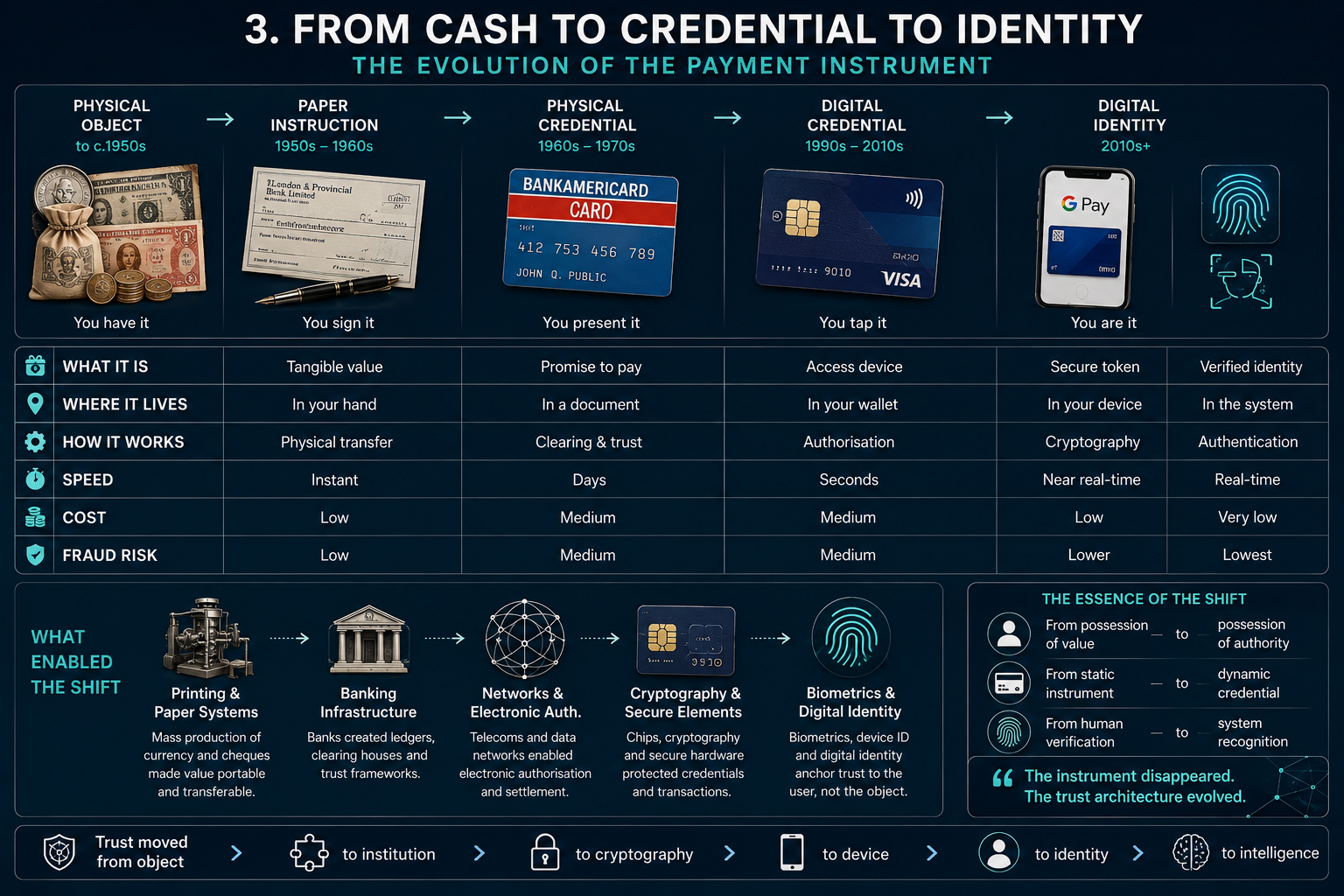
The evolution of the payment instrument: from something we possess, to an instruction we sign, to a credential we present, to a device we tap — and increasingly to an identity the system recognises.
Seen from the customer’s perspective, the transformation is remarkable. With cash, authority derives largely from possession: you have it. With a cheque, you provide an instruction and authenticate it through a signature: you sign it. With a traditional card, you present a credential: you present it. Contactless technologies simplify the gesture further: you tap it. And when authentication becomes biometric and identity-based, the relationship changes again: increasingly, you are it.
This does not mean that identity has replaced all previous payment mechanisms. The infrastructures underneath remain layered, and many contemporary digital wallets still ultimately rely on card or bank-account systems developed decades earlier. What has changed is the point at which the user encounters those infrastructures.
Trust has progressively migrated away from the visible instrument towards the systems surrounding it: from the object to the institution, from the institution to the network, from the network to cryptography and secure devices, and increasingly towards digital identity.
The instrument appears to disappear because trust is moving into the architecture.
The smartphone as an architecture, not simply a device
The smartphone accelerated this process because it brought together capabilities that had previously belonged to separate systems. It was simultaneously a computer, a network connection, a personal interface, a location-aware device, a secure environment and, increasingly, a mechanism for establishing identity.
For payments, this combination was transformational.
Digital wallets and tokenisation meant that the underlying payment credential no longer needed to be exposed in the same way during every transaction. Fingerprint and facial recognition changed authentication. Secure hardware and operating-system capabilities made the device itself part of the trust model.
The smartphone therefore did more than replace the plastic card with a digital representation of the plastic card. It changed the architecture through which the user interacted with the payment system.
A transaction increasingly became an interaction between identity, device, software, cryptography and network.
This also altered the competitive landscape. When the payment instrument was primarily a card, one of the central questions was which card the customer would choose. Once the instrument moved into software, another question became increasingly important: which interface would mediate the customer’s economic activity?
The wallet could become that interface. So could the operating system, the merchant application or the digital platform.
And, increasingly, so might the intelligent assistant.
From payment products to payment infrastructure
While the visible payment instrument was disappearing, another transition was taking place underneath it. Payment itself was becoming programmable infrastructure.
Open Banking, PSD2, APIs, account-to-account payments and instant-payment systems challenged the assumption that digital commerce had to be organised exclusively around traditional card architectures. Financial capabilities could increasingly be exposed to software in a structured and programmable form.
This changed the nature of integration. An application could initiate a payment through an API; digital identity mechanisms could contribute to authentication; risk could be evaluated using real-time information; and new payment rails could reduce the delay between initiation and settlement.
The conceptual evolution is significant. What began as a payment instrument became a payment service; the service increasingly became infrastructure; and infrastructure exposed through software becomes a capability that can be embedded within something else.
Once payment becomes a software-accessible capability, the boundary between a business process and the payment associated with it begins to dissolve. A marketplace can orchestrate payments between buyers and sellers. A mobility application can integrate transport and payment. An accounting system can initiate and reconcile transactions. An enterprise platform can connect purchasing, approval and settlement without forcing users to move manually between unrelated environments.
From the customer’s perspective, all of this can appear remarkably simple: a tap, a click, a glance or sometimes no explicit payment action at all.
But that simplicity is deceptive.
The invisible payment stack
Behind even a seemingly trivial digital transaction lies a sophisticated sequence of interactions.
The customer encounters an experience layer: perhaps a card, application, wallet, QR code or wearable device. Behind it, the system has to establish some form of identity and determine who — or what — is attempting to transact. Authentication provides evidence that the relevant person, device or credential is legitimate, while authorisation determines whether the particular transaction should be permitted.
That decision may incorporate much more than a simple account balance. Risk engines, fraud models, device information, transaction history, spending limits and contextual signals can all influence the result.
Once authorised, the payment message has to be routed through an appropriate network or payment rail. Financial obligations have to be calculated and reconciled through clearing processes, while settlement ultimately moves the relevant value and establishes financial finality.
Surrounding these technical functions is a layer that is less visible but no less important: governance. Regulation, compliance, technical standards, scheme rules, liability frameworks and institutional responsibilities determine how the system behaves when everything works — and, more importantly, what happens when it does not.
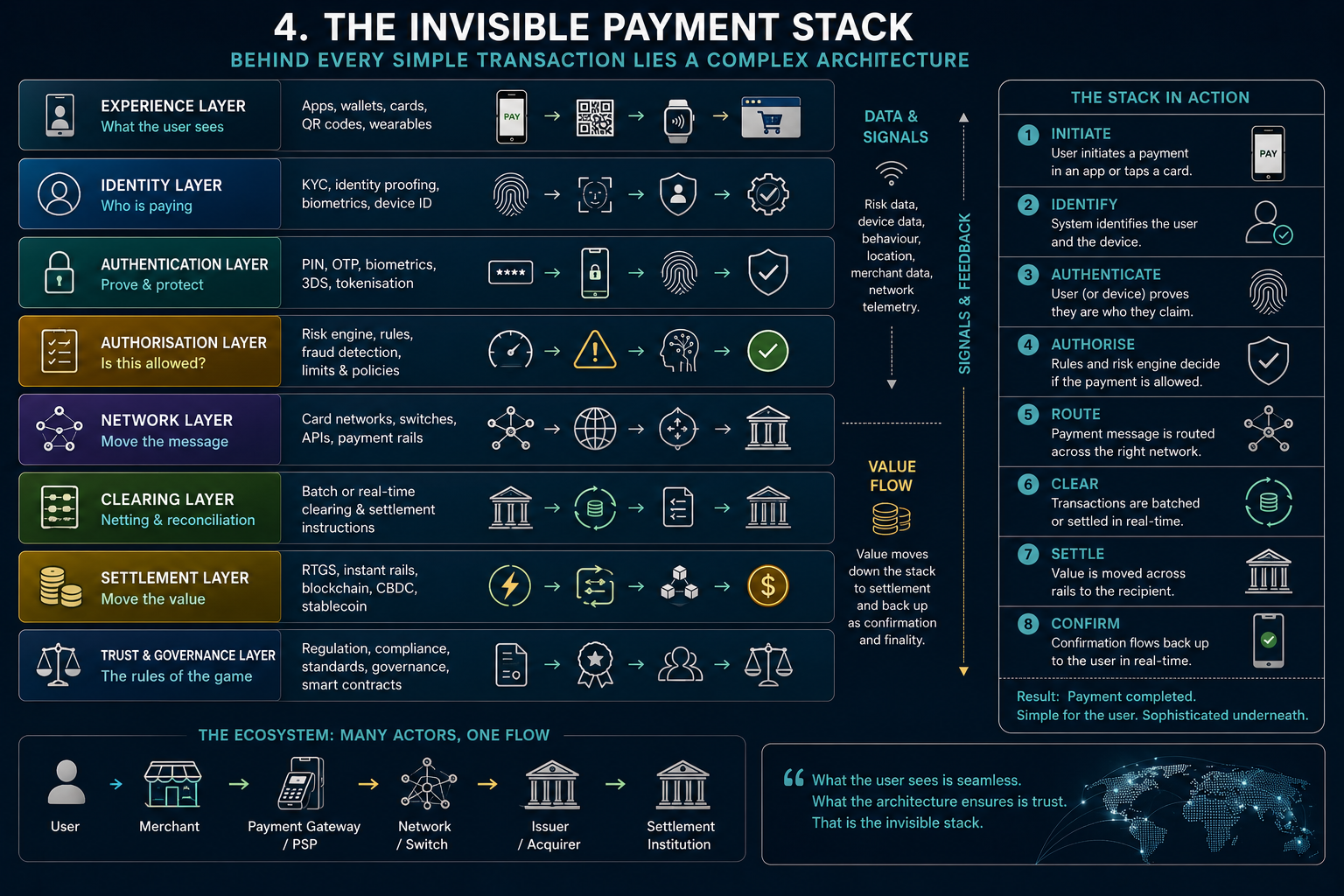
What the customer experiences as a simple payment is supported by layers of identity, authentication, authorisation, networking, clearing, settlement and governance.
This is why it is misleading to say that payments themselves have simply become easier.
The experience has become easier because the architecture has become more sophisticated.
The user sees a tap. The infrastructure sees identities, credentials, devices, risk signals, authorisation requests, routing decisions, clearing obligations, settlement mechanisms and regulatory responsibilities.
Payment becomes invisible precisely because the architecture behind it has become capable of carrying more of the complexity on the user’s behalf.
From closed networks to open economic infrastructure
Historically, many payment systems developed as relatively closed networks. Participation was controlled, interfaces were specialised and integration often required significant institutional and technical coordination.
The Internet and the API economy began to change that model. Open Banking accelerated the idea that financial capabilities could be made accessible programmatically, while instant-payment infrastructures challenged the expectation that the movement of money necessarily had to follow traditional batch cycles.
The strategic significance extends beyond speed.
When payment capabilities are accessible to software, developers can incorporate financial functions directly into experiences that are not primarily financial. The payment system begins to resemble a form of economic infrastructure available to other digital systems.
This is one of the reasons embedded finance has attracted so much attention. Its significance is not merely that another company can offer a payment button or a financial product. It reflects a deeper architectural shift in which financial capabilities become components that can be orchestrated within broader services.
And once payment infrastructure can be invoked by software, an obvious question follows.
What happens when the software invoking it becomes intelligent enough to make decisions?
Before reaching that question, however, another part of the architecture is changing: the representation of money itself.
Money itself becomes digital infrastructure
Stablecoins, tokenised deposits, central-bank digital currency experiments and distributed-ledger architectures have reopened a question that appeared relatively settled during much of the electronic-payment era: what exactly is the digital object being transferred?
Traditional electronic payments generally move messages between institutions whose ledgers subsequently reflect the economic consequences of those messages. The payment may appear instantaneous to the customer, while clearing, reconciliation and settlement follow an institutional process underneath.
Tokenised architectures introduce another possibility: digitally represented value can itself become more directly addressable and, potentially, programmable.
The distinction matters because programmability can change the relationship between money and the conditions under which it moves. Transactions can potentially become more closely integrated with digital rules, contractual logic or other machine-readable conditions.
This should not be interpreted as evidence that traditional financial infrastructure is about to disappear. The history examined throughout this article suggests almost the opposite. Payment architectures tend to accumulate.
Cash survives alongside cards. Cards coexist with bank transfers. Digital wallets often rely on card infrastructure. Instant payments coexist with older clearing mechanisms. Tokenised forms of value may similarly coexist with — and in many cases connect back into — existing financial systems.
Innovation therefore does not always replace an architecture. Frequently, it creates another layer of abstraction around it.
That observation is particularly important as we move towards AI and agentic payments. An intelligent agent will not necessarily require an entirely new form of money. It may operate across cards, bank accounts, instant-payment rails, digital wallets and potentially tokenised assets, selecting among them according to context.
What changes most radically may not be the money.
It may be who – or what – decides when and how that money moves.
The next payment instrument may not belong to a human
Artificial intelligence introduces perhaps the most intriguing transition in this entire history.
Until now, almost every payment architecture has ultimately assumed a human intention somewhere near the beginning of the transaction. A person handed over cash, signed a cheque, presented a card, entered a PIN or tapped a phone. Even automated payments generally originated from rules that a person explicitly established beforehand.
AI agents potentially change this relationship.
Consider something relatively ordinary: organising a business trip. Today I might ask an intelligent system to identify suitable flights or recommend a hotel. But imagine an agent capable of understanding the complete objective: get me to Stockholm for a meeting on Tuesday morning, return Wednesday evening, stay close to the meeting location, respect my travel preferences and keep the total cost within a defined budget.
The agent could identify flights, compare schedules and fare conditions, select accommodation, arrange local transport and purchase the necessary services. If a flight were cancelled, it might evaluate the alternatives and rebook. Afterwards, it could reconcile the expenses with the relevant systems.
At what point in that sequence should the human explicitly press Pay?
Perhaps nowhere.
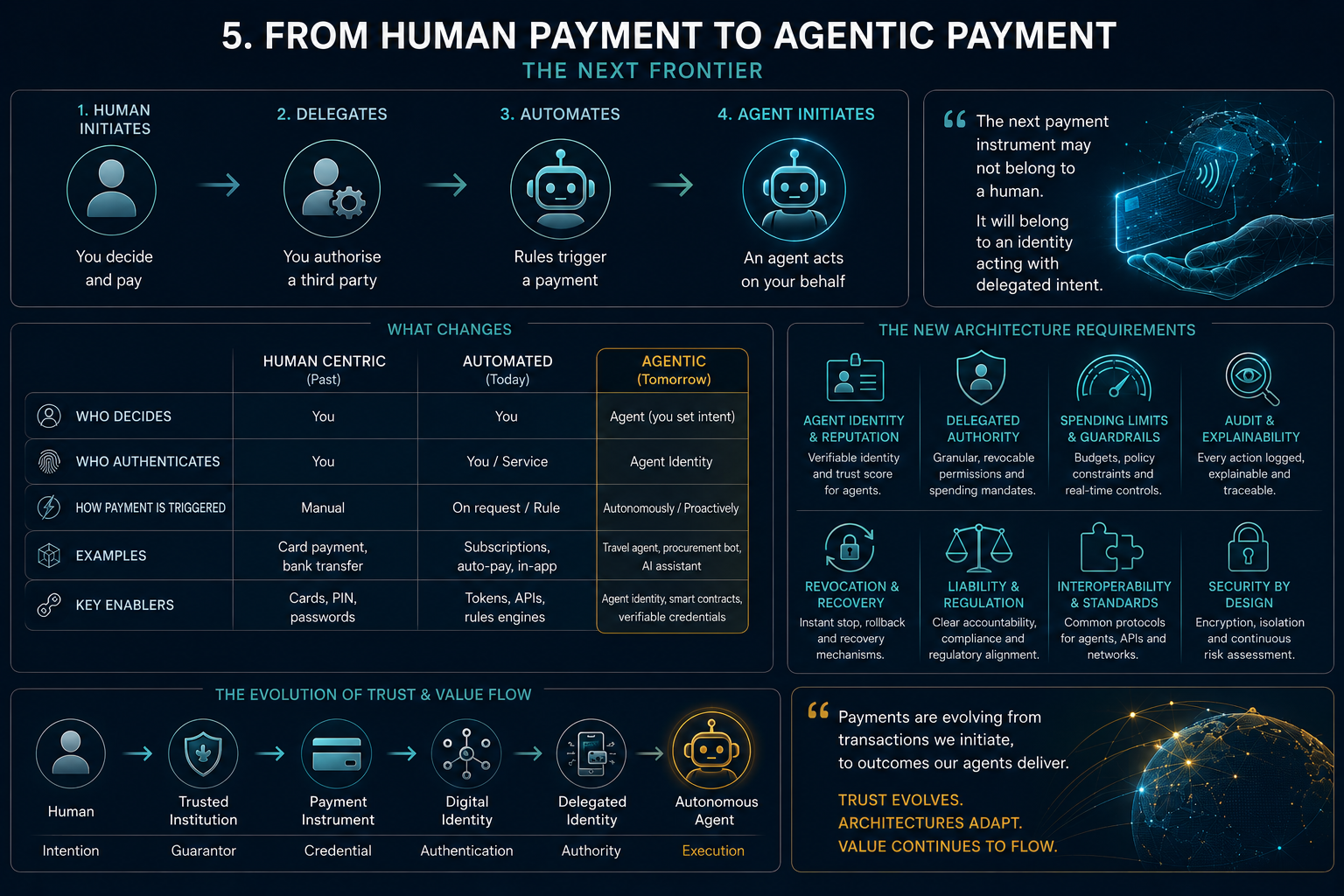
The next frontier: from transactions initiated directly by humans to transactions executed by intelligent agents acting under delegated authority.
This does not mean that the human disappears from the economic relationship. It means that human intention may move further upstream.
Instead of authorising every individual transaction, I may authorise an agent to operate within boundaries I have established. That changes the payment problem fundamentally. The central question is no longer simply whether the person presenting a credential is entitled to use it. It becomes whether a particular actor — potentially a machine — has legitimate authority to perform a particular economic action on someone else’s behalf.
From authentication to delegated authority
For decades, much of payment security has been organised around authentication: establishing that the person presenting a credential is entitled to use it. PINs, cryptographic keys, one-time passwords, device authentication and biometrics are different technological answers to essentially the same question: are you who you claim to be?
Agentic payments introduce a different question.
An AI agent does not necessarily claim to be the customer. It claims to be acting for the customer.
That distinction may appear subtle, but architecturally it is profound. Identity alone is no longer sufficient. A payment system needs to understand the relationship between an individual, an intelligent agent and the authority delegated from one to the other.
Consider again the business trip. I might authorise an agent to arrange travel to Stockholm, but that authority does not imply unrestricted access to my financial life. The agent might be permitted to spend up to a certain amount, use particular categories of suppliers, make purchases only during a defined period and optimise according to preferences I have established. It might be allowed to rebook a cancelled flight automatically, while requiring my approval before accepting a substantially more expensive alternative.
What matters, therefore, is not simply whether the agent can authenticate itself. What matters is whether it can demonstrate that this particular transaction falls within the authority it has been given.
This brings payments into the territory of delegated authority, where permissions need to be bounded, contextual and revocable.
It also changes the meaning of control. Today, control is often represented by the moment at which we press Pay, enter a PIN or confirm a transaction with our face or fingerprint. In an agentic environment, meaningful human control may occur much earlier, when we establish the objectives and boundaries within which the system is permitted to act.
The human decision does not necessarily disappear.
It moves upstream.
Spending limits, auditability, revocation, liability and explainability therefore cease to be peripheral security features and become fundamental components of the architecture. If an autonomous system makes an unexpected purchase, we will need to reconstruct not only what happened technically but why the transaction was considered permissible. If circumstances change, delegated authority must be capable of being withdrawn. And if an agent acts incorrectly, responsibility cannot remain suspended indefinitely somewhere between the customer, the AI provider, the merchant and the financial institution.
These are questions of governance as much as technology — which is precisely why they feel familiar.
Every major transition in payments has eventually confronted the same issue: technical possibility arrives first; institutional architecture has to catch up.
From identity to intent
There is an even deeper consequence.
The evolution described throughout this article can be understood as a progressive abstraction of the relationship between people and value. With cash, possession was central. With the cheque, the important element became an instruction. With the card, it became a credential. With digital wallets and biometrics, the architecture moved increasingly towards digital identity.
Agentic systems potentially take us one step further: from identity to intent.
A conventional payment system needs to establish who is attempting to transact and whether the transaction should be authorised. An intelligent economic system may increasingly need to understand something more contextual: what is this person trying to achieve, what authority has been delegated to the agent pursuing that objective, and does the proposed transaction remain consistent with those intentions?
This is quite different from simply giving an AI access to a wallet.
Imagine telling an agent: get me to London tomorrow morning for an important meeting, minimise the total travel time, use my preferred airline where practical and keep the overall cost below €1,000.
That statement contains an economic objective, preferences and constraints. It does not specify a flight number, hotel, payment method or sequence of transactions.
The agent must transform intent into economic action.
In doing so, it may compare alternatives, negotiate conditions, select suppliers and execute several transactions. Payment would no longer sit at the end of a decision process performed entirely by a human. Decision, negotiation and payment would increasingly become parts of the same computational process.
That is why the transition to agentic payments may eventually prove more significant than another improvement in checkout technology.
The interface is no longer merely disappearing.
The boundary between deciding and paying is beginning to move.
And if that happens at scale, the architecture of payments will increasingly become part of the architecture of economic agency itself.
Seventy years of making payments disappear
Looking back across this history, there is a striking continuity beneath all the technological change.
We began with physical objects. A coin or banknote represented value directly. The cheque separated the instruction from the value. Electronic networks transformed that instruction into information capable of travelling almost instantaneously. Cards turned the payment instrument into a credential. Smartphones absorbed that credential into a connected computing device. Biometrics moved authentication closer to identity. APIs transformed payment into infrastructure that software could invoke.
Now AI may allow that infrastructure to respond not merely to commands, but increasingly to intent.
Seen from this perspective, the history of payments is a history of progressive abstraction. What was once physical became informational. What was informational became networked. What was networked became programmable. And what became programmable may now become increasingly intelligent and autonomous.
Yet there is an important paradox.
As the visible components of payment have disappeared, trust has not.
It has simply migrated.
Trust once resided largely in the authenticity of the physical object and the authority of its issuer. It then expanded into banking institutions and clearing systems. Payment networks became another layer of trust. Cryptography made credentials and messages verifiable in new ways. Secure devices and biometrics brought identity into the architecture.
Agentic payments will not somehow complete this journey by eliminating trust. They will create another place in which trust has to be designed.
We will have to trust not only that the payment message is authentic, but that the machine generating it is authorised to act; not only that an identity is valid, but that delegated authority remains within its intended boundaries; not only that a transaction has been executed correctly, but that the reasoning that produced it is consistent with human intent.
In that sense, AI does not reduce the importance of payment architecture.
It exposes how important that architecture has always been.
A personal perspective on the next transition
Having worked through several chapters of this evolution, I find the present moment strangely familiar.
I remember when the mobile phone was still primarily understood as a communications device and we were beginning to explore what it could mean for commerce and payments. The technology suggested extraordinary possibilities, but technology was never the whole story.
The difficult questions were about ecosystems. Who controlled the customer relationship? Who owned the credential? Where should security reside? What role should the mobile operator play? What belonged to the bank, the card scheme, the handset manufacturer or the service provider? Which standards would allow different systems to work together?
The same pattern appeared around smart cards and NFC. The technical capability mattered enormously, but the architecture surrounding that capability ultimately determined how it could operate at scale.
Working across mobile commerce, micropayments, transport and ticketing, smart cards, NFC and broader payment ecosystems made one lesson increasingly clear to me: innovation becomes transformative only when technology, institutions and human behaviour find an architecture in which they can coexist.
That is why I am cautious about describing agentic payments simply as the next technological revolution.
The interesting question is not whether an AI system can technically initiate a payment. That threshold is comparatively easy to cross.
The interesting question is what happens when we begin to give intelligent systems economic agency.
How much authority should we delegate, and how should that authority be represented? How should another system know that the delegation is genuine? When should the human be brought back into the loop? And who carries responsibility when an autonomous decision produces an unintended economic consequence?
Those questions echo debates I have seen before, although the technological actors are different.
When mobile payments emerged, some predicted the end of the card. When smartphones arrived, others predicted the disappearance of banks from the customer relationship. New payment rails have repeatedly been presented as replacements for everything that preceded them.
History has been more interesting.
Cash survived cards. Cards survived mobile wallets. Banking networks coexist with instant payments. Digital wallets frequently operate on top of infrastructures developed decades earlier.
Architectures rarely disappear overnight. They evolve by absorbing what came before them.
AI is likely to follow the same pattern.
Human agency should not disappear simply because machines become capable of transacting. Instead, we may develop new architectures through which human agency can be expressed, constrained and delegated.
And perhaps that brings us back to the central idea running through this entire history.
For more than seventy years, we have been making payments progressively less visible. We made the physical money disappear from many transactions. Then the paper disappeared. The card began to disappear into the phone. The credential disappeared behind biometrics. The payment interface itself began disappearing into services and APIs.
Now, perhaps, even the explicit act of paying may sometimes disappear into an intelligent system acting on our behalf.
But one thing remains.
Trust.
The technology changes. The actors change. The interfaces change. The mechanisms through which trust is established change.
The need for it does not.
Perhaps that is the real history of payments:
Money did not disappear.
The architecture around it became progressively invisible.
And the next chapter may not primarily be about making payments faster or easier.
It may be about something considerably more consequential:
deciding who – or what – we are prepared to trust to make them.