From Renaissance workshops to generative AI, the strange history of the individual creator
There is an image of authorship that we seem reluctant to abandon.
A writer alone at a desk. A painter standing before an empty canvas. A composer hearing a melody that nobody else has heard. Somewhere inside the individual, an idea appears. It travels from mind to hand and eventually becomes a book, a painting, a symphony.
We call that person the author.
It is a powerful image. It is also, perhaps, one of our most persistent cultural simplifications.
Today, generative artificial intelligence appears to threaten it. If a machine can produce a paragraph, compose a melody or generate an image from a few sentences, we immediately ask who created the result. The person who wrote the prompt? The engineers who built the model? The countless people whose works contributed, directly or indirectly, to the cultural environment from which the model learned? The machine itself?
Who is the author now?
But perhaps we are asking the question from the wrong end of history.
Perhaps AI has not created the problem of authorship.
Perhaps it has simply made visible a problem that was always there.
The Solitary Genius
Walk through a museum and the labels encourage a particular way of seeing.
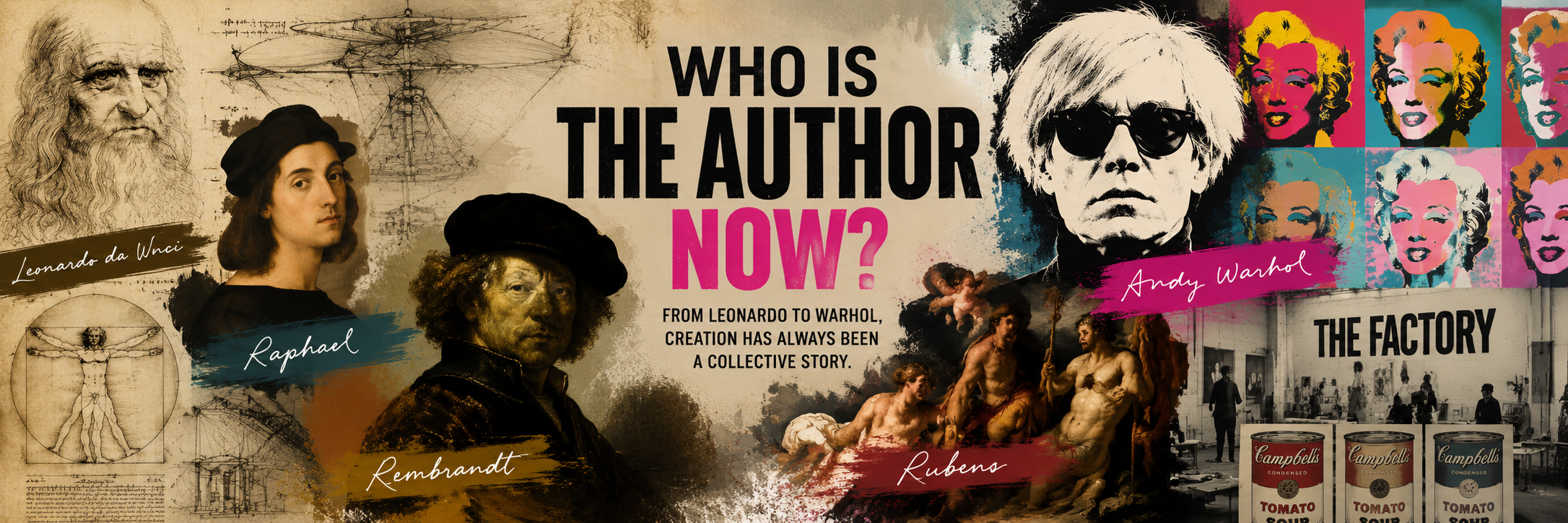
- Leonardo da Vinci.
- Raphael.
- Rembrandt.
- Rubens.
One name. One work. One author.
Yet many of the great European masters worked within workshops populated by apprentices and assistants. Materials were prepared by others. Backgrounds could be painted by others. Parts of a composition might be executed under the master’s supervision rather than directly by his hand.
The work nevertheless emerged under one name.
The same ambiguity exists elsewhere.
A cathedral has an architect, but thousands of hands may participate in its existence. A film has a director, although hundreds of people contribute to what appears on the screen. A scientific paper may carry several names while resting upon decades, sometimes centuries, of accumulated knowledge.
Even the apparently solitary writer is not particularly solitary.
Every sentence is constructed from a language the writer did not invent.
The words belong to generations before us. The grammar is inherited. The metaphors have histories. The concepts through which we understand reality come from teachers, books, conversations, institutions and experiences.
I can write a sentence that has never existed before while using almost nothing that is originally mine.
And nevertheless, somehow, the sentence becomes mine.
That paradox existed long before artificial intelligence.
When Creation Became Selection
Art began making the paradox increasingly explicit during the twentieth century.
In 1917, Marcel Duchamp submitted an ordinary porcelain urinal to an exhibition, signed it R. Mutt, gave it a title — Fountain — and transformed one of the most mundane objects imaginable into one of the most discussed works in modern art.
Duchamp had not manufactured the urinal.
His creative act was elsewhere.
- He selected.
- He displaced.
- He renamed.
- He changed the context.
Suddenly, authorship no longer necessarily meant producing the physical object. It could mean making the intellectual decision through which an object acquired another meaning.
Decades later, Andy Warhol would push the ambiguity further. His studio was called, appropriately, The Factory. Assistants participated in producing works bearing Warhol’s artistic identity. Repetition, reproduction and industrial processes were not hidden imperfections in his practice. They were part of the idea itself.
The artist was becoming something more complicated than the person holding the brush.
Director. Selector. Curator. System designer.
This should sound strangely familiar today.
Music Had Already Understood
Music complicates authorship even further.
Consider jazz.
A musician begins a phrase. Another responds. A drummer changes the rhythm. The bassist follows, or deliberately does not. Something emerges between them that none of them could have completely planned beforehand.
Who authored that moment?
The pianist?
The quartet?
The musical tradition that gave them a shared vocabulary?
Or the interaction itself?
Later, sampling made the question impossible to ignore.
Hip-hop and electronic music demonstrated that creativity could emerge through recombination. A fragment of an existing recording could be removed from one context, altered, repeated, layered with something else and transformed into a new cultural object.
The creative act had moved again.
Not necessarily from nothing to something, but from something to something else.
And perhaps this is where our contemporary discomfort with generative AI becomes particularly interesting.
When someone produces an image with an AI system, we often hear the objection:
You didn’t make that. The machine did.
But what exactly do we mean by make?
For more than a century, art has repeatedly challenged the assumption that creation requires physically producing every component of the final work.
AI did not invent this ambiguity.
It inherited it.
The Author Was Already Dying
Long before ChatGPT, Midjourney or large language models, twentieth-century thinkers were questioning the privileged position of the author.
In 1967, Roland Barthes famously announced The Death of the Author. His concern was not artificial intelligence but interpretation. Meaning, he argued, could not simply be reduced to what an author intended. Once a text entered the world, it became entangled with language, culture and its readers.
Michel Foucault later asked an even more fundamental question:
What is an author?
More than half a century later, the question has acquired an unexpected technological dimension.
Consider what happens when someone writes with generative AI.
There is an intention.
There is a prompt.
Behind the prompt is a human being carrying years of education, experience, reading, conversations and cultural assumptions.
The prompt enters a model built by researchers and engineers, trained through enormous computational infrastructures and shaped by vast quantities of human-produced material.
The system generates possibilities.
The human accepts some, rejects others, changes a sentence, rewrites a paragraph, challenges an argument, introduces an experience, removes something that feels wrong.
Eventually, something is published.
Where, along that chain, does authorship reside?
Perhaps nowhere entirely.
Or perhaps everywhere partially.
The Author as a Network
We tend to imagine intelligence as something contained inside an individual.
Perhaps we have made the same mistake with authorship.
Neither intelligence nor creativity exists in isolation.
We think through languages we inherited, concepts developed by others, technologies we did not build and institutions that preserve knowledge across generations.
A library is part of our cognitive environment.
- So is a notebook.
- So is Google.
- So is a conversation with a colleague.
- And increasingly, so is artificial intelligence.
The difference is significant, of course. A generative model does not simply retrieve information. It participates in the production of possibilities. It proposes formulations, associations, images and structures that may not previously have existed in precisely that form.
But this may require us to reconsider authorship rather than abandon it.
Perhaps the author of the AI age is less the person who produces every element and more the person who gives direction to a process of creation.
That sounds radical only until we remember the Renaissance workshop, the film director, the jazz ensemble, Duchamp’s urinal and Warhol’s Factory.
We have been here before.
Just never at this scale.
And What About Me?
There is an uncomfortable reason why this question interests me.
I write about artificial intelligence while living through the moment in which artificial intelligence is becoming part of the environment in which we write.
When I write a book or an essay today, what exactly makes it mine?
Certainly not the words. English existed before me.
Not all the ideas. Many have been shaped by people I have read, conversations I have had and experiences accumulated across decades of working with technology and organisations.
Not even necessarily every formulation. Like most contemporary writers, I work inside an ecosystem of digital tools that would have appeared extraordinary to an author only a generation ago.
And yet, when my name appears on the cover, I consider the work mine.
Why?
I increasingly think the answer has less to do with production than with responsibility.
- I decide what I believe.
- I decide what remains.
- I decide what is removed.
- I decide whether an argument represents my experience and my thinking.
And ultimately I decide whether I am prepared to put my name underneath it.
That may become the essential distinction of authorship in the age of artificial intelligence.
From Creation to Responsibility
A machine can generate a paragraph.
It can generate ten alternatives before I have finished writing one.
It can imitate styles, suggest metaphors, restructure arguments and combine ideas at extraordinary speed.
But there is one sentence it cannot meaningfully utter:
I stand behind this.
Not because the words cannot be generated. They obviously can.
But because standing behind something is not a linguistic operation.
It means accepting responsibility.
It means being prepared to explain why something was said, why something was omitted and what consequences may follow.
It means connecting a work to a history, a reputation, a set of values and ultimately a human life.
Perhaps this is where authorship survives.
Not in the romantic idea that everything must originate inside one isolated mind, but in the willingness of someone to take responsibility for the whole.
Generative AI may therefore change the author’s role profoundly.
We may become less exclusively producers and increasingly directors, selectors, editors and curators of possibility.
But curation is not neutrality.
Selection is a decision.
And decisions have authors.
So perhaps the arrival of artificial intelligence does not mean the death of the author after all.
It may force us to rediscover what an author was all along.
The question is no longer simply whether AI can become an author.
The more difficult question is what we are prepared to mean when we say:
This work is mine.