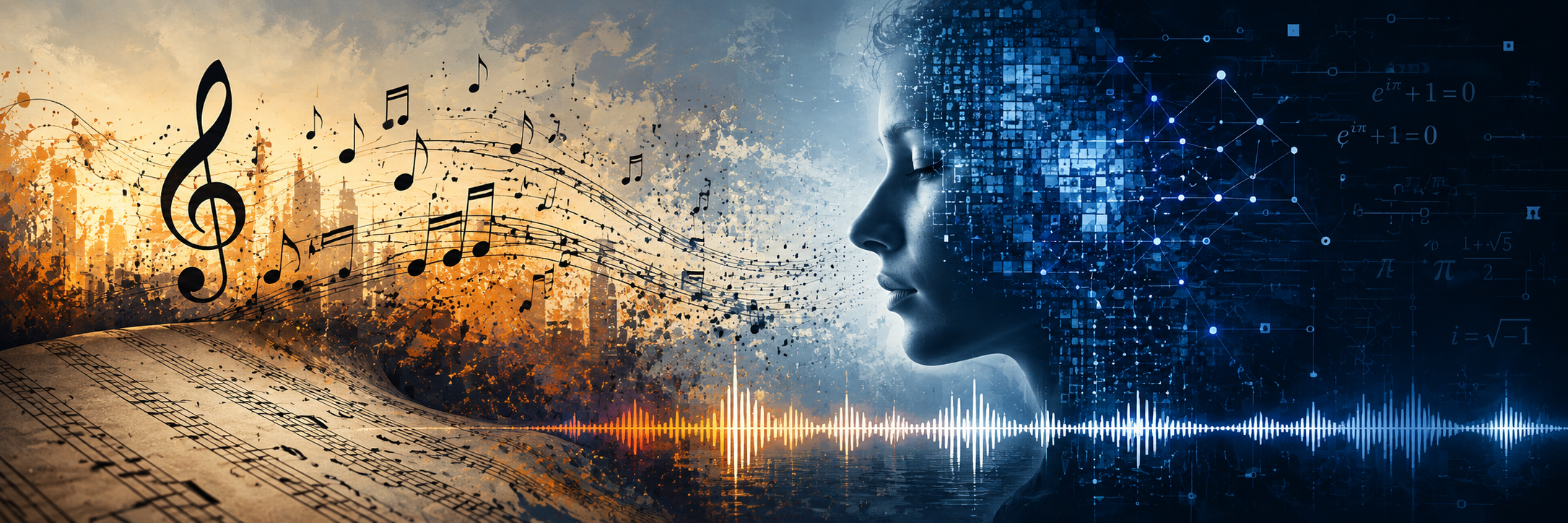
I have spent much of my professional and intellectual life moving between worlds that are often treated as separate: technology and the humanities, computation and creativity, organisations and individuals, artificial intelligence and human judgement. Music has accompanied that journey not simply as an artistic interest, but as another way of thinking about intelligence itself.
There is something profoundly instructive about music in the age of Artificial Intelligence.
Contemporary music, perhaps more visibly than many other artistic forms, has progressively challenged the idea that meaning must arise from a fixed vocabulary. Harmony can coexist with dissonance. Rhythm can be interrupted. Silence can become part of the composition. Electronic sound can stand beside an acoustic instrument. Algorithms can generate structures that no composer would have written note by note. Improvisation can transform a score into something that exists only once.
And yet we still recognise music.
This suggests that meaning does not reside exclusively in the individual elements of a system. It emerges from relationships: between notes, between sound and silence, between expectation and surprise, between the musician and the score, between the performer and the listener.
I increasingly think about Artificial Intelligence in similar terms.
For decades, we have tried to understand intelligence by decomposing it. We have represented knowledge through symbols, rules, probabilities, vectors, networks and increasingly vast computational models. Each generation of AI has offered a new vocabulary for describing aspects of cognition. Expert systems attempted to formalise reasoning. Machine learning discovered patterns without requiring every rule to be explicitly written. Contemporary generative models operate within immense spaces of statistical relationships, producing language, images, music and code with a fluency that would have seemed extraordinary only a few years ago.
But the extraordinary capability of these systems also exposes a deeper question.
Is intelligence really something that can be located entirely inside an individual – whether that individual is biological or artificial?
Music suggests another possibility.
A note by itself contains very little music. Its significance emerges from what came before it, what follows it, what surrounds it and what the listener expects to hear. The same note can create resolution in one context and tension in another. A silence can be absence, hesitation, anticipation or conclusion.
Context transforms information into meaning.
The same distinction matters enormously for AI.
A machine can process more information than any human being. It can discover correlations hidden across millions of observations, compare alternatives at a scale inaccessible to individual cognition, and generate plausible responses almost instantaneously. But information, however extensive, is not identical to meaning.
Meaning depends upon context, history, intention, consequence and values.
This is particularly important when Artificial Intelligence enters organisations and institutions. An algorithm may identify the statistically optimal decision while remaining unable to recognise that the objective itself should be questioned. A model may produce a highly accurate prediction without understanding whether acting upon that prediction is legitimate. A system may optimise efficiency while quietly eliminating qualities that were never represented in its objective function: dignity, trust, fairness, empathy or institutional memory.
These are not necessarily failures of computation.
They are reminders that computation exists within a larger human system.
Music offers an illuminating analogy here as well. A perfectly executed sequence of notes is not necessarily a meaningful performance. Technical precision matters, but interpretation matters too. The musician must understand when to follow the score and when the written notation is insufficient to communicate what the composition requires.
There is knowledge in the score, but there is also knowledge in the performer.
And there is knowledge in the relationship between them.
Perhaps the same will become true of human beings and Artificial Intelligence.
The most interesting future may not be one in which machines eventually reproduce every dimension of human intelligence, nor one in which humans preserve some mysterious territory forever inaccessible to computation. Both narratives assume that intelligence belongs primarily to isolated entities and that the central question is therefore one of comparison: human versus machine.
I suspect that this framing will increasingly become inadequate.
The more consequential question may be what forms of intelligence emerge between us.
Human beings bring experience, embodied knowledge, moral responsibility, cultural memory and the ability to recognise that a situation may require reframing rather than optimisation. Machines bring extraordinary capacities for computation, memory, pattern recognition and exploration across spaces too large for human cognition.
Neither should be romanticised.
Human judgement is fallible. We are biased, inconsistent and sometimes irrational. Our memories are incomplete, our attention limited and our decisions influenced by factors we do not recognise.
Artificial intelligence is not neutral either. Every model inherits representations, objectives, training data, design decisions and institutional assumptions. Even systems capable of producing unexpected outputs operate within structures created through human choices.
The interesting intelligence may therefore emerge not from replacing one with the other, but from designing the relationship between them.
This is where my experience with music continues to influence how I think about technology.
A musical ensemble does not become more intelligent simply by adding more technically capable musicians. Its quality depends upon listening. Each performer must simultaneously contribute and remain sensitive to what others are doing. In improvisation especially, intelligence becomes distributed. No single musician completely controls the emerging composition. Each contribution changes the context within which the next contribution will be made.
The intelligence belongs partly to the musicians, but partly to the interaction itself.
Organisations work in much the same way.
Their intelligence cannot be measured simply by adding together the intelligence of the people they employ, just as introducing Artificial Intelligence does not automatically make an organisation intelligent. Organisational intelligence emerges from relationships between people, information, processes, technologies, incentives, institutional memory and judgement.
AI changes those relationships.
That is why I see Artificial Intelligence not merely as another generation of information technology, but as something that forces us to reconsider the architecture of decision-making itself.
- Who knows?
- Who decides?
- Who challenges the decision?
- What knowledge has been represented?
- What remains tacit?
- What has been optimised?
- What has been ignored because it could not easily be measured?
- And ultimately: who remains responsible?
These questions become more important, not less, as machines become more capable.
There is a temptation in technological history to equate progress with the elimination of uncertainty. Better models should produce better predictions; better predictions should produce better decisions; better decisions should produce better organisations.
But uncertainty is not always a defect waiting to be engineered away.
In contemporary music, ambiguity can be intentional. Dissonance can carry information. Silence can create meaning precisely because it leaves something unresolved.
Human societies contain similar forms of irreducible ambiguity.
Not every conflict is an optimisation problem. Not every value can be converted into a metric. Not every important form of knowledge can be placed into a database. And not everything that can be predicted should necessarily determine what we choose to do.
Perhaps one of the great intellectual challenges of Artificial Intelligence will therefore be learning to distinguish between what should be calculated and what must still be judged.
That distinction has shaped much of my work across technology, organisations and Artificial Intelligence.
After decades spent observing successive technological transformations, I have become less interested in asking what machines will eventually be capable of doing and increasingly interested in asking what their capabilities will require usto become.
The question is no longer simply whether machines can think.
It is whether we can design institutions capable of thinking responsibly with machines.
Music offers no final answer to that question. But it provides a powerful metaphor.
The future of intelligence may resemble neither a solo performance by humanity nor a composition generated entirely by machines.
It may be closer to an ensemble whose instruments we are still learning to hear.
Some voices will be human. Some will be artificial. Some patterns will be calculated; others will emerge through experience, intuition and interaction. At times the machine may lead. At other moments human judgement must interrupt the pattern, change the tempo or question the score itself.
The quality of the resulting composition will depend not simply upon the sophistication of the instruments, but upon our ability to listen.
And perhaps that is where the deepest intelligence has always lived:
- not entirely within the individual mind,
- not entirely within the machine,
- but in the relationships through which information becomes understanding, knowledge becomes judgement, and separate voices become meaning.
A Coda: Listening to Contemporary Intelligence
Perhaps these ideas become clearer when we listen to some of the music that has accompanied the technological transformation of the last century and the beginning of this one.
Contemporary music has repeatedly questioned what music actually is, just as Artificial Intelligence is now forcing us to question what intelligence actually is.
John Cage‘s 4′33″ is perhaps the most radical example. The performer does not play the instrument in the conventional sense. What we hear instead is the environment: breathing, movement, distant sounds, the accidental acoustics of the room. Cage transforms silence from the absence of music into a space in which listening itself becomes the composition.
There is an intriguing parallel with Artificial Intelligence. What is absent from a model can sometimes be as important as what is represented within it. Data tells us what has been captured; silence reminds us to ask what has not.
Steve Reich approached the question differently. In works such as Piano Phase and Music for 18 Musicians, simple patterns interact, repeat and gradually move relative to one another. Complexity is not necessarily written explicitly into every moment of the composition. It emerges from relationships between relatively simple processes.
This resembles an important characteristic of complex intelligent systems: sophisticated behaviour can emerge from interactions among components without being completely attributable to any single component. The intelligence may reside partly in the architecture of the relationship.
Philip Glass offers another perspective. Repetition in his music is rarely mere repetition. A pattern returns, but our perception of it changes. Small variations acquire significance precisely because they occur inside structures that initially appear stable.
There is something similar in machine learning. Repetition, exposure and variation can gradually create structures that were never explicitly programmed as individual rules. Yet Glass’s music also reminds us that pattern alone is insufficient. It is the human perception of change within the pattern that transforms repetition into experience.
Brian Eno pushed this idea further through generative music. Rather than composing every instant of a work, he became interested in designing systems capable of producing music. The composer’s role shifts from specifying every output to establishing conditions from which outputs can emerge.
This distinction has become remarkably contemporary.
It resembles the transition we are experiencing in software and Artificial Intelligence: from programming individual outcomes towards designing systems that generate possibilities.
The creator increasingly designs the space of potential behaviour.
Yet the responsibility of the creator does not disappear merely because the result is generated rather than explicitly written. If anything, it becomes more important. Designing the rules of a generative system means accepting responsibility for the space within which generation occurs.
That is as true for AI as it is for music.
In a different musical territory, Miles Davis‘s later electric experiments — particularly Bitches Brew — provide another useful image. Although rooted in jazz rather than what is conventionally classified as contemporary classical music, the work dissolved boundaries between composition, improvisation, electronic processing and studio construction. What we hear cannot easily be attributed to a single performer or even to a single moment of performance. The recording itself becomes part of the creative system.
Here again, authorship becomes distributed.
And this may be increasingly relevant in a world of generative Artificial Intelligence. When a human formulates an intention, a model generates alternatives, another human selects among them, software transforms them and an organisation decides how they will be used, where exactly does authorship reside?
Perhaps the question itself needs to change.
More recently, artists such as Ryuichi Sakamoto explored the relationship between acoustic sound, electronics, noise, environment and silence. His later work in particular often seems less concerned with demonstrating musical complexity than with creating spaces in which tiny sounds acquire extraordinary significance.
This is almost the opposite of the current technological obsession with scale.
Artificial Intelligence celebrates billions of parameters, enormous datasets and rapidly increasing computational capacity. Sakamoto’s music can remind us that significance does not necessarily increase with quantity. Sometimes intelligence consists in recognising which tiny signal deserves our attention among millions of possible signals.
And then there is the extraordinary work of artists who have deliberately placed technology itself inside the creative relationship.
Holly Herndon, for example, has experimented with machine learning not merely as an instrument that obeys the composer, but as something closer to a participant in the creative process. Her work raises questions that extend well beyond music: What does collaboration mean when one participant is artificial? Who is the author? What has the machine learned from human culture? What do we recognise as genuinely new, and what is recombination?
These are no longer questions belonging only to experimental music.
They are becoming questions for writers, designers, scientists, managers, governments and organisations.
Perhaps this is why contemporary music provides such a useful intellectual companion to Artificial Intelligence.
- Cage teaches us to listen to what is absent.
- Reich shows how complexity can emerge from relationships.
- Glass demonstrates how repetition and variation transform perception.
- Eno shifts attention from creating individual outputs to designing generative systems.
- Miles Davis shows how creativity can become distributed across people, technologies, improvisation and subsequent transformation.
- Sakamoto reminds us that greater quantity does not necessarily produce greater meaning.
- Herndon asks what happens when the machine itself enters the ensemble.
None of these examples provides a theory of Artificial Intelligence. Nor should we force music to become a technological metaphor.
But together they suggest something important.
The history of contemporary music is partly a history of expanding our definition of what can constitute music: silence, noise, repetition, electronics, algorithms, environmental sound, improvisation and now machine-generated material.
Perhaps we are living through a comparable expansion of the meaning of intelligence.
For centuries, we associated intelligence primarily with the individual human mind. Today we are beginning to encounter intelligence distributed across humans, machines, organisations, networks and increasingly complex systems of interaction.
The challenge will not simply be to make the artificial instruments more powerful.
It will be to understand the composition we are creating with them.
Because the future of intelligence may ultimately depend on something musicians have always understood:
- knowing how to produce a sound is not the same as knowing when to play it.
- And knowing when to play is still not enough.
- You must also know when to listen.