 Over the past thirty-five years, I have had the privilege of witnessing several technological revolutions. I began my career when Artificial Intelligence was still largely confined to university laboratories, expert systems, and research papers. Computing power was scarce, networks were slow, and the idea that millions of people would one day converse naturally with machines belonged more to science fiction than to business strategy. Since then, I have worked across telecommunications, financial services, digital payments, consulting, public administration, and international initiatives, experiencing firsthand how each new wave of technology promised to redefine the future.
Looking back, I have noticed a recurring pattern. Every major technological breakthrough initially captures our imagination because of what it can do. Only later do we begin to understand what it requires. The Internet was celebrated for connecting the world before we realized the importance of global fibre networks. Smartphones transformed daily life before mobile broadband became a strategic national asset. Cloud computing promised unlimited flexibility before hyperscale data centres quietly became part of our critical infrastructure.
Artificial Intelligence is following the same trajectory.
Today, public attention remains focused on increasingly capable models, astonishing demonstrations, and the race among technology companies to build systems that reason better, generate more convincing content, or solve increasingly complex problems. Yet beneath this visible competition, another transformation is taking place—one that may ultimately prove far more consequential.
The real challenge is no longer intelligence.
It is infrastructure.
This realization did not come from reading research papers or attending conferences. It emerged gradually through conversations with executives, public administrators, engineers, policymakers, and researchers across different countries and industries. Regardless of the sector, the questions have started to change. Only a year ago organizations wanted to know which Large Language Model they should adopt. Today they increasingly ask whether they have sufficient computing resources, how much AI will cost to operate at scale, whether their existing data architecture is adequate, and how governance should evolve to manage systems that continuously learn and reason.
The conversation has shifted.
Artificial Intelligence is no longer simply another software application.
It is becoming part of our industrial infrastructure.
For decades we have comfortably assumed that computing resources would always become cheaper and more abundant. Moore’s Law reinforced the expectation that every few years processing power would double while costs declined. Software innovation could therefore focus almost exclusively on functionality because infrastructure quietly evolved in the background.
Generative AI has disrupted that assumption.
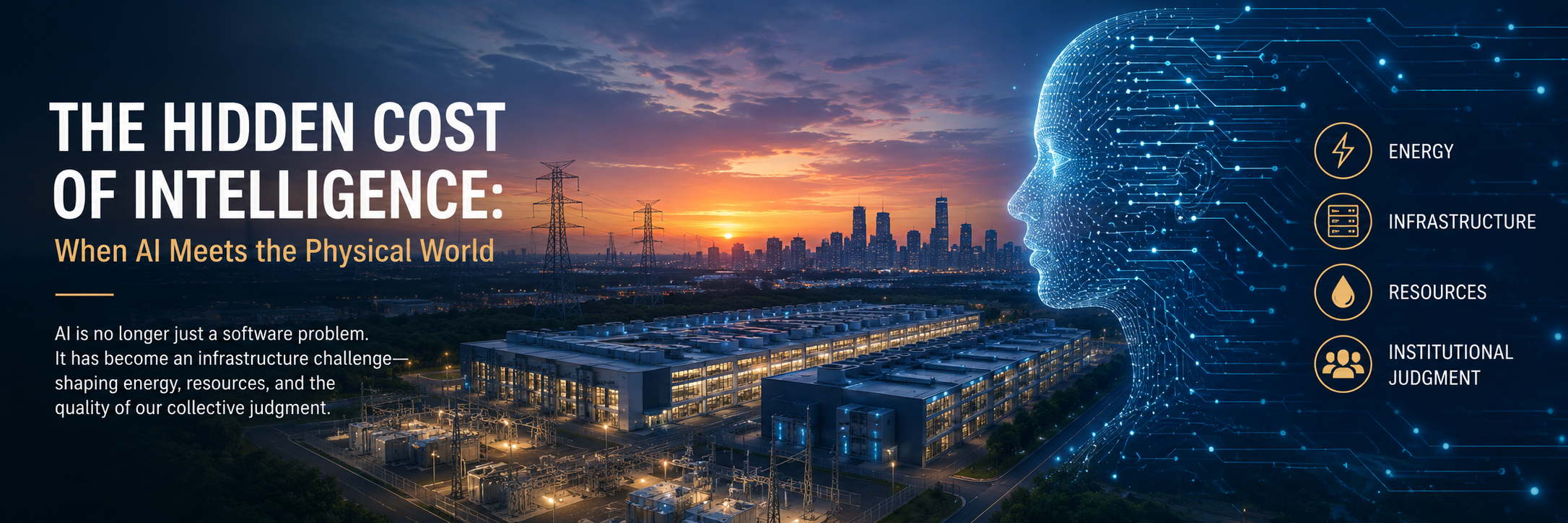
Every interaction with an advanced reasoning model consumes considerable computational resources. Behind what appears to users as a simple conversation lies an immense physical ecosystem of GPUs, semiconductor manufacturing, high-speed networking, sophisticated cooling systems, electrical substations, and increasingly complex energy management. Recent analyses by the International Energy Agency suggest that AI data centres are becoming major industrial consumers of electricity, with significant implications for national energy planning and investment.
The digital world, once seemingly detached from physical limitations, has become profoundly material again.
I find this fascinating because it reminds me of previous moments in technological history. Railways were never simply about locomotives; they required steel production, bridges, and entirely new logistics systems. Commercial aviation depended not only on aircraft but on airports, air traffic control, and international regulation. Likewise, Artificial Intelligence cannot be understood merely through algorithms. It depends on a growing ecosystem of physical assets that societies must build, regulate, finance, and sustain.
This has important implications for organizations.
Throughout my career I have learned that technology itself rarely determines competitive advantage. When mobile telecommunications emerged, success did not belong exclusively to those who owned the best networks but to those capable of redesigning their business models around new possibilities. During the rise of digital payments, the winning organisations were not necessarily those with superior technology but those able to establish trusted ecosystems involving banks, merchants, regulators, and consumers.
Artificial Intelligence will follow the same path.
Organizations can purchase access to the most advanced models. They can rent cloud infrastructure. They can deploy increasingly capable AI assistants. These are largely financial decisions.
Far more difficult is developing the institutional capability to determine where AI genuinely improves decision-making.
This is where I believe the discussion must move.
The scarcity of the coming decade will not primarily concern computational power.
- It will concern judgment.
- Judgment cannot be downloaded.
- It cannot be licensed through an API.
- It cannot simply be added to an organization by deploying another model.
Judgment emerges from experience, institutional memory, governance, organizational culture, and the ability to combine human expertise with machine intelligence in meaningful ways.
This is precisely why I have increasingly focused my research on what I call Institutional Intelligence. The objective has never been to create organizations that merely use Artificial Intelligence. Rather, it is to design organizations capable of learning collectively, preserving knowledge, improving decision quality, and ensuring that technology strengthens rather than replaces human reasoning.
As AI becomes more computationally demanding, efficiency itself will become a strategic capability. Every duplicated knowledge repository, every unnecessary inference, every fragmented workflow represents not only operational complexity but also wasted computational resources. The organizations that succeed will therefore be those that learn how to reason more effectively rather than merely compute more extensively.
This represents an important inversion of the prevailing narrative.
Much of today’s public discourse assumes that progress will come from ever larger models and ever greater computational capacity. Those developments will undoubtedly continue. Yet history suggests that sustainable advantage rarely belongs to those possessing the largest technological assets. More often, it belongs to those capable of integrating technology into coherent institutions that make consistently better decisions.
That distinction matters.
An organization equipped with extraordinary Artificial Intelligence but poor governance may simply make mistakes faster.
An organization with strong institutional judgment can transform the same technology into lasting capability.
Perhaps this is why I remain optimistic despite the extraordinary pace of change. Having experienced multiple technological revolutions, I have learned that every generation initially overestimates what technology alone can accomplish while underestimating the importance of human adaptation. Eventually, attention shifts from invention to integration, from capability to governance, and from individual tools to institutional transformation.
I believe we are approaching precisely that moment again.
The future of Artificial Intelligence will certainly depend on advances in semiconductors, energy infrastructure, networking, and computational efficiency. Those developments will shape what machines become capable of doing.
But the future of our organizations will depend on something else entirely.
It will depend on whether we can transform abundant computational intelligence into better collective judgment.
Because every technological revolution eventually encounters physical limits.
The organizations that endure are not those with the most intelligence.
They are those that learn how to use intelligence wisely.