There was a time when crossing a European border meant leaving your mobile phone behind.
Not literally, perhaps. You could carry the device with you. But there was no guarantee that it would remain useful.
In the 1980s, mobile telecommunications was a collection of national systems. The Nordic countries had NMT. Britain and Italy used variants of TACS. France had Radiocom 2000. Germany had C-Netz. They represented remarkable engineering achievements, but they also reproduced something deeply European: national infrastructures separated by borders.
A mobile telephone belonged not only to its owner but, in a sense, to the network that made it work.
What happened next is usually told as part of the history of telecommunications.
I think it deserves to be understood as something much larger.
Europe did not simply create another generation of mobile technology.
Europe created an architecture.
And that architecture would eventually help put a computer into almost every pocket on Earth.
Before the mobile phone became personal
The first mobile telephones were impressive precisely because mobility itself was impressive.
For most of the twentieth century, the telephone had been associated with a place. You called a house, an office, a hotel or a telephone booth. The number identified, in practical terms, a location.
Early cellular systems began to break that relationship.
The telephone was becoming attached to a person rather than a place.
But mobility was still fragmented.
Different countries developed different analogue cellular systems, with different frequencies, technologies and infrastructures. The result was a patchwork of successful but incompatible networks.
This was not simply an inconvenience for travellers. It represented a fundamental limit to scale.
Manufacturers faced fragmented markets. Operators developed within national boundaries. Subscribers could not assume that their service would follow them across Europe.
The breakthrough therefore did not begin with a smaller telephone.
It began with an agreement.
The invention that was a standard
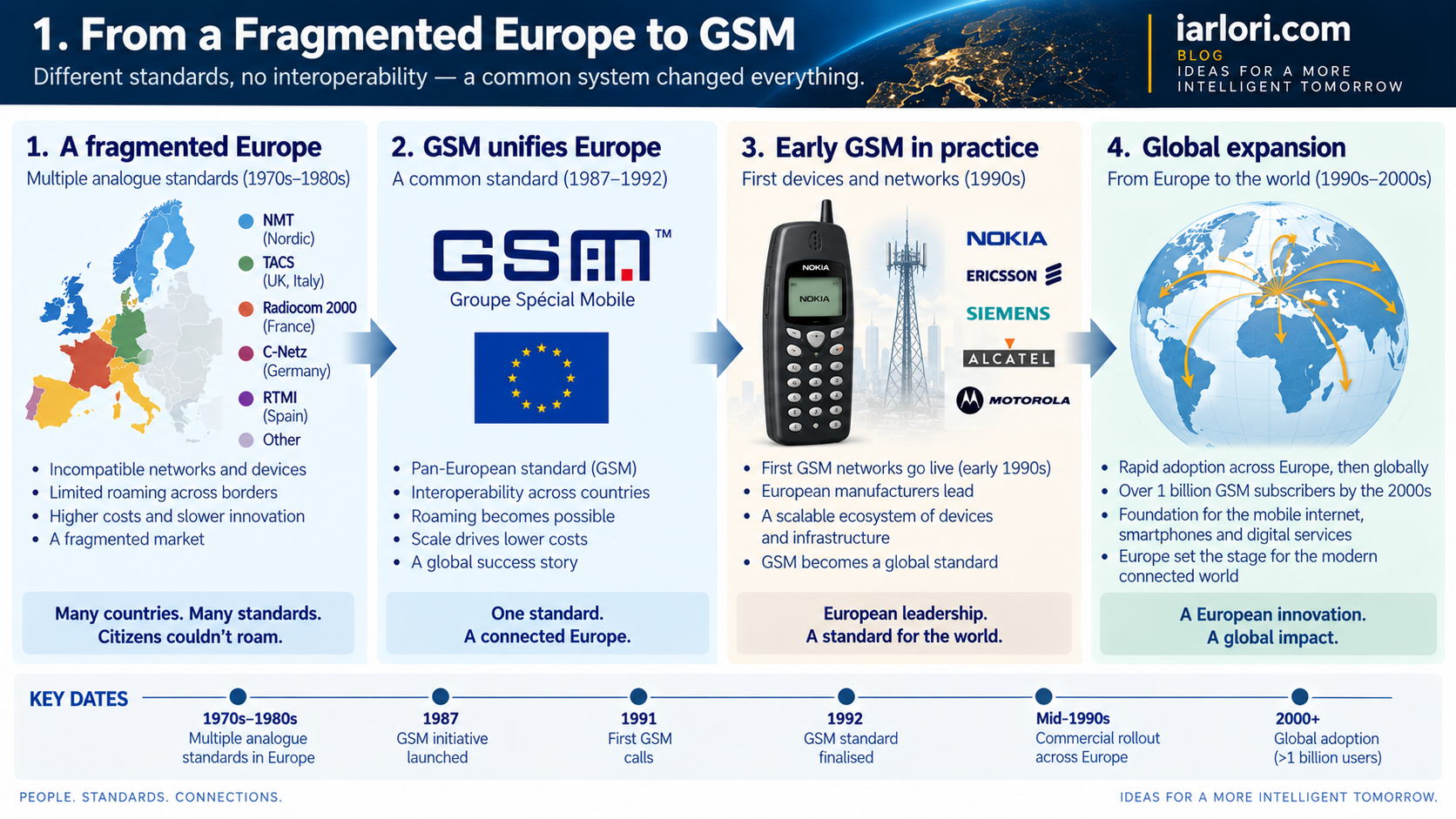
During the 1980s, European countries began working toward a common digital cellular system. France and Germany signed a joint development agreement in 1984; Italy and the United Kingdom later joined the effort. In September 1987, fifteen representatives from thirteen countries signed the GSM Memorandum of Understanding in Copenhagen, committing themselves to deploying a common system.
It is difficult today to appreciate how consequential that decision was.
The participants were not designing a successful consumer product. They were establishing the rules that would allow thousands of future products, networks and services to coexist.
The first specifications were ready for implementation in 1988, and responsibility for GSM subsequently moved into the newly created European Telecommunications Standards Institute, ETSI.
Then, in 1991, the first commercial GSM call was made in Finland.
A year later came the first international roaming agreement between Telecom Finland and Vodafone UK.
And in 1992 came something that initially appeared far less important than voice communications:
the first SMS.
Within a few years, what had begun as a European interoperability project was becoming a global telecommunications architecture.
This is why I find the GSM story so interesting.
One of Europe’s greatest technological innovations was not a device. It was the agreement that allowed devices to work together.
The small card that changed identity
There was another architectural innovation hidden inside the GSM phone.
The SIM.
For users, it was simply the small plastic card inserted into the handset. Technically and conceptually, however, it represented something much more interesting.
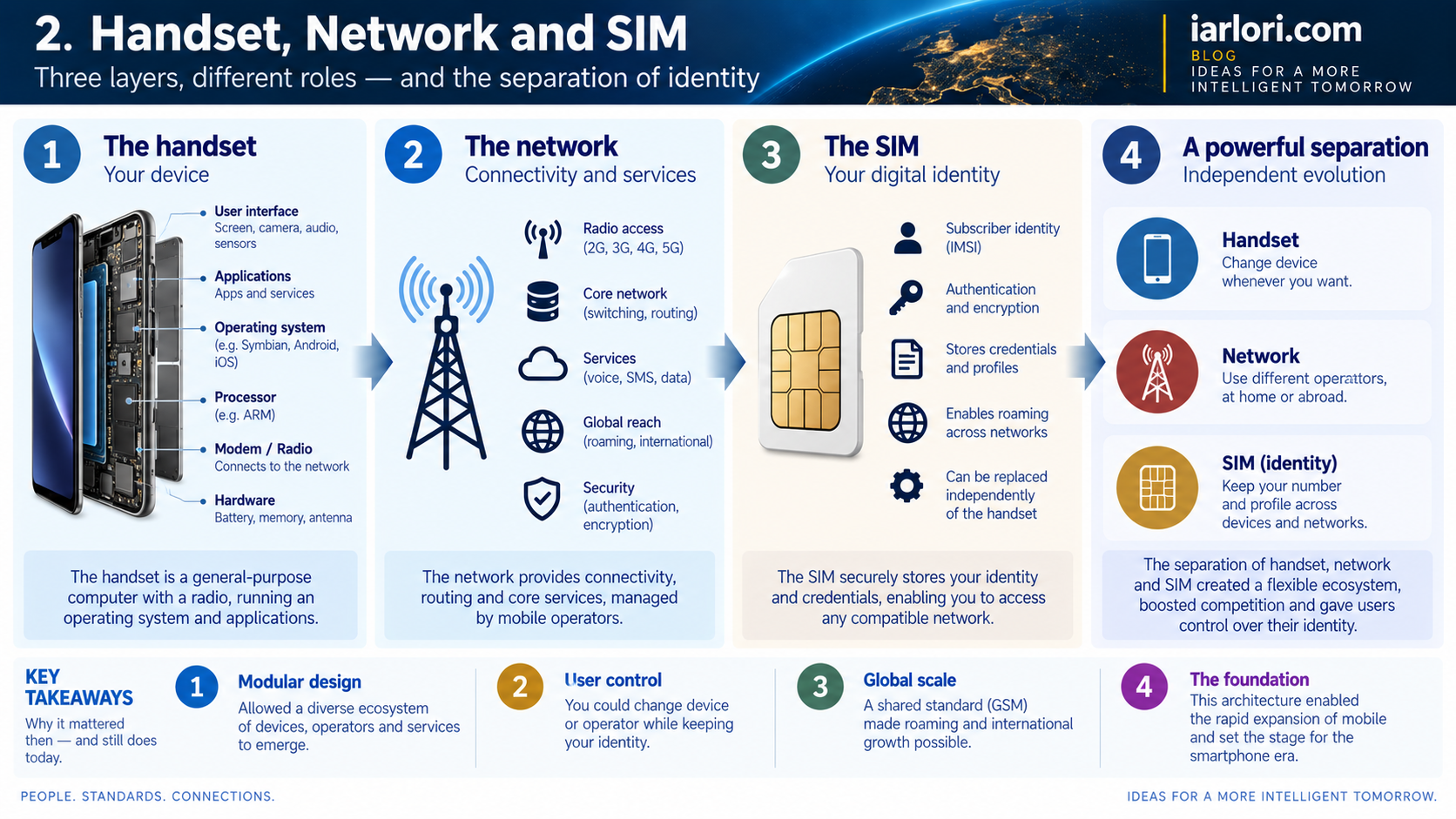
The subscriber’s identity could be separated from the physical telephone.
Change the handset, move the SIM, and your relationship with the network could move with you.
This seems obvious today. At the time, it represented an important abstraction.
The device was one thing.
The network was another.
The subscriber was something else.
GSM provided mechanisms for authentication and encryption while enabling the interfaces necessary for European roaming. Contemporary European descriptions of the system explicitly recognised that agreement on network interfaces could remove the barriers created by incompatible national systems.
Looking back from today’s world of digital wallets, eSIMs, identity platforms and secure elements, the SIM can be seen as something more than a telecommunications component.
It was an early architecture for portable digital identity.
And that idea would later become important far beyond telecommunications.
When Europe was the centre of mobile
By the second half of the 1990s, something extraordinary had happened.
Mobile telephony was moving from an expensive specialist technology to a mass consumer phenomenon.
And much of the centre of gravity was European.
Nokia was becoming one of the most recognisable technology companies in the world. Ericsson was building networks across continents. European operators were expanding rapidly. GSM was spreading far beyond Europe.
For those of us working around telecommunications at the time, particularly in the Nordic ecosystem, it was difficult to imagine that Europe would not remain at the centre of the mobile future.
The devices became smaller.
Batteries lasted longer.
Displays improved.
SMS became part of everyday communication.
Then phones acquired calendars, address books, games, data connectivity and increasingly sophisticated software.
Something subtle was happening.
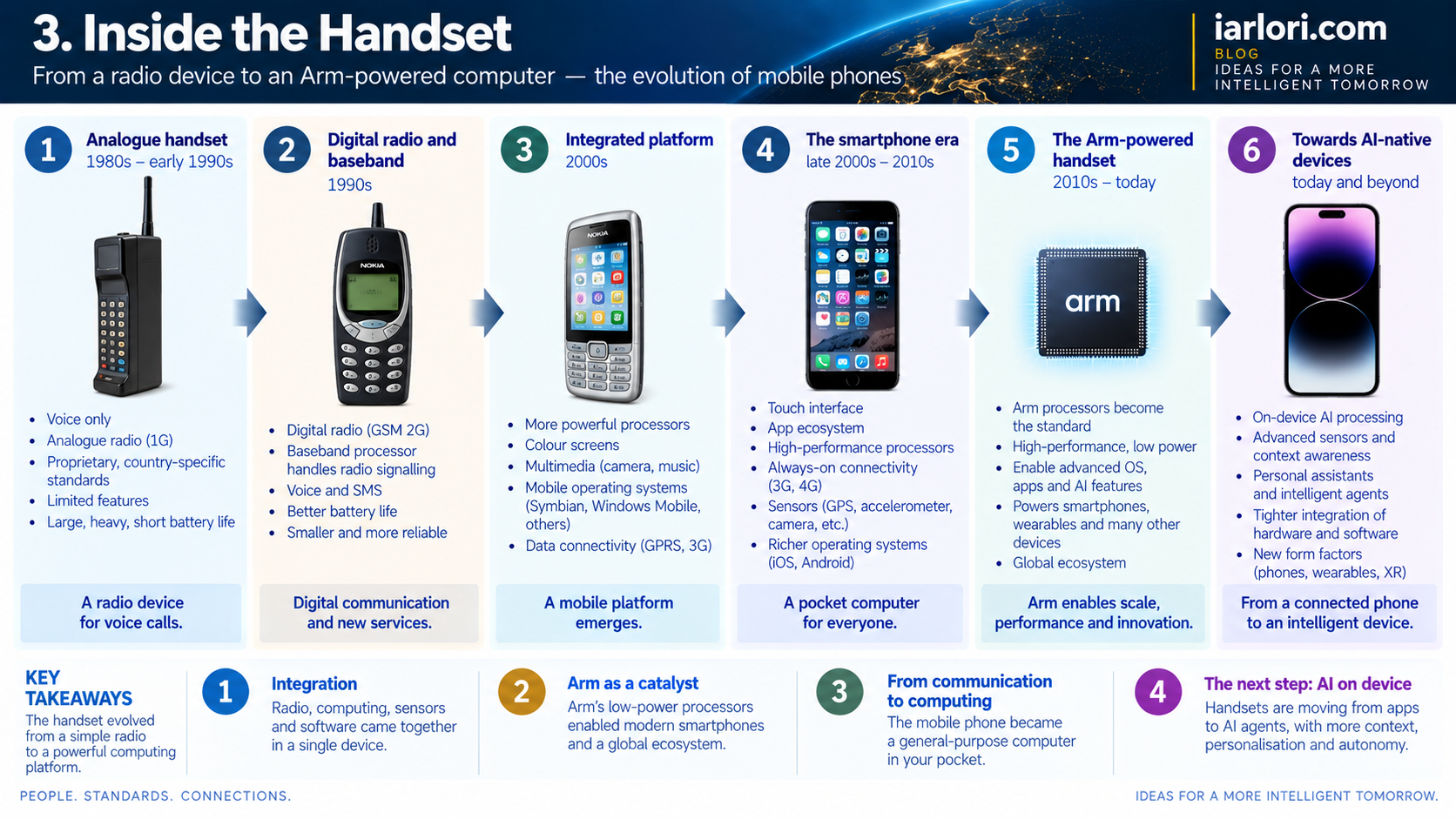
The mobile telephone was becoming a computer.
The revolution inside the handset
Some of the most consequential innovations were invisible to the person holding the phone.
As handsets became smaller and more capable, computation had to become extraordinarily efficient.
A desktop computer could consume considerable power. A mobile device could not. Every additional capability competed for battery, memory, physical space and heat.
This constraint helped another European technology become fundamental to the mobile world.
Arm.
The architecture originated at Acorn Computers in Cambridge in the 1980s. Arm became a separate company in 1990, and its emphasis on efficient computation proved remarkably suited to mobile devices.
The Nokia 6110 became the first GSM phone powered by an Arm processor. Arm describes Nokia’s adoption of the ARM7 family as one of the pivotal events that established its architecture in mobile computing.
That relationship would become enormous.
Today, Arm says more than 99 per cent of smartphones are based on its technology.
There is an interesting historical irony here.
The personal computer revolution had been organised largely around American computing architectures and software.
But the processor architecture underneath the global smartphone revolution emerged from Cambridge.
Europe was contributing not only the mobile standard and telecommunications infrastructure.
It was also contributing part of the computational architecture inside the device.
The telephone discovers software
Once computing entered the handset, the trajectory changed.
At first, software added features to a telephone.
- A calculator.
- A calendar.
- Snake.
- Then messaging.
- Then email.
- Then a rudimentary web browser.
- Then a camera.
- Then GPS.
- Then downloadable applications.
The distinction between a telephone and a computer became increasingly difficult to maintain.
The Nokia Communicator made the direction particularly visible. Devices based on Symbian pushed the idea further. BlackBerry transformed mobile email into an essential professional service. Nokia’s N-series combined cameras, multimedia, internet access and increasingly sophisticated applications.
Long before 2007, many of the components of what we now call the smartphone already existed.
And this is an important part of the story.
The iPhone did not suddenly make computing mobile. Computing had been migrating into the telephone for more than a decade.
What changed in 2007 was something different.
The organising principle changed.
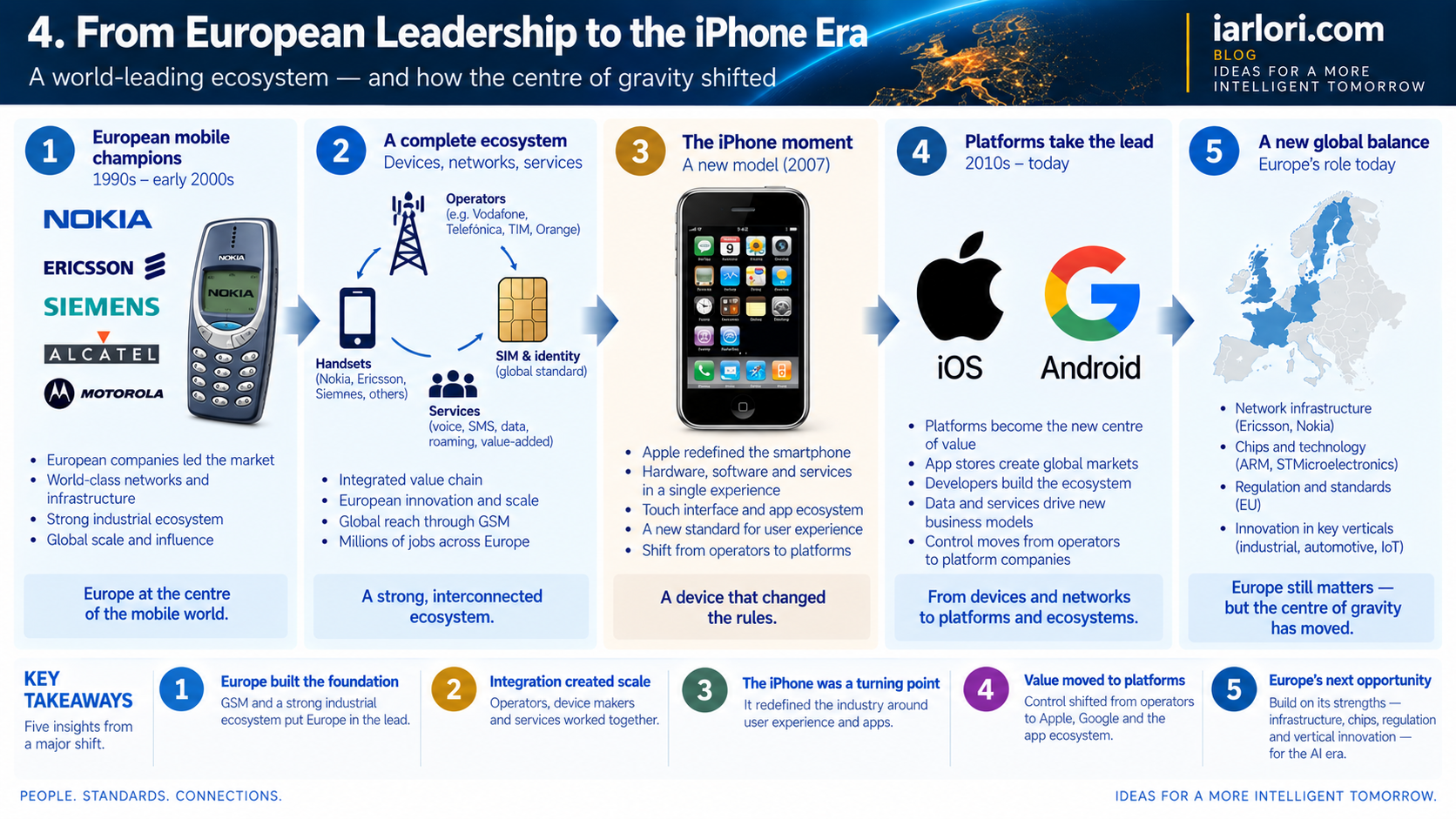
The moment the operator stopped being the centre
For much of the GSM era, the mobile operator occupied the privileged position in the ecosystem.
The operator controlled the network.
It issued the SIM.
It managed the subscription.
It billed the customer.
It often controlled which devices were distributed and which services appeared on them.
Even early mobile internet experiences frequently reflected this operator-centric architecture.
The handset existed largely at the edge of the telecommunications network.
Then Apple introduced the iPhone.
Much has been written about the touchscreen, industrial design and user interface. All were important.
But from a business architecture perspective, something more profound was happening.
The centre of gravity was moving from the network to the platform.
The device was no longer simply a terminal connected to an operator’s services.
It was becoming the gateway to an independent software ecosystem.
With the emergence of app stores, developers could build services without negotiating their existence individually with mobile operators.
The customer relationship began moving with them.
Navigation, music, messaging, media, games, commerce and eventually payments increasingly belonged to software platforms rather than telecommunications networks.
The network remained indispensable.
But indispensability is not the same thing as control.
From product to ecosystem
Android accelerated the transition.
Suddenly the competitive unit was no longer simply the handset.
It was an ecosystem.
- Operating system.
- Applications.
- Developer community.
- Cloud services.
- Identity.
- Maps.
- Search.
- Advertising.
- Payments.
- Content.
- Data.
- Hardware.
This distinction helps explain one of the great strategic misunderstandings of the mobile era.
If you compared one Nokia handset with one iPhone, Nokia could remain extremely competitive.
If you compared Nokia with an emerging software ecosystem organised around operating systems, developers, applications, cloud services and digital identities, the nature of the competition looked entirely different.
One company was still extraordinarily good at making mobile products.
The others were increasingly constructing platform economies.
The difference would prove decisive.
What Europe actually invented
Looking back at the history of mobile communications, it is tempting to reduce the European experience to a familiar story of technological decline. Europe had Nokia and Ericsson; then Apple and Google arrived, the centre of the industry moved across the Atlantic, and Europe lost its position.
There is some truth in that account, but it misses what Europe actually contributed to the mobile revolution. Europe did not simply produce a few remarkably successful telecommunications companies. It helped create the architecture within which the global mobile industry could develop.
GSM demonstrated the extraordinary economic power of a common standard. Roaming turned what had been a collection of national networks into an increasingly continuous communications space. The SIM separated subscriber identity from the physical handset, allowing people to change devices while retaining their relationship with the network. European companies became global leaders in network infrastructure and mobile devices, while in Cambridge the processor architecture that would eventually become fundamental to mobile computing was taking shape.
Seen from this perspective, the interesting question is not whether Europe failed to invent mobile technology. It clearly did not. The more interesting question is why Europe proved so successful at creating the standards, infrastructure and industrial capabilities upon which the mobile world was built, yet was much less successful at capturing the platform layer that subsequently emerged above them.
That distinction matters because the greatest economic value does not necessarily remain with those who build the foundations of a technological system. It often migrates towards whoever controls the next layer.
And that is precisely what happened.
From place to person to platform
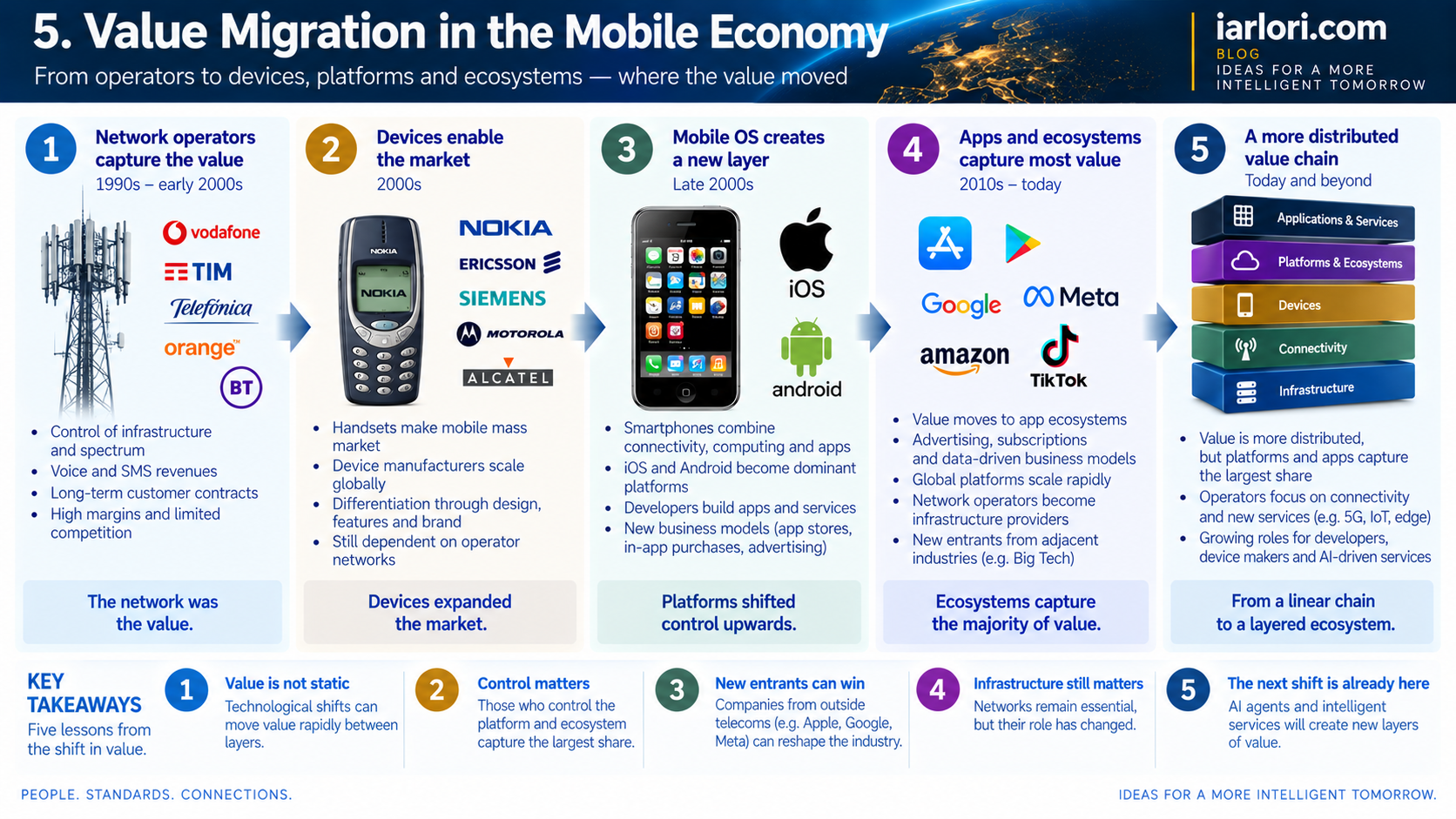
Perhaps the history of mobile communications is best understood not as a succession of devices, but as a succession of constraints that disappeared.
For most of the twentieth century, the telephone belonged to a place. A telephone number led to a house, an office, a hotel or a desk. Mobile telephony broke that relationship by allowing communication to follow the individual. GSM removed another boundary by making mobile communications interoperable across national infrastructures, while the SIM went further still, allowing the subscriber’s identity to exist independently of a particular handset.
Computing underwent a similar transformation. Processing escaped from the desktop and entered the device in our pocket. The smartphone then loosened another relationship: digital services no longer had to be defined primarily by the telecommunications operator. Applications could be created by independent developers and distributed through global software platforms. Later, cloud computing made many of those services increasingly independent of the physical device itself.
None of these transitions eliminated what came before. Fixed networks survived mobile telephony. Telecommunications operators survived the smartphone. Handsets remained essential after applications became dominant. What changed was where control accumulated and where new value could be created.
This is one of the more important lessons I take from the mobile revolution. Technological change is not only about replacing one device with another. Often, the deeper transformation occurs when an existing layer becomes sufficiently reliable, standardised and ubiquitous that we begin to take it for granted. At that moment it becomes infrastructure, and innovation moves somewhere else.
The network once defined the mobile experience. Eventually it became the largely invisible foundation upon which somebody else could build the experience.
That pattern may now be repeating.
And now, perhaps, another layer is moving
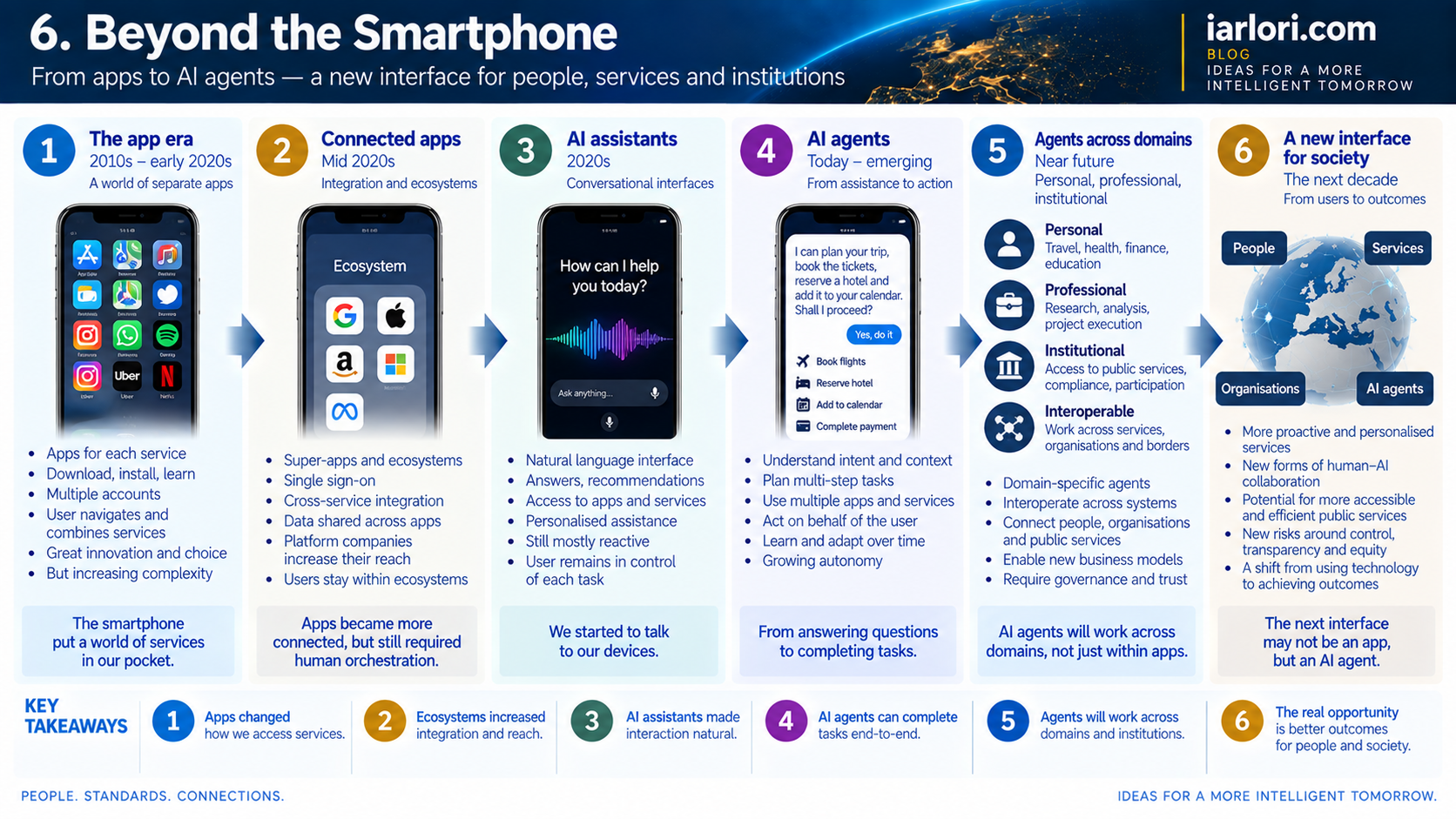
For almost twenty years, the application has been the organising principle of our digital lives. We learned to navigate a world of icons: one application for communication, another for travel, another for banking, another for shopping, another for work. The smartphone brought all these services into our pocket, but it still left us responsible for orchestrating them.
If I want to organise a journey, I know that I may need a search engine, an airline application, a hotel service, a map, a payment instrument and a calendar. The technology is extraordinarily sophisticated, yet much of the integration still takes place in my head. I am the one who knows which application to open next.
Artificial Intelligence may begin to change that relationship.
An intelligent agent does not necessarily need the user to know which application provides which capability. I can describe an intention — arrange the journey, compare the alternatives, prepare the meeting, reserve the hotel — and increasingly the system can determine which information, applications and services need to be brought together to achieve it.
That distinction between an application and an intention may prove more important than it initially appears.
Applications will not disappear, just as telecommunications networks did not disappear when smartphones arrived. They may instead become less visible. The application could remain an essential technological and commercial component while gradually becoming infrastructure underneath a new interface: an intelligent layer capable of interpreting context, selecting services and coordinating actions on our behalf.
We have seen this kind of transition before. Once mobile connectivity became reliable enough, we stopped thinking about the network every time we used a digital service. Once cloud infrastructure became ubiquitous, most users stopped caring where an application was actually running. AI agents could produce a similar abstraction at the application layer.
The smartphone itself may therefore remain in our pockets for many years while becoming less important as the organising metaphor for digital life. The next competition may not be primarily about who builds the best handset, or even who owns the most successful application. It may be about who controls the intelligent layer through which intentions are translated into actions.
That brings the story back to Europe — and to the lesson of GSM.
Nearly forty years ago, Europe demonstrated that common standards, interoperability, portable identity and shared infrastructure could create the foundations of an enormous global market. It helped build the architecture of the mobile world, even though others eventually captured much of the platform economy that grew above it.
As Artificial Intelligence begins to create another layer in the digital architecture, Europe faces a remarkably familiar question. The challenge is not simply whether it can produce competitive AI models, companies or applications. It is whether it can recognise where the architecture is moving, help define the standards and institutions around that new layer, and this time capture more of the value created above the infrastructure it helps to build.
The history of GSM reminds us that Europe can build architectures for the world. The question is whether, in the age of AI, it can also build – and retain influence over – the layer that comes next.
And this brings us back to Europe.
Nearly forty years ago, Europe showed that it could create an architecture powerful enough for an entire global industry to grow upon.
GSM was more than a telecommunications standard.
It was evidence that interoperability, identity, common rules and shared infrastructure could create enormous markets.
Europe helped build the architecture of the mobile world.
Others eventually captured much of the platform above it.
As Artificial Intelligence begins to reorganise the digital world once again, perhaps the most important question is therefore not whether Europe can produce another successful technology.
It is whether Europe can recognise which layer will matter next – and build it before somebody else does.