For much of my professional life, technology occupied the center of the conversation.
This was understandable. During the 1980s and 1990s, computing was still perceived as something exceptional. Organizations invested heavily in information systems because they believed, often correctly, that technology would provide a competitive advantage. Information technology was visible. It was tangible. It was discussed in boardrooms and executive meetings. New systems represented progress, and the people who managed those systems often found themselves close to the center of organizational decision-making.
Over time, however, I began noticing a curious phenomenon.
The more successful technology became, the less people seemed interested in discussing it.
At first glance this appears contradictory. We live in the most technologically intensive period in human history. Never before have societies depended so completely on digital infrastructures. Never before have organizations delegated so many activities to machines, software, networks, algorithms, and automated systems. Never before have individuals carried so much computing power in their pockets.
Yet despite this extraordinary dependence, technology itself has become strangely invisible.
Most people no longer think about it.
- They simply expect it to work.
- This is not a sign of failure.
- It is a sign of maturity.
The history of innovation repeatedly follows this pattern. A new technology appears and captures public imagination. For a period, society becomes fascinated by the technology itself. Newspapers discuss it. Conferences celebrate it. Experts debate its future. Entire professions emerge around it.
Then, gradually, the technology disappears from view.
Not because it becomes less important, but because it becomes part of everyday life.
Electricity followed this path. Telecommunications followed this path. The automobile followed this path. Even the Internet, once considered revolutionary, has become so ordinary that younger generations struggle to imagine a world without it.
We notice these technologies only when they fail.
The same process is occurring with information technology.
For decades, organizations built dedicated departments to manage technology. The arrangement was logical. Technology was specialized. Expertise was concentrated. Systems were expensive and difficult to maintain. The IT department became both guardian and gatekeeper of organizational computing.
Today the situation is very different.
Technology is no longer a separate domain.
Technology has become the environment within which organizations operate.
It permeates every process, every interaction, every decision, and every relationship.
At some point, the distinction between business and technology began to lose meaning.
And when a distinction loses meaning, the structures built around it inevitably begin to change.
For several years I have argued that we are witnessing the gradual disappearance of the traditional IT department. Not its elimination, but its absorption into the broader fabric of the organization. Technology has become too pervasive to be confined within a single organizational silo.
Yet there is another implication that receives far less attention.
If technology ceases to be a separate domain, what becomes of the technology manager?
The question is not intended to be provocative, although it may sound that way.
It is simply the logical continuation of a trend that has been developing for years.
Historically, the authority of technology leaders derived from their mastery of a scarce and complex discipline. Organizations depended on individuals capable of understanding systems that others could not easily understand. Technical expertise justified organizational influence.
But scarcity is a temporary condition.
As technologies mature, knowledge spreads. Tools become simpler. Interfaces become more intuitive. Services become standardized. Complex infrastructures are hidden behind layers of abstraction.
Cloud computing removed much of the burden associated with managing physical infrastructure.
Software-as-a-Service reduced the need to maintain large application portfolios internally.
Artificial Intelligence is beginning to automate activities that only a few years ago required highly specialized expertise.
None of this diminishes the importance of technology.
What it changes is the nature of the value being created.
Increasingly, organizations are less interested in technology itself and more interested in outcomes.
- They care about customer experience.
- They care about innovation.
- They care about productivity.
- They care about resilience.
- They care about growth.
Technology matters only if it contributes to these objectives.
This may seem obvious, but it represents a profound shift in perspective.
The technology leader who defines his or her role through the management of technology alone risks becoming increasingly operational.
- Essential, certainly.
- Respected, perhaps.
- But operational.
The comparison that comes to mind is not that of a strategist but of a chief engineer in a large hotel.
The engineer performs a vital function. Without him, the building cannot operate. The elevators stop. The lights fail. The heating system breaks down. Guests become dissatisfied.
Yet guests do not choose a hotel because of its engineering department.
They choose it because of the experience the hotel creates.
The engineer contributes to that experience, but he is not perceived as its architect.
I sometimes wonder whether many technology leaders are moving toward a similar position without fully realizing it.
The organization increasingly sees technology as infrastructure.
- Necessary infrastructure.
- Critical infrastructure.
- But infrastructure nonetheless.
And infrastructure, by its nature, tends to fade into the background.
Artificial Intelligence makes this discussion particularly interesting.
Everywhere we hear conversations about models, agents, automation, platforms, and computational capabilities. We are once again fascinated by the technology itself.
This fascination is understandable. We are witnessing extraordinary developments.
Yet history suggests that the excitement surrounding the technology will eventually diminish.
- The technology will remain.
- The fascination will not.
A generation from now, people may interact continuously with artificial intelligence without consciously thinking about it, just as they interact with the Internet today.
When that moment arrives, the important questions will no longer concern algorithms.
They will concern people.
- How do organizations make decisions?
- How do individuals learn?
- How do institutions maintain trust?
- How do leaders exercise judgment?
- How do societies balance efficiency with responsibility?
These questions have accompanied every major technological transformation throughout history.
- The tools change.
- The questions endure.
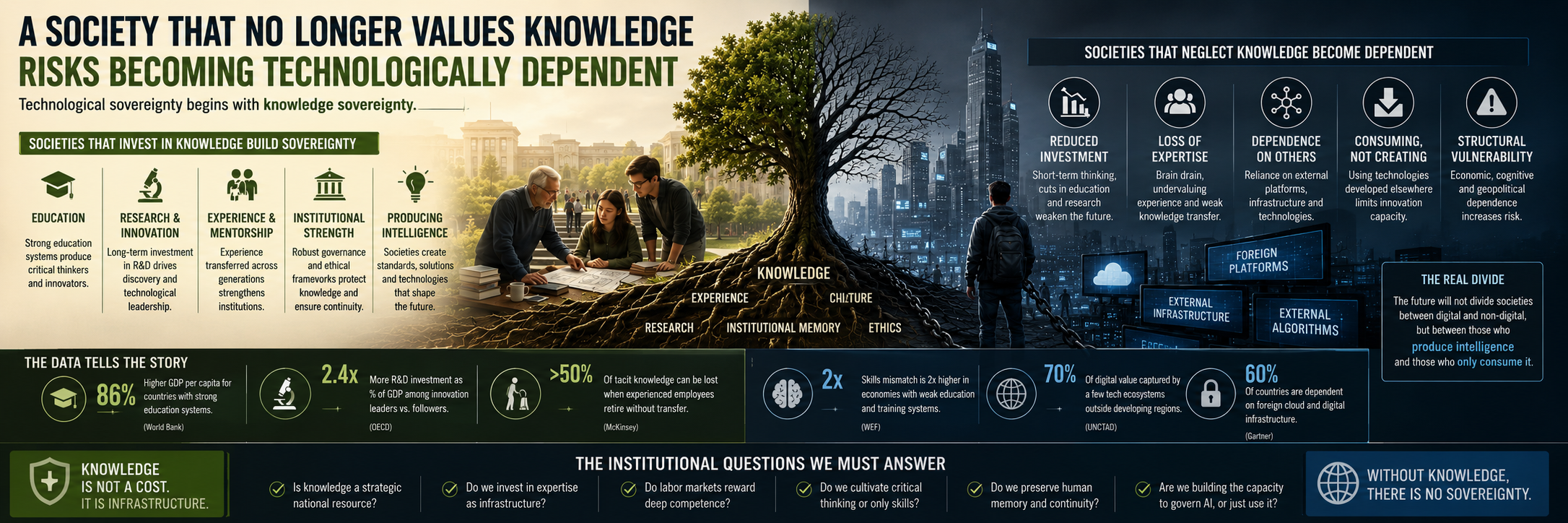
Perhaps this is why, after decades spent working with technology, I find myself increasingly interested in subjects that are not usually classified as technological at all: culture, education, governance, leadership, institutions, psychology, and human behavior.
Technology influences all of them.
But none of them can be reduced to technology.
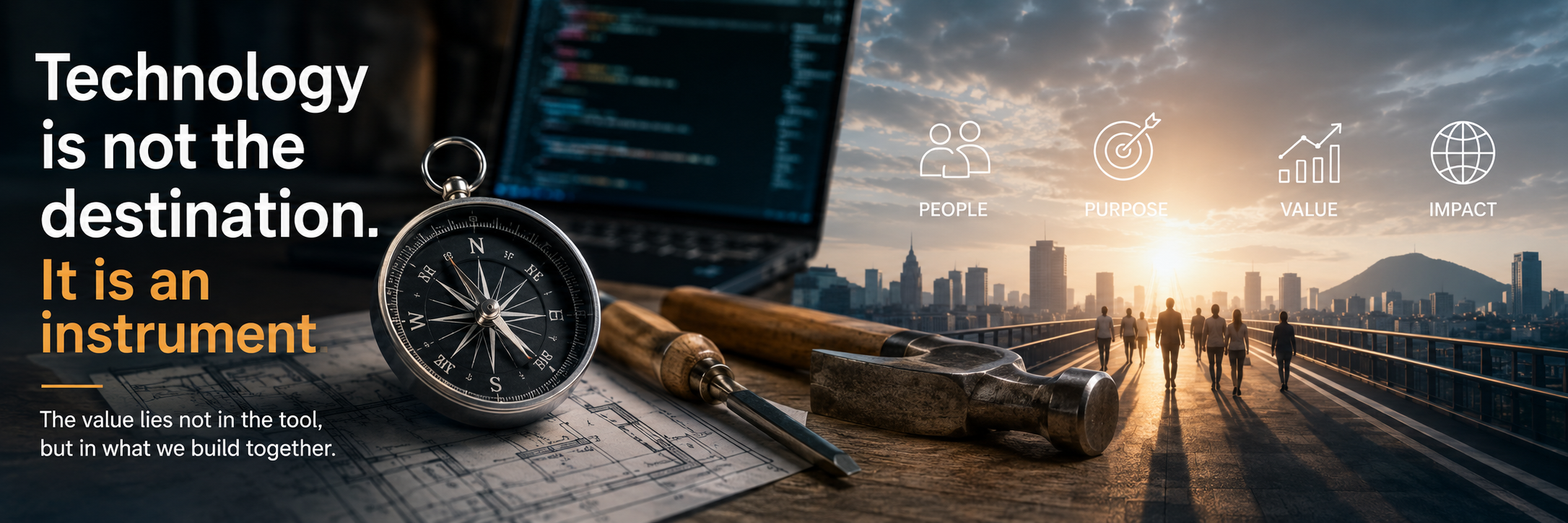
A cathedral is not remembered because of the tools used to build it.
The tools were indispensable, certainly. Without them the structure could not exist.
Yet history remembers the vision, the architecture, the purpose, and the human ambition embodied within the stone.
- The hammer mattered.
- The cathedral mattered more.
I suspect we are approaching a similar moment in our relationship with technology.
Organizations will continue investing in digital systems. Artificial intelligence will become increasingly powerful. New platforms will emerge. Existing professions will evolve.
But eventually the conversation will move beyond the technology itself.
It always does.
And perhaps that is the clearest sign that a technology has succeeded.
When people stop talking about the instrument and begin focusing entirely on what the instrument makes possible.