From knowledge scarcity to judgement scarcity
For most of my life, I have lived in a world in which knowing things mattered.
That may sound obvious. Of course knowledge matters. But I mean something more specific. Knowledge was scarce enough to create value in itself.
If you knew how a computer worked, you were valuable because most people did not. If you could write software, understand a telecommunications network, analyse a complex organisation, interpret a regulation or navigate a large technological system, that knowledge differentiated you from others.
I have watched this mechanism at work across very different environments: technology, corporations, universities and public institutions. The vocabulary changes, the structures change, the objectives change, but one principle has remained remarkably persistent.
Someone knows something that someone else does not.
And around that difference we build roles, professions, hierarchies and authority.
The engineer knows how the system works. The lawyer knows how the law works. The doctor knows how the body works. The academic knows a field of knowledge. The manager knows the organisation, its strategy and often information that is unavailable to those further down the hierarchy.
We rarely describe organisations this way, but they are partly architectures for distributing knowledge.
And knowledge, because it has historically been difficult to acquire, has also been a source of status.
Then artificial intelligence arrived.
And I increasingly wonder whether one of its deepest consequences will have very little to do with machines replacing people.
Perhaps the more important transformation is that intelligence itself — or at least many of the things through which we recognise intelligence — is becoming abundant.
That changes much more than productivity.
It changes the social value of knowing.
When I first encountered artificial intelligence many years ago, AI was fundamentally about encoding expertise. Expert systems were built around a very revealing assumption: there was valuable knowledge somewhere, usually inside the head of a specialist, and our challenge was to extract it, formalise it and make it computational.
The expert was still at the centre of the system.
The machine was trying to capture something scarce.
Today’s generative AI reverses the experience.
We no longer approach the machine primarily because we need to painstakingly encode an expert’s knowledge. We approach it because an extraordinary quantity of accumulated human knowledge has already become computationally accessible.
- Ask for an explanation.
- Ask for an analysis.
- Ask for some code.
- Ask for a translation.
- Ask for a business plan.
- Ask for a legal argument, a lesson, a strategy, a summary, a presentation.
Within seconds, something appears.
It may be excellent. It may be mediocre. It may even be completely wrong.
But that is not the sociological point.
The sociological point is that producing something that looks intelligent has become extraordinarily cheap.
And I think we have only begun to understand what that means.
Consider how we recognise expertise.
For centuries, societies have developed signals for it.
The book demonstrated scholarship. The beautifully constructed argument demonstrated education. The complex calculation demonstrated mathematical competence. The software demonstrated programming ability. The professional report demonstrated analytical capability.
Of course, these signals were never perfect. People have always been capable of sounding more knowledgeable than they really are.
But producing the signal itself required effort.
Now the relationship is breaking.
- A person who cannot program particularly well can produce working software.
- Someone with limited writing ability can produce elegant prose.
- A student who has barely understood a subject can submit a sophisticated essay about it.
- A manager can generate a strategic document without having performed the analysis that traditionally preceded such a document.
We therefore face a strange inversion.
The more easily we can produce the outward signs of competence, the less those signs necessarily tell us about competence.
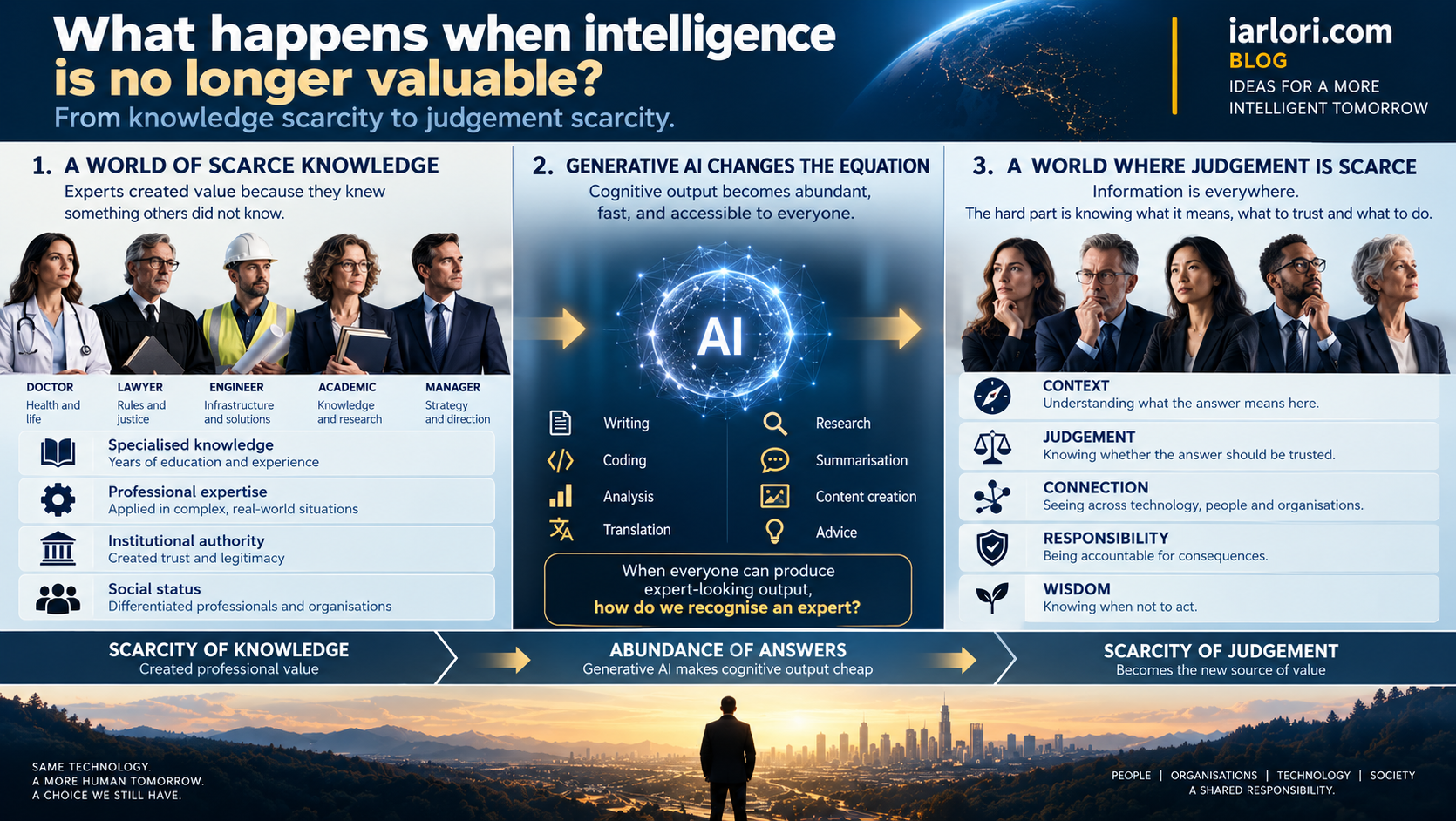
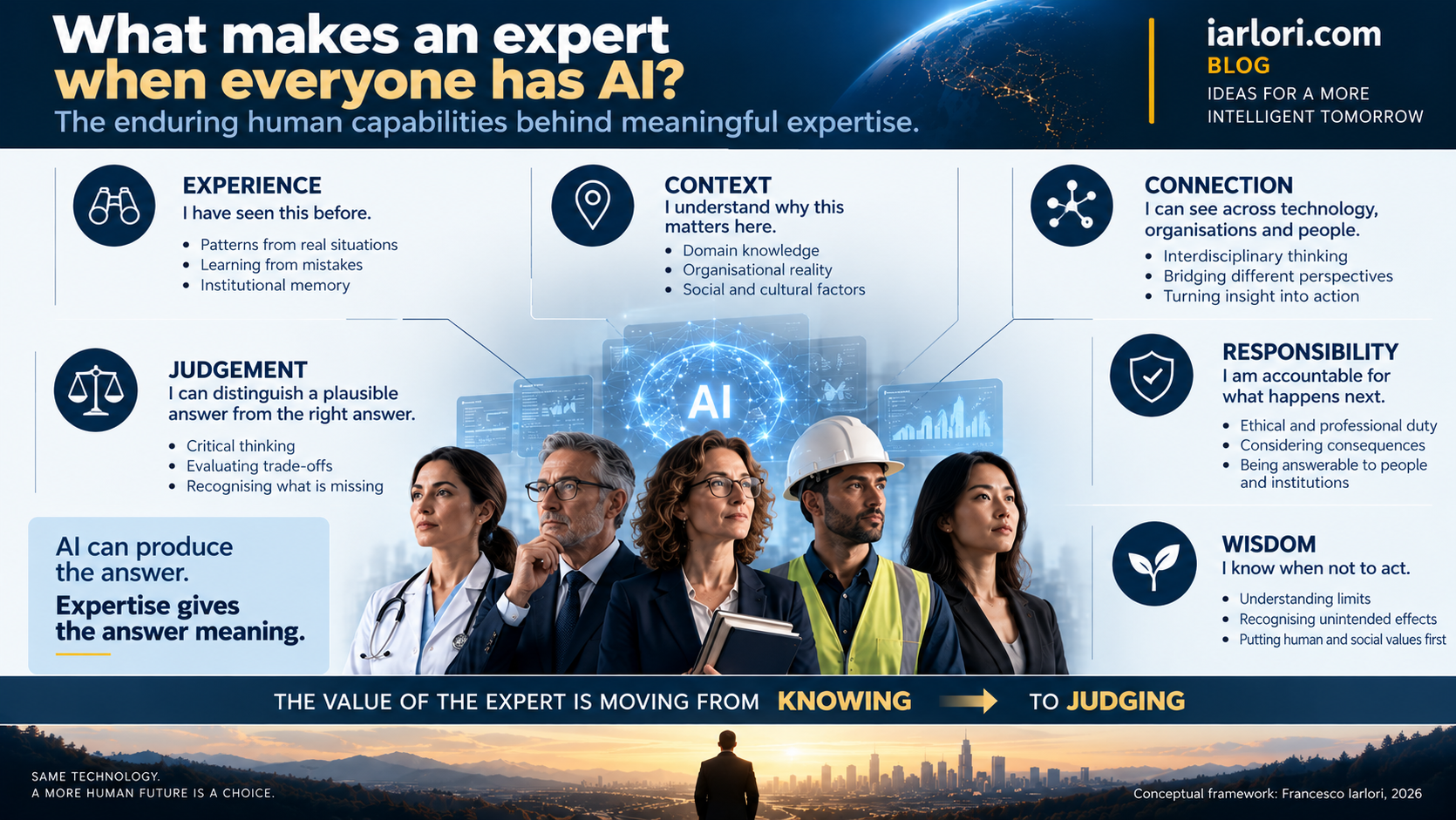
Figure 1 – Generative AI changes the scarcity on which professional expertise has traditionally been built. As cognitive output becomes abundant, value increasingly shifts from possessing and producing knowledge toward context, judgement, connection, responsibility and wisdom.
That interests me much more than the endless discussion about whether AI will eliminate this or that profession.
Because professions are not simply collections of tasks.
They are social constructions around knowledge, legitimacy and trust.
A doctor is not a doctor because she can generate a diagnosis. A lawyer is not a lawyer because he can produce a convincing legal paragraph. An engineer is not an engineer because she can calculate a load. A professor is not a professor because he can explain a theory.
Their professional legitimacy emerges from something larger: education, experience, institutional recognition, practice, responsibility and the accumulated judgement that comes from having encountered reality repeatedly.
AI can reproduce parts of the output.
It cannot automatically reproduce the social process through which we learned to trust the person producing it.
And that creates a problem.
The sociologist Max Weber understood how important specialised knowledge had become to modern institutions. Bureaucracies depend upon expertise. Modern organisations divide reality into areas of competence and assign people authority over them.
Pierre Bourdieu gives us another useful lens. Knowledge and education do not exist only as practical capabilities; they can become cultural and symbolic capital. They help determine position, recognition and status.
Michael Polanyi adds yet another dimension with his famous observation that we can know more than we can tell. Much of genuine expertise is tacit. It exists not in rules that can easily be written down, but in experience: recognising patterns, sensing anomalies, understanding context.
These ideas suddenly feel remarkably contemporary.
Because AI is forcing us to distinguish between knowledge that can be generated and judgement that must be exercised.
And perhaps this is where the real scarcity is moving.
I see this increasingly in organisations.
Two people can now sit in front of essentially the same AI system. They have access to the same model, the same interface and broadly the same computational capability.
Yet their results can be radically different.
One asks the obvious question.
The other realises that it is the wrong question.
One accepts the answer.
The other notices the assumption hidden inside it.
One sees a technically elegant solution.
The other remembers that the organisation tried something similar eight years ago and understands why it failed.
One optimises the process.
The other asks whether the process should exist at all.
One sees data.
The other sees the people represented — imperfectly — by that data.
The difference between these two people is difficult to capture in a benchmark.
But it may become one of the most valuable differences in the AI economy.
It is judgement.
And judgement is an unusual form of knowledge because it is deeply connected to experience, context and consequences.
This is also why I am increasingly uncomfortable with the expression AI expert.
Of course we need people who deeply understand models, architectures, data, security and AI engineering. Technical expertise remains essential.
But when AI enters an organisation, the most difficult problems very quickly stop being exclusively technical.
A system touches data.
Data touches processes.
Processes touch organisational structures.
Organisational structures touch incentives.
Incentives affect behaviour.
Behaviour affects people.
And eventually somebody has to decide who is responsible when something goes wrong.
Where, exactly, does IT stop and management begin?
Where does technology stop and organisation begin?
Where does automation stop and governance begin?
Increasingly, I am not sure these boundaries are useful.
I have spent much of my professional life moving between technology, business, organisations and institutions, and for many years this kind of profile could occasionally appear difficult to classify. Are you a technologist? A strategist? A manager? Someone concerned with organisations?
Perhaps that ambiguity is becoming an advantage.
Because the problems themselves are becoming ambiguous.
The professional who understands only the technology sees only part of the system. The manager who understands nothing about the technology also sees only part of it. The organisational specialist who ignores the data architecture is missing something. The engineer who ignores human behaviour is missing something equally important.
The interesting intelligence increasingly exists between disciplines.
And this may be one of the most important changes AI brings to professional life.
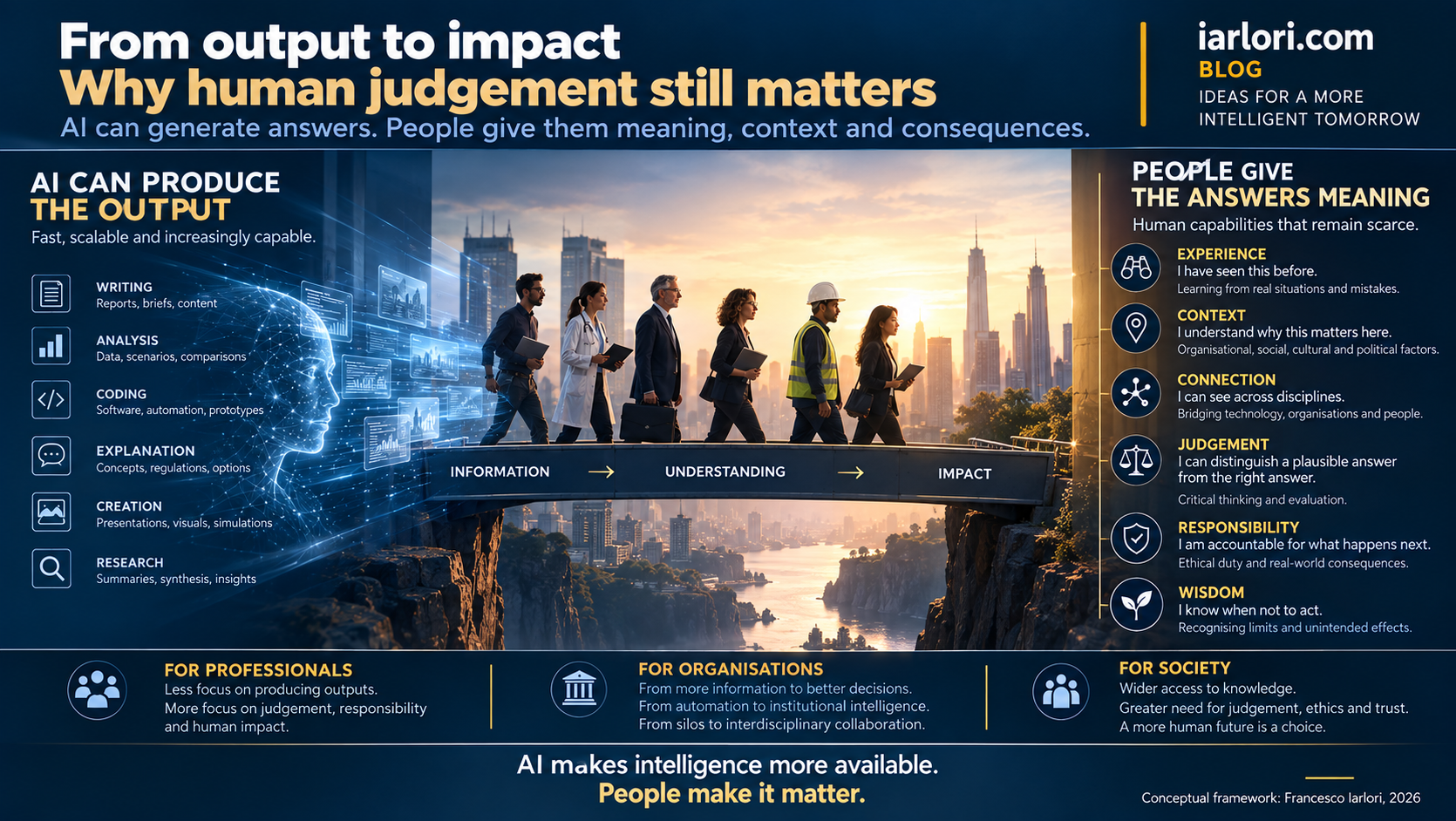
Figure 2 – As AI reproduces more of the visible outputs of professional competence, expertise does not disappear; its centre of gravity changes. Experience, context, interdisciplinary connection, judgement, responsibility and wisdom become increasingly important in giving machine-generated knowledge meaning.
There is also a more uncomfortable social question.
What happens to status when the capability on which that status was partly based becomes abundant?
We have seen this before.
Technological change does not merely eliminate activities. It changes what society rewards.
When photography appeared, being able to reproduce reality visually acquired a different meaning. When calculators became ubiquitous, performing arithmetic ceased to distinguish educated professionals in the way it once had. Search engines transformed the value of remembering certain kinds of information.
AI may produce a similar transformation across a much broader range of cognitive activities.
Writing will remain important.
Coding will remain important.
Analysis will remain important.
Knowledge will remain important.
But merely demonstrating these capabilities may no longer provide the same social signal.
This can be deeply unsettling.
Imagine spending twenty years developing a capability that forms part of your professional identity and then watching a machine produce something superficially similar in twenty seconds.
The reaction is not necessarily fear of unemployment.
It can be something more personal.
If the machine can do this, what exactly made me valuable?
Millions of people may quietly ask themselves some version of that question over the coming years.
And I don’t think we should dismiss it as resistance to technology.
It is a legitimate question about identity.
Work gives people more than income. It provides recognition, competence, belonging and often social status. If AI changes the relationship between expertise and recognition, its effects will therefore extend well beyond the labour market.
They will enter our understanding of ourselves.
Education will face the same problem.
We currently worry about students using AI to write essays.
That is understandable, but perhaps it misses the larger question.
Why did we ask students to write the essay?
If the purpose was to produce 2,000 words about a subject, AI has largely solved the problem.
But surely that was never the real purpose.
The purpose was to force the student to encounter ideas, organise them, struggle with contradictions, construct an argument and develop judgement.
The essay was evidence of a cognitive process.
AI can now produce the evidence without necessarily producing the process.
That means education cannot simply defend the old artefact.
It must rediscover the capability the artefact was supposed to demonstrate.
The same is true of professional work.
The report was not supposed to be valuable because organisations needed more PDFs.
The presentation was not valuable because society suffered from a shortage of PowerPoint slides.
The software was not valuable merely because we needed more lines of code.
These artefacts represented thinking.
Now that artefacts can increasingly be generated independently of that thinking, we have to become much more precise about what we actually value.
And there is an institutional danger here.
AI makes it possible for organisations to produce vastly more cognitive output.
- More analyses.
- More reports.
- More recommendations.
- More documents.
- More dashboards.
- More summaries.
- More scenarios.
- More communication.
We may interpret this as becoming more intelligent.
But an organisation drowning in machine-generated analysis is not necessarily an intelligent organisation.
It may simply be an organisation producing more information.
Indeed, one of the great ironies of the AI era could be that we solve the problem of insufficient information by creating an even larger problem of excessive apparent knowledge.
The scarce resource then becomes attention.
And after attention, interpretation.
And after interpretation, judgement.
An intelligent institution is not one that generates the largest number of answers.
It is one capable of determining which answers matter.
It must allow inconvenient knowledge to travel.
It must preserve institutional memory.
It must enable expertise from different domains to interact.
It must allow people to challenge automated conclusions.
And perhaps most importantly, it must preserve someone’s ability to say:
No.
Not because the algorithm is necessarily wrong.
But because optimisation is not the same thing as judgement.
This is where the discussion about humans and AI often becomes too simplistic.
We talk about keeping a “human in the loop” as though the physical presence of a human being automatically restores responsibility.
It does not.
A human clicking approve on a recommendation generated by a system they do not understand, under time pressure, without access to contradictory evidence and without meaningful authority to reject it is not exercising judgement.
They are performing a ritual.
Human judgement requires more than human presence.
It requires knowledge, authority, time, context and responsibility.
Figure 3 – AI can increasingly generate cognitive output at scale, but moving from information to understanding and from understanding to meaningful action remains an organisational and human process. The challenge is therefore not simply to produce more intelligence, but to connect it with judgement, responsibility and consequences.
That is why the future of AI cannot simply be designed as an interaction between a person and a model.
It must be designed as an interaction between people, technology and institutions.
Perhaps, then, we are using the wrong language when we say that AI is making intelligence cheap.
Human intelligence is not becoming cheap.
Something subtler is happening.
The production of intelligent-looking output is becoming abundant.
And abundance changes value.
When information became abundant, finding information became valuable.
When content became abundant, attention became valuable.
When computing became abundant, knowing what to build became valuable.
And as cognitive output becomes abundant, I suspect judgement will become increasingly valuable.
- Context.
- Experience.
- Connection.
- Responsibility.
- Wisdom.
Knowing when the answer is technically correct but institutionally wrong.
Knowing when the data says one thing but reality says another.
Knowing when efficiency should not be the objective.
Knowing when another profession needs to be involved.
Knowing when to act.
And knowing when not to.
These qualities are much harder to demonstrate than the traditional artefacts of knowledge.
Perhaps that is precisely why they will matter.
There is a final paradox.
For decades, we have invested enormous intellectual, technological and financial resources in trying to make machines more intelligent.
We measured progress by asking whether machines could perform more activities that previously required human cognition.
Now they can.
And they will undoubtedly become capable of much more.
But perhaps the most important question of the next phase will no longer be:
How intelligent can machines become?
It will be:
What becomes valuable when intelligence is everywhere?
My suspicion is that the answer will take us back toward qualities we have sometimes undervalued precisely because they were difficult to measure: experience, context, relationships, institutional memory, responsibility and judgement.
AI does not make expertise irrelevant.
It forces us to rediscover what expertise actually was.
And perhaps that is one of the more optimistic possibilities hidden inside this technological disruption.
If machines make the appearance of intelligence abundant, humans and institutions may finally have to become much better at distinguishing intelligence from knowledge, knowledge from expertise, expertise from judgement — and judgement from wisdom.
When everyone can produce an answer, the person who understands what the answer means becomes more important, not less.
And when intelligence is no longer scarce, perhaps wisdom finally becomes visible.