For most of modern history, knowledge was scarce, although not necessarily because information itself was unavailable. Books, archives, libraries and, more recently, databases have contained enormous quantities of information for centuries, but accessing information has never been the same thing as understanding it, connecting it to a particular problem and knowing how to use it in order to make a judgement or take a decision. What was genuinely scarce was therefore not information alone, but the human capacity to navigate complex bodies of knowledge, interpret them in context and transform them into action, and it was around this scarcity that modern societies constructed some of their most important institutions.
Universities did not simply transmit knowledge; they certified those who had acquired sufficient command of it to be recognised by society as specialists. Professional associations established boundaries around particular domains of competence, organisations created hierarchies in which experience and accumulated knowledge progressively translated into authority, and governments developed bureaucracies whose legitimacy depended partly upon the existence of specialised expertise. The doctor knew medicine, the lawyer understood the law, the engineer understood technical systems, the professor had accumulated knowledge through years of study and research, while the experienced manager was assumed to understand the organisation, its people and its mechanisms better than those who had only recently entered it. In each case, expertise was not merely a cognitive capability but also a social position, because knowledge produced authority and authority, in turn, helped to determine hierarchy, status and access to decision-making.
Artificial intelligence may now be beginning to disturb this relationship, not because machines suddenly possess all human knowledge, nor because experts are becoming unnecessary, but because significant portions of codified professional knowledge can increasingly be accessed, interpreted, combined and applied by people who have never passed through the institutions that traditionally controlled access to expertise. This may prove to be one of the most consequential sociological dimensions of artificial intelligence, yet much of the current debate remains concentrated on a narrower question: how many jobs AI will eliminate.
That question matters, but it may not be the most interesting one. The deeper question concerns what happens to a society when some of the cognitive capabilities around which it constructed education, professions, organisational hierarchy and institutional authority become dramatically easier to access. Sociology emerged in response to previous transformations of comparable magnitude, particularly industrialisation, urbanisation and the reorganisation of social life produced by modern institutions, and it may once again provide one of the most useful perspectives from which to understand what is happening.
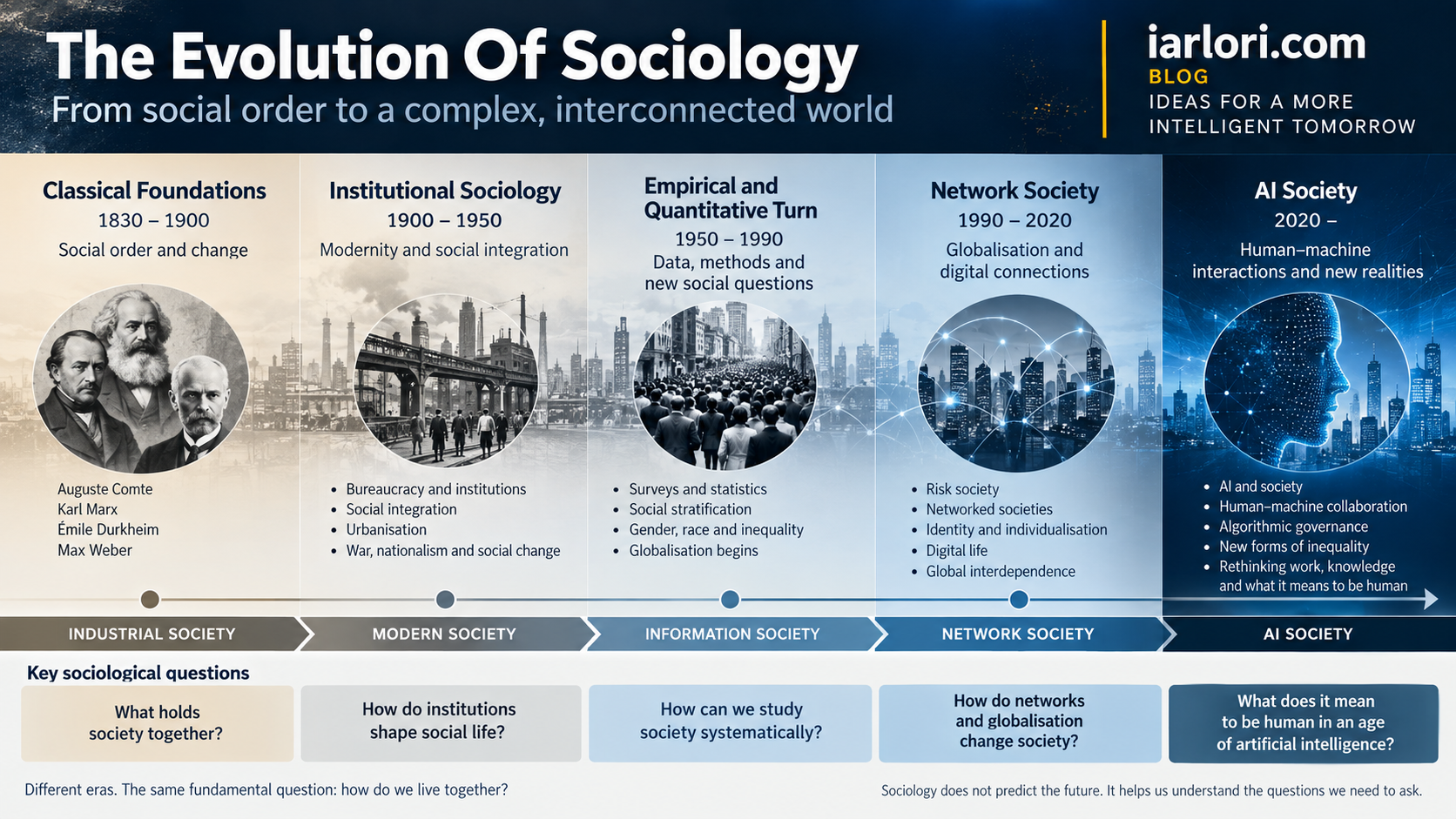
Figure 1. The Evolution of Sociology: from industrial society to the age of artificial intelligence.
From physical power to cognitive power
The Industrial Revolution mechanised physical capability and, in doing so, transformed the relationship between human beings and physical production. Machines could lift more than workers, manufacture objects faster, operate continuously and reproduce processes with levels of consistency that human labour could rarely achieve. Yet industrialisation did not eliminate hierarchy; in many respects, it reinforced a different hierarchy, because as physical labour became increasingly mechanised, education, technical knowledge and intellectual work acquired greater economic and social importance.
The development of the modern knowledge economy can be understood partly through this transition. Advanced societies gradually moved from economies dominated by physical production towards systems increasingly organised around information, services, professional expertise and coordination, and their institutions evolved accordingly. Large organisations became elaborate mechanisms for distributing specialised knowledge: finance departments understood financial resources, legal departments interpreted regulation and contracts, technology departments understood systems and infrastructure, operational units accumulated knowledge of processes, while senior management attempted to coordinate these different forms of expertise and transform them into organisational decisions.
The modern organisation therefore became, among many other things, a mechanism for organising human knowledge, and its hierarchy reflected the difficulty of acquiring, moving and coordinating that knowledge across institutional boundaries. The emergence of computing and later of global digital networks changed this architecture again, because information could increasingly be stored, copied, transmitted and retrieved at negligible marginal cost. The Internet made information abundant, but abundance did not necessarily make it intelligible. Search engines could help us locate documents, databases could preserve enormous quantities of records and networks could connect people across continents, but human beings were still largely responsible for interpreting what had been found and transforming information into knowledge relevant to a particular situation.
Artificial intelligence enters this historical progression at an unusually important moment because it does not primarily enter the territory of physical capability, nor does it simply increase the quantity or speed of information available to us. It enters precisely the territory that advanced societies progressively elevated as distinctively human and economically valuable: language, analysis, classification, interpretation, synthesis, programming, planning and, with all the necessary qualifications, elements of reasoning and decision support.
The difference is fundamental. Industrial machinery altered the economics of physical power, while digital networks altered the economics of information and communication. Artificial intelligence may now begin to alter the economics of cognitive capability itself. The sociological question consequently changes with each transition: industrialisation forced societies to reconsider labour, digitalisation forced them to reconsider information and networks, and AI may force them to reconsider knowledge, expertise and authority.
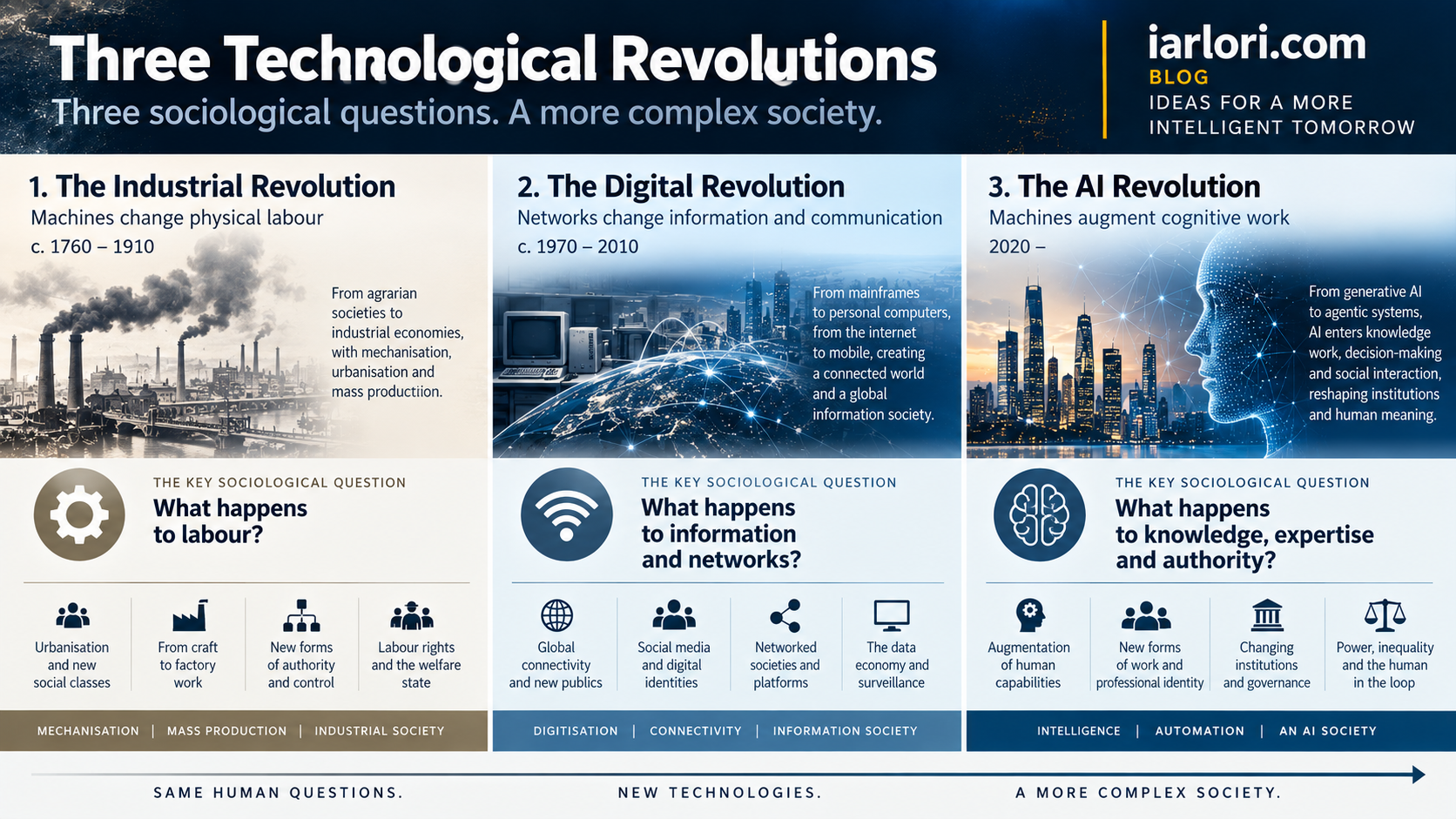
Figure 2. Three technological revolutions and the changing sociological questions they create.
Expertise was also an architecture of access
Becoming an expert has traditionally required much more than accumulating information. It required years of education, access to teachers and institutions, professional practice, repeated exposure to cases, interaction with other specialists and, perhaps most importantly, time. Expertise accumulated slowly, and because it accumulated slowly it created a considerable advantage for those who possessed it.
A citizen facing a complex legal problem could theoretically spend months reading legislation, precedents and legal commentary, but in practice consulted a lawyer because the lawyer possessed not merely the relevant information but an intellectual architecture for navigating it. The same principle applied to medicine, engineering, finance, technology and public administration. The value of the expert consisted partly in knowing what information mattered, where to find it, how different pieces of information related to one another and which interpretation was appropriate in a particular context.
Artificial intelligence begins to change the economics of this navigation. A person can increasingly interrogate large bodies of information through natural language; a junior employee can explore technical documentation without first mastering every component of the underlying system; a citizen can obtain an accessible explanation of complex regulation; a programmer can begin working in an unfamiliar language; a manager can investigate questions outside the boundaries of his or her original discipline; and a researcher can explore connections across fields at a speed that would previously have required days of searching and reading.
None of this turns the non-expert into an expert, and confusing access to AI with possession of expertise would be a serious mistake. An answer generated in seconds cannot reproduce years of professional experience, responsibility or contextual understanding. Nevertheless, something important happens when the distance between expert and non-expert begins to narrow, because social structures are often built not around absolute differences in capability but around the distance separating those who possess a scarce resource from those who do not.
Knowledge has historically been one of those resources, and the professions themselves can partly be understood as social arrangements constructed around its scarcity. If AI changes the cost of accessing and applying portions of professional knowledge, it may not abolish professional expertise, but it could change what society expects an expert to contribute.
When organisational memory becomes accessible
The implications become particularly interesting inside organisations. Imagine two employees, one of whom has spent twenty-five years inside an institution while the other arrived only three years ago. Traditionally, the experienced employee possessed an informational advantage that could not easily be replicated, because twenty-five years of organisational life had produced knowledge of procedures, previous decisions, failed projects, informal relationships, exceptions to formal rules, historical compromises and the countless practical details that explain why an institution behaves as it does.
Anyone who has spent significant time inside a large organisation will recognise this form of expertise. Some individuals exercise influence that cannot be understood simply by looking at their formal position in the organisational chart, because their real authority comes from knowing how the institution works, where information can be found, which procedure matters, whom to contact and what happened the last time somebody attempted something similar. Their knowledge is valuable precisely because much of it is difficult for others to access, and institutional memory consequently becomes not only an organisational asset but also a source of individual power.
Now imagine that decades of documents, decisions, procedures, regulations, correspondence, project reports and organisational history become searchable and interpretable through an intelligent institutional system. A relatively new employee might ask why a procedure was introduced, whether the organisation had previously encountered a particular problem, which regulations influenced an earlier decision, what comparable projects had been attempted, why they succeeded or failed and which people or organisational units had been involved.
The system would not reproduce twenty-five years of lived experience, but it might recover enough institutional memory to reduce substantially the informational asymmetry between the two employees. What changes in this situation is therefore not merely productivity, because the younger employee is not simply completing a task more quickly. The distribution of organisational knowledge itself is beginning to change, and when knowledge is redistributed inside an institution, power, authority and professional status may eventually be redistributed with it.
This is particularly significant for public institutions, which often possess extraordinary quantities of accumulated knowledge but struggle to make that knowledge available across organisational boundaries. A large public administration may contain thousands of professionals, millions of documents and decades of regulations, decisions, projects, datasets, precedents and accumulated experience, yet much of this intellectual capital remains fragmented across databases, document repositories, departments and individual memories. Some of it disappears whenever experienced employees retire or move elsewhere, while other parts remain technically preserved but practically inaccessible because nobody knows where to find them or how they relate to the problem currently being addressed.
The central problem is therefore often not that the institution lacks knowledge, but that it cannot transform the knowledge it already possesses into a collective capability. Seen from this perspective, the most interesting question is not whether public administrations will “adopt AI”, as though artificial intelligence were simply another generation of office technology. The deeper question is whether they will learn to connect fragmented organisational knowledge, professional expertise, institutional memory and computational capability in ways that allow the institution itself to become more intelligent.
The transition from artificial intelligence as a tool to institutional intelligence as an organisational capability is a much more profound transformation.
Weber in the age of artificial intelligence
This transformation also invites us to reconsider some of the foundations of modern bureaucracy. Max Weber understood bureaucratic organisation as a remarkably powerful system for coordinating complex societies through specialised competence, formal roles, procedures and legitimate authority. Modern institutions could operate at enormous scale precisely because responsibilities were divided among offices, each office had a defined sphere of competence, and the individuals occupying those offices possessed qualifications that justified their authority.
The relationship between knowledge and institutional position was therefore fundamental. Qualifications demonstrated competence, competence justified responsibility and responsibility legitimised authority. Much of the modern state and the modern corporation still rests on this architecture, even when contemporary organisations appear very different from the bureaucracies Weber observed.
Artificial intelligence introduces something unusual into this model because it creates the possibility of separating access to certain forms of institutional knowledge from the individuals and organisational units that traditionally carried them. Knowledge that once travelled vertically through managerial hierarchies or horizontally through professional networks may increasingly become accessible through computational systems capable of retrieving, connecting and interpreting information across organisational boundaries.
This does not imply the disappearance of bureaucracy, nor would it be desirable to replace institutional responsibility with algorithmic authority. Decisions made by public institutions and large organisations involve legitimacy, accountability, values and consequences that cannot simply be delegated to machines. What may change, however, is the informational architecture upon which bureaucracy has historically depended. If knowledge can move more freely across an institution, some organisational boundaries may become less important while other forms of responsibility become more important.
The question is therefore not whether Weber’s bureaucracy will be replaced by AI, but whether the relationship between knowledge, expertise and authority upon which bureaucratic organisation was constructed will remain unchanged when knowledge becomes computationally accessible.
The uncomfortable question about management
The same argument eventually reaches management itself. For decades, discussions about automation followed a relatively reassuring trajectory: machines would automate repetitive physical or administrative activities, while humans would progressively move towards higher-value intellectual work involving judgement, creativity and leadership. Managers and professional knowledge workers consequently appeared relatively protected from automation because they occupied precisely the cognitive territory into which workers were expected to migrate.
Generative AI makes this narrative considerably more complicated because a substantial part of managerial activity consists of processing and coordinating information. Managers read reports, summarise developments, prepare presentations, allocate activities, monitor progress, compare alternatives, organise meetings, translate information between organisational levels, prepare forecasts, write documents and communicate decisions. None of these activities constitutes the whole of management, but together they occupy a significant proportion of managerial time, and they are precisely the kinds of activities for which contemporary AI systems are becoming increasingly capable assistants.
The important question is therefore not whether AI can replace a manager. Framed in those terms, the discussion quickly becomes simplistic. The more interesting question is what happens to organisational structure when the cost of information processing and coordination falls dramatically.
The managerial hierarchy of the twentieth-century corporation was partly a response to an information problem. Information moved upwards through successive layers, where it was aggregated and interpreted, while decisions travelled downwards through the same structure and were translated into increasingly specific actions. Digital technologies have already weakened some of these informational constraints by allowing information to circulate directly across organisational levels, but AI could accelerate this process by making it possible not only to transmit information but also to interpret, summarise, compare and contextualise it automatically.
The organisation of the future may therefore not simply contain fewer people performing today’s jobs with greater productivity. It may require fewer intermediary structures between those who possess knowledge, those who make decisions and those who act upon them. If this occurs, the consequences will extend far beyond automation, because organisations will need to reconsider what management is actually for when some of the informational functions historically performed by management become increasingly computational.
This does not make leadership less important. It potentially makes the distinction between management as information processing and leadership as judgement, responsibility, direction and meaning much more visible.
The return of tacit knowledge
There is an obvious danger in this argument. If AI makes knowledge more accessible, one might conclude that expertise itself is becoming less valuable, yet I suspect that the opposite may ultimately occur. Artificial intelligence may force us to distinguish much more carefully between information, explicit knowledge and genuine expertise, revealing that many of the capabilities we previously grouped together under the word “knowledge” are fundamentally different.
Michael Polanyi’s concept of tacit knowledge becomes particularly important here because human beings routinely know more than they can formally articulate. An experienced surgeon does not merely possess a database of medical facts, just as an experienced engineer does not simply remember technical specifications and a senior public official does not understand an institution merely because he or she has read its procedures. Expertise emerges through accumulated experience, pattern recognition, context, relationships, intuition, judgement and the gradual construction of mental models that allow an individual to recognise what matters in situations that are never completely identical to those encountered before.
Perhaps most importantly, experienced professionals often know when the formally correct answer is not the appropriate answer. They understand consequences that are not visible in the data, recognise political or institutional constraints that have never been documented, detect weak signals that would appear insignificant to someone without experience and know when an apparently rational decision would damage trust, legitimacy or human relationships.
If artificial intelligence makes explicit knowledge increasingly abundant, these tacit dimensions of expertise may become more rather than less important. Knowing what may become cheaper and knowing how may become increasingly assisted, while knowing when to act, why a particular interpretation matters, which consequences deserve attention and whether an action should be taken at all may become central to the meaning of professional expertise.
AI may therefore not eliminate expertise. It may reveal which parts of what we called expertise were consequences of information scarcity and which parts represented genuine judgement.
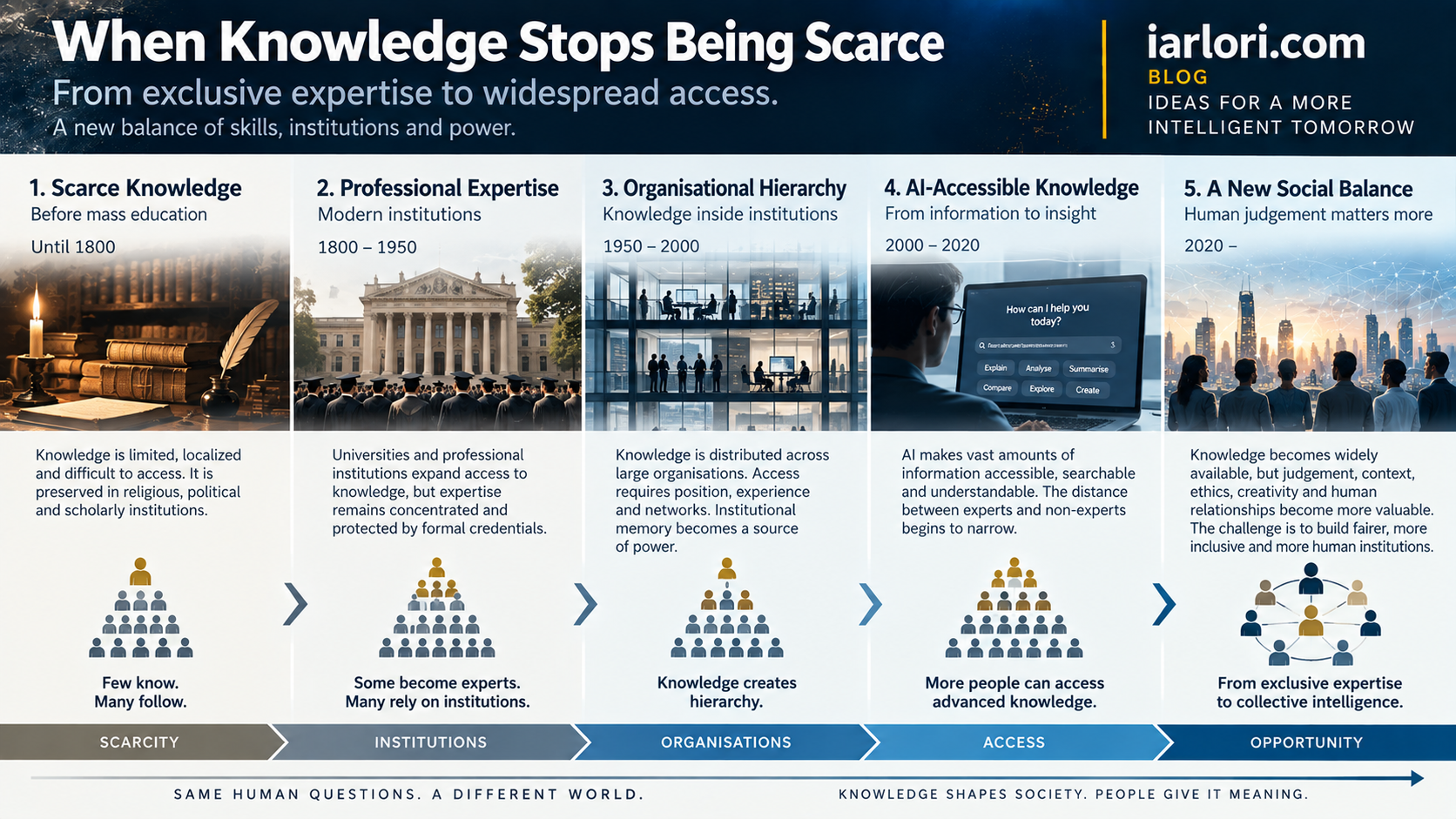
Figure 3. When knowledge stops being scarce: the transition from exclusive expertise to distributed access and collective intelligence.
A new sociology of knowledge
This brings us to a larger question that cannot be answered simply by counting jobs at risk of automation. Modern societies have organised education, professions, management and institutional authority around an assumption that has rarely needed to be stated explicitly: advanced knowledge is scarce, difficult to acquire and unevenly distributed. The possibility that sophisticated cognitive assistance could become widely available challenges that assumption, and its effects may extend far beyond productivity into the mechanisms through which societies allocate status, organisations construct hierarchy, universities define their role, professions defend their boundaries and individuals establish credibility.
The university, for example, cannot be understood only as a mechanism for transmitting information, because information is already abundant and AI will make explanation increasingly abundant as well. Its enduring value may therefore shift even more towards developing judgement, intellectual discipline, critical reasoning, scientific method and the ability to distinguish plausible answers from reliable knowledge. Education in such a world does not become less important; rather, an educational system designed primarily around the reproduction of information becomes increasingly difficult to justify when machines can reproduce, summarise and explain information almost instantaneously.
Professional authority may undergo a similar transformation. Experts will increasingly encounter clients, citizens, colleagues and patients who arrive having already explored their problem with AI. Sometimes those individuals will be better informed; sometimes they will possess an impressive collection of sophisticated misunderstandings. In either case, the relationship changes because the professional no longer begins from the assumption that specialised information is inaccessible to the person sitting on the other side of the table. Authority will consequently need to rest increasingly on the capacity to interpret, validate, contextualise and assume responsibility for knowledge rather than merely possessing privileged access to it.
Organisational authority may change too. If employees can access institutional knowledge directly, hierarchy can no longer justify itself simply through privileged access to information. Managers may increasingly have to demonstrate their value through judgement, direction, responsibility, trust and the capacity to create meaning from information rather than merely controlling its circulation.
There is, however, a profound paradox at the centre of this apparent democratisation. Artificial intelligence could simultaneously distribute cognitive capability and concentrate technological power. Individuals may gain access to analytical and linguistic capabilities that were once available only to specialists or large organisations, while the computational infrastructure enabling those capabilities remains concentrated in a relatively small number of companies and countries. Knowledge could therefore become more distributed at the level of use while the infrastructure of intelligence becomes more concentrated at the level of production.
The sociology of AI will consequently need to examine not only the relationship between humans and machines but also the institutions, infrastructures and concentrations of power through which machine intelligence is produced and distributed. Who controls the models, computational resources, data and interfaces through which increasingly large portions of society access knowledge will become as important as what those systems themselves are capable of doing.
This tension between cognitive democratisation and infrastructural concentration may become one of the defining political and sociological questions of the AI era.
When intelligence stops being scarce
We continue to ask whether artificial intelligence will replace human beings, but replacement may be the wrong conceptual framework. Technologies rarely transform society simply by substituting one thing for another; they change relationships, alter the cost of previously scarce capabilities and eventually make organisational structures that once appeared natural seem historically contingent.
The printing press did not simply replace scribes; it changed who could access knowledge and ultimately transformed religion, science, education and political authority. Industrial machinery did not merely replace physical labour; it reorganised production, cities, families, class structures and political institutions. The Internet did not simply replace letters and newspapers; it changed the economics of communication and reorganised entire industries around new relationships between information, networks and power.
Artificial intelligence may need to be understood in similar terms. Its deepest sociological consequence may not be that machines become intelligent enough to replace people, but that cognitive capabilities which societies spent centuries treating as scarce become sufficiently abundant to change the institutions constructed around their scarcity.
When knowledge is difficult to obtain, those who possess it acquire authority. When information is difficult to coordinate, organisations create managerial layers to coordinate it. When expertise is difficult to access, professions develop strong boundaries around it. When institutional memory resides primarily in individuals, experience becomes a form of organisational power. If AI changes these conditions, it will inevitably change some of the structures built upon them.
The decisive question will then no longer be simply what artificial intelligence can do, but what remains distinctively valuable when intelligence itself becomes easier to access.
Perhaps this is where the real disruption begins, because the AI revolution may ultimately force us to rediscover something that the knowledge economy occasionally encouraged us to forget: human value has never consisted simply in possessing information. It lies in our ability to interpret experience, exercise judgement, assume responsibility, understand context, create meaning and decide what ought to be done when knowledge alone cannot provide the answer.
The Industrial Revolution forced humanity to reconsider the value of physical labour in a world of increasingly powerful machines. The digital revolution changed our relationship with information by making communication and access global, immediate and increasingly abundant. Artificial intelligence may now force us to reconsider the value of cognitive labour in a world in which sophisticated cognitive capability itself becomes increasingly accessible.
If that is what is happening, AI is not simply transforming work, automating tasks or introducing another generation of technological tools into organisations. It is beginning to change the relationship between knowledge and authority, between expertise and access, between hierarchy and information, and ultimately between intelligence and human value.
It is beginning to transform the sociology of knowledge itself.
References and intellectual foundations
Weber, Max. Economy and Society (1922).
For the discussion of bureaucracy, specialised competence, legitimate authority and the relationship between knowledge and organisational position.
Polanyi, Michael. The Tacit Dimension (1966).
For the distinction between explicit and tacit knowledge, and the idea that human expertise includes forms of knowledge that cannot be completely articulated or codified.
Bell, Daniel. The Coming of Post-Industrial Society (1973).
For the transition from industrial production towards a society increasingly organised around knowledge, professional expertise and information.
Castells, Manuel. The Rise of the Network Society (1996).
For the transformation from hierarchical industrial structures towards information networks and digitally interconnected societies.
Burrell, Jenna & Fourcade, Marion. “The Society of Algorithms.” Annual Review of Sociology (2021).
For a contemporary sociological perspective on algorithms, expertise, classification and the changing distribution of power in digital societies.
These works provide some of the sociological foundations for the argument developed here; the interpretation of their relevance to artificial intelligence, organisational intelligence and the changing scarcity of cognitive capability is my own.