When Process Replaces Thinking: The Quiet Rise of Procedural Intelligence

There is a moment, subtle, almost imperceptible, that occurs in many organisations today. It happens in meetings that run flawlessly, in conferences that feel professionally orchestrated, in initiatives that follow well-established frameworks. Everything appears to function exactly as intended. Time is respected, formats are clear, outputs are produced.

And yet something is missing.

Artificial Intelligence, Labor, and the Reconfiguration of Economic Growth

Artificial intelligence is not merely a technological innovation. It represents a structural shift in how societies produce value, organize labor, and ultimately generate economic growth. In previous industrial transitions, machines replaced human physical effort while leaving cognitive work largely intact. Today, AI operates in a different domain: it targets repetitive cognition, the predictable patterns of thinking that underpin a large portion of modern economic activity.

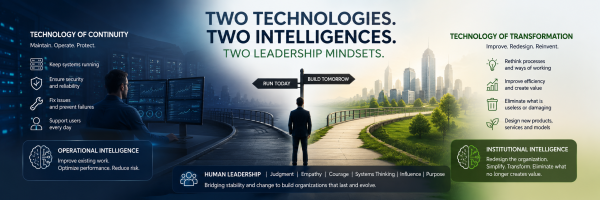
The IT Department Is Dead. Long Live the Organization.

We treated technology as a toolset—servers, networks, applications—something to be deployed, maintained, and occasionally fixed. The IT department became the custodian of this machinery: provisioning access, patching vulnerabilities, restoring what was broken.

But something fundamental changed.

Technology stopped being infrastructure and became cognition.

Algorithms don’t just execute—they decide.
Systems don’t just store—they interpret.
Platforms don’t just connect—they shape behavior.

And yet, we are still organizing ourselves as if “thinking with machines” were a specialized function delegated to a single department.

It is not.

It never was.

The Translation Problem: Why Technical Excellence Is No Longer Enough

Most careers in technology follow a trajectory that appears both logical and rewarding. You begin as an engineer, you deepen your expertise, you become senior, and eventually you take responsibility for teams, systems, and increasingly complex architectures. Over time, you learn how to design for scale, how to optimize performance, how to manage constraints and trade-offs within highly structured environments.

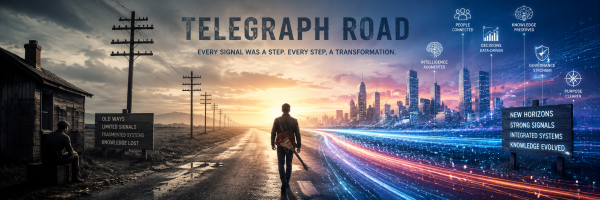
Seeing the Light: From Disney’s Lanterns to Artificial Intelligence as Institutional Infrastructure.

Stories often prepare society for transformations long before technology makes them real. In the lantern scene of Tangled, accompanied by the song I See the Light, the moment of illumination is not just emotional—it is structural. Rapunzel moves from observing distant lights from a tower to inhabiting a world reorganized by them. The shift is subtle but profound: what once appeared as scattered signals becomes the architecture of her environment. Today something similar is happening with Artificial Intelligence. AI is no longer merely a tool augmenting human activity; it is gradually becoming an infrastructural layer embedded in organizations, governance systems, and knowledge flows.

When Intelligence Stops Being Scarce

For centuries, human institutions have been structured around a fundamental constraint: intelligence was scarce. Expertise resided in individuals, knowledge accumulated slowly, and organizations had to create mechanisms to manage this scarcity. Hierarchies emerged because information moved slowly through organizations. Departments were created because expertise was fragmented. Procedures and bureaucratic processes evolved because complex decisions required coordination among people who could not easily access all the relevant information. In this sense, institutions, from governments to corporations, were architectural responses to the limits of human cognition. Their structures reflected the fact that analysis was slow, expertise was specialized, and decision-making required time.

Managerial Ecosystems, SME Dominance, and Political Intermediation: A Structural Interaction

In SME-dominant economies, the structure of firms interacts with the structure of political representation.

When the productive fabric is highly fragmented – composed largely of small and family-controlled firms – political systems often reflect that fragmentation. Electoral incentives encourage responsiveness to organized micro-interests rather than to long-term structural transformation.