AI adoption is accelerating while skills remain scarce, companies cannot find workers, productivity growth is weak and the workforce is ageing
Too Few Workers, Too Much Work, and the Coming AI Economy
For much of the public debate, artificial intelligence and employment are discussed through a deceptively simple question: how many jobs will AI destroy?
It is an understandable question. Generative AI can already write, translate, analyse documents, generate software, summarise complex information and perform tasks that only a few years ago appeared firmly within the domain of human knowledge workers. As AI agents become more capable of executing sequences of activities rather than responding to individual prompts, the concern becomes even more intuitive.
But in Italy, this may be the wrong question.
The Italian economy is entering the AI transition with an unusual combination of conditions: an ageing population, labour shortages, relatively weak productivity growth, a shortage of digital skills, millions of small and medium-sized enterprises, and organisational structures that have often changed more slowly than technology.
Against this background, AI may not create an economy with too few jobs.
It may become necessary because Italy increasingly has too few people, with the right skills, doing too much work through organisational models designed for another era.
That changes the nature of the debate.
The real issue is not simply whether artificial intelligence replaces labour. It is whether Italy can use artificial intelligence to redesign work, increase productivity and preserve economic capacity while its demographic and skills base changes.
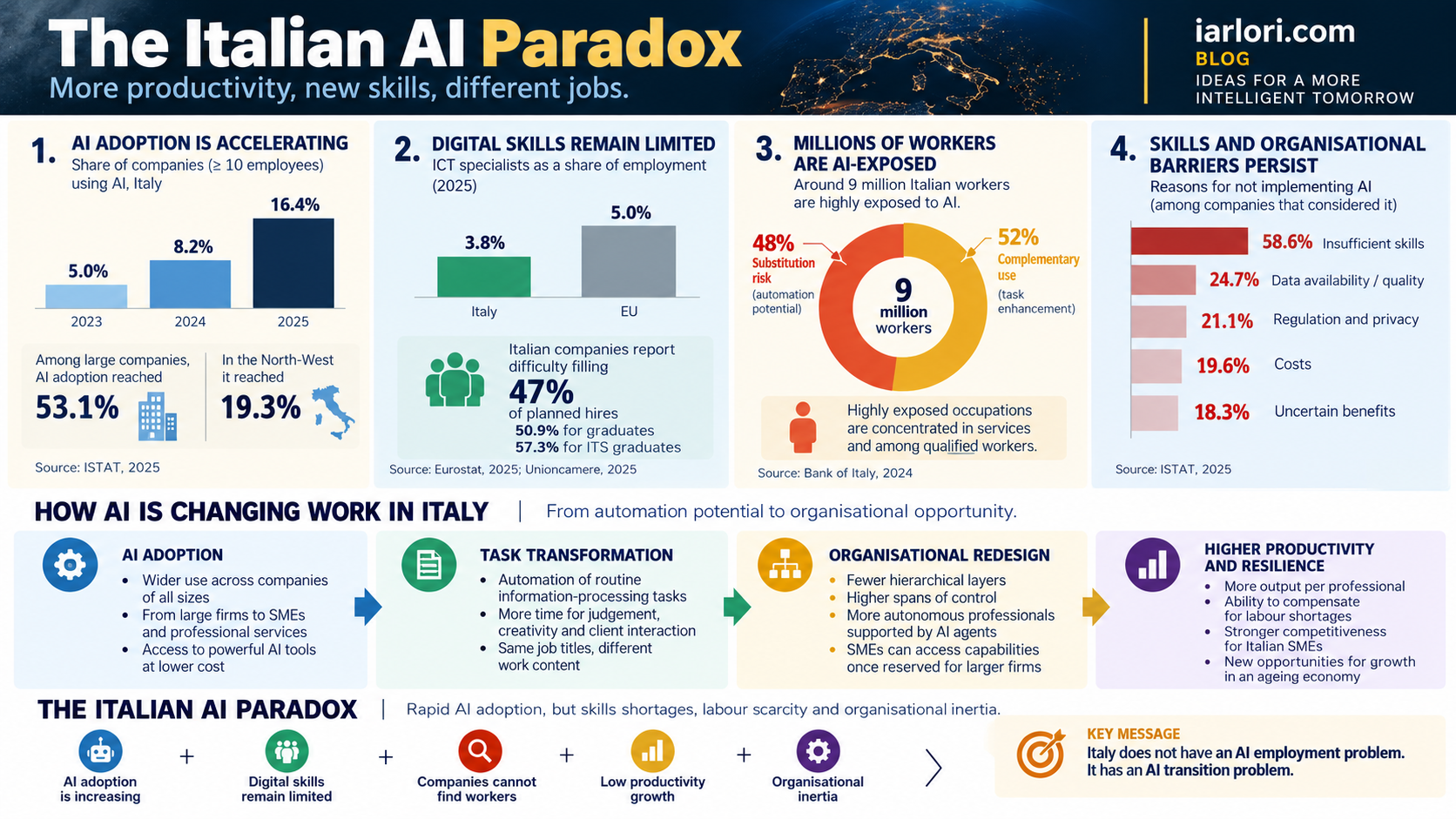
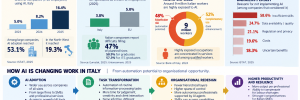
Figure 1 – The Italian AI Paradox. AI adoption is accelerating while digital skills remain scarce, companies struggle to find workers, productivity growth remains weak and organisational inertia persists. The challenge is therefore not simply employment displacement, but the transition towards AI-augmented work and redesigned organisations.
Sources: ISTAT; Eurostat; Unioncamere; Banca d’Italia. Author’s elaboration.
AI adoption is no longer hypothetical
The first important change is that AI has moved from experimentation to adoption.
According to ISTAT, the percentage of Italian enterprises with at least ten employees using artificial intelligence doubled from 8.2% in 2024 to 16.4% in 2025. Among large enterprises, adoption reached 53.1%. In North-West Italy, it reached 19.3%.
These numbers are significant not simply because they show growth. They tell us that AI is beginning to leave the innovation laboratory and enter ordinary economic activity.
And this transition is likely to accelerate.
The cost of accessing sophisticated AI capabilities has fallen dramatically. A small professional firm can now use language models, coding assistants, document-analysis systems and increasingly AI agents without building its own artificial-intelligence infrastructure.
This matters enormously in Italy.
The Italian economy is not composed primarily of multinational corporations employing tens of thousands of people. Its distinctive productive structure includes a very large population of SMEs, family businesses, professional practices and highly specialised companies.
Historically, size has imposed limitations on these organisations.
A small company cannot easily maintain departments dedicated to market intelligence, advanced analytics, communications, legal research, software development, internationalisation and strategic planning.
AI begins to alter that equation.
A company does not need to become large to gain access to capabilities that were previously economical only at scale.
This may ultimately prove to be one of AI’s most consequential effects on the Italian economy.
The Italian paradox: companies need people they cannot find
There is another reason why the conventional automation narrative fits Italy poorly.
Italian companies are already struggling to recruit.
Unioncamere’s Excelsior data indicate that employers had difficulty finding candidates for around 47% of planned hires in 2025. The mismatch becomes even more pronounced for some qualified profiles: difficulties were reported for approximately half of graduate hires and an even larger share of ITS graduates.
At the same time, Italy remains behind the European average in the availability of digital specialists. Eurostat reported that ICT specialists represented 3.8% of Italian employment in 2025, compared with 5.0% across the European Union.
Put these facts together and an interesting contradiction emerges.
Italy worries that machines may take people’s jobs while companies simultaneously report that they cannot find enough people with the skills they need.
This is not an argument that technological displacement cannot happen. It can, and almost certainly will in particular activities.
But it suggests that the macroeconomic question is considerably more complicated.
In an economy facing demographic contraction and skills shortages, automation can be both a displacement mechanism and a response to scarcity.
We therefore need to distinguish between replacing a worker and replacing a task.
Jobs are bundles of tasks
This distinction is fundamental.
We tend to talk about occupations as indivisible entities: accountant, programmer, civil servant, lawyer, journalist, engineer, consultant.
But economically, a job is a bundle of activities.
Consider an accountant. Part of the work consists of collecting information, checking documents, reconciling data, identifying anomalies, preparing reports, communicating with clients and exercising professional judgement.
AI does not need to “replace the accountant” to transform this occupation.
If it automates or accelerates document classification, information retrieval, reconciliation and preliminary analysis, the remaining human work changes.
The title may remain exactly the same.
The job does not.
Research by the Bank of Italy illustrates the importance of this distinction. It has estimated that around nine million Italian workers are highly exposed to AI, with more than half in occupations where AI is expected to be complementary to human work rather than simply substitutive. Exposure is particularly significant in services and qualified occupations.
This produces an apparently counter-intuitive result.
The workers most exposed to artificial intelligence are not necessarily those whose jobs are most likely to disappear.
In many cases, they are precisely the people whose work contains the greatest amount of information processing — and therefore the greatest potential for augmentation.
Two workers with the same job may no longer be economically equivalent
Imagine two professionals with comparable education, experience and job titles.
One continues to search manually through documents, prepare first drafts, construct routine analyses and retrieve information from multiple systems.
The other works with an AI environment that performs much of the preliminary research, compares documents, identifies inconsistencies, produces initial analyses and prepares drafts.
The second professional does not necessarily work fewer hours.
Instead, those hours can migrate towards judgement, negotiation, interpretation, relationships, creativity and decisions.
Their professional title remains identical.
Their productive capacity does not.
This suggests that one of the important divisions in the future labour market may not simply be between high-skilled and low-skilled workers.
It may increasingly be between:
AI-augmented workers and non-AI-augmented workers.
And eventually between organisations capable of augmenting their workforce and those unable to do so.
That distinction matters because technology alone does not produce productivity.
The bottleneck is moving from technology to organisation
AI systems are becoming remarkably accessible.
Organisational transformation is not.
ISTAT’s data provide an important clue. Among Italian enterprises that had considered using AI but had not implemented it, 58.6% identified insufficient skills as an obstacle. Other barriers included data availability and quality, regulatory and privacy concerns, costs and uncertainty regarding benefits.
The scarcity, therefore, is gradually shifting.
For decades, sophisticated computing capacity itself was scarce. Organisations with better technology possessed an advantage because competitors could not easily reproduce it.
Generative AI changes this.
Increasingly, organisations can access similar foundation models, cloud infrastructure and AI services.
The differentiating factor becomes the organisation’s ability to integrate intelligence into work.
- Where should an AI agent operate?
- Which information should it access?
- Which decisions can it prepare?
- Which decisions can it execute?
- When must a human intervene?
- Who remains accountable?
- What knowledge must remain within the organisation rather than being delegated to a machine?
These are not primarily software questions.
They are questions of organisational architecture.
And this is where the Italian AI transition could succeed or fail.
AI could change the economics of being small
This question is particularly important for Italy because of its productive structure.
For decades, Italian SMEs have demonstrated that small organisations can be extraordinarily competitive when they possess specialised knowledge, craftsmanship, flexibility and strong industrial networks.
But smallness also creates costs.
A small enterprise cannot distribute specialised functions across thousands of employees. Expertise is concentrated in a few individuals. Management bandwidth is limited. Internationalisation is expensive. Data analysis is often rudimentary. Knowledge may remain tacit rather than institutionalised.
AI can potentially reduce some of these disadvantages.
Imagine a twenty-person manufacturing company capable of deploying AI for multilingual commercial communication, technical-document analysis, supplier monitoring, regulatory research, knowledge management and preliminary market intelligence.
It has not become a multinational.
But its functional capacity has expanded.
The same could happen in professional services.
A five-person consultancy supported by AI agents for research, analysis, documentation and knowledge retrieval may be capable of undertaking work that previously required a considerably larger organisation.
AI therefore does something economically interesting.
It does not merely reduce labour requirements.
It may reduce the minimum organisational scale required to possess sophisticated capabilities.
For an economy dominated by SMEs, that could be transformational.
The forgotten labour-market question: management
Much discussion about AI focuses on programmers, administrative employees, customer-service workers and creative professionals.
Less attention is paid to management.
Yet organisations themselves are information-processing systems.
A considerable amount of managerial work exists because information must move through hierarchies. Employees report to managers; managers aggregate information; reports travel upwards; decisions travel downwards; meetings synchronise knowledge across organisational boundaries.
AI can reduce the cost of many of these processes.
Agents can monitor workflows, synthesise information, identify exceptions, coordinate activities and make organisational knowledge available without requiring every piece of information to travel vertically through a hierarchy.
This does not imply that management disappears.
Leadership, accountability, conflict resolution, institutional judgement and responsibility remain deeply human functions.
But some of the information-processing justification for managerial layers may weaken.
The result could be flatter organisations with wider spans of control and more autonomous professionals.
In other words, AI may transform organisational charts before it eliminates entire professions.
For Italy, where improving productivity has been a persistent economic challenge, this deserves considerably more attention.
Productivity is the real question
Italy’s long-standing productivity problem makes the AI debate different from that of an economy experiencing rapid productivity growth.
The objective cannot simply be to automate what organisations already do.
If an inefficient process is automated, we may simply obtain an efficiently executed inefficient process.
Real productivity gains require something more difficult: redesigning the process itself.
That means asking why an activity exists, what information it requires, where decisions should be taken, which controls remain necessary and what humans should contribute once machines can perform much of the underlying information processing.
This distinction is particularly important in public administration.
Using generative AI to draft the same document slightly faster produces an efficiency improvement.
Redesigning the entire information flow through which knowledge is found, verified, interpreted, approved and communicated can produce an organisational transformation.
The first saves minutes.
The second changes institutional capacity.
Demography changes the meaning of automation
There is also a longer-term issue that Italy cannot avoid.
Italy is ageing.
As the working-age population contracts, the country will have to maintain companies, public services, healthcare, infrastructure and economic activity with a different demographic structure.
Under those circumstances, the relationship between automation and employment changes fundamentally.
We may eventually discover that the critical question was never:
How many jobs can AI replace?
It was:
How much economic and institutional capacity can Italy preserve because AI allows fewer people to accomplish more?
This does not eliminate the social consequences of technological change.
Some occupations will contract. Entry-level roles may change substantially. Skills will become obsolete. New inequalities may emerge. Workers whose activities are easily automated may face difficult transitions.
These effects require serious labour policy, education, reskilling and social dialogue.
But attempting to preserve every existing task would be equally dangerous.
In a shrinking workforce, refusing productivity-enhancing technologies can itself have social consequences.
Education will have to change too
There is another uncomfortable implication.
If AI performs more of the routine cognitive work traditionally assigned to junior employees, how do people become senior experts?
A young lawyer learns partly by reviewing documents. A junior consultant learns partly by conducting research. A young programmer learns partly by writing relatively straightforward code. A civil servant acquires institutional knowledge through apparently ordinary administrative work.
These activities may be precisely those most easily delegated to AI.
Removing them without redesigning professional development could create an expertise paradox:
AI makes experienced workers more productive while weakening the pathway through which inexperienced workers become experienced.
This is not a reason to prohibit automation.
It is a reason to rethink education, apprenticeship and professional development.
The future labour market cannot simply teach people to “use AI”.
It must teach them to develop judgement in an environment where AI already exists.
That is a much harder educational problem.
From employment policy to transition policy
This brings us back to the initial question.
Will AI destroy jobs in Italy?
Almost certainly some.
Will it create others?
Almost certainly.
But counting jobs created and destroyed may tell us surprisingly little about the transformation underway.
The deeper changes will occur inside occupations, companies and institutions.
Some tasks will disappear.
Others will become more valuable.
Some professional boundaries will blur.
Small organisations will acquire capabilities once associated with large organisations.
Management structures may become flatter.
Human judgement may become more valuable precisely because routine cognitive production becomes cheaper.
And the ability to organise human and artificial intelligence together may become a significant source of competitive advantage.
The principal danger for Italy, therefore, may not be technological unemployment.
It may be asymmetric transformation.
Some companies will redesign themselves around AI while others merely add a chatbot.
Some professionals will become dramatically more capable while others continue working through processes designed for the twentieth century.
Some public institutions will convert AI into institutional capacity while others will automate fragments of bureaucracy without changing the bureaucracy itself.
That would produce a new divide — not between organisations that possess AI and those that do not, but between those that have learned how to organise around intelligence and those that have not.
Italy does not have an AI employment problem. It has an AI transition problem.
That distinction matters.
The objective of public policy should not be to maximise automation. Nor should it be to minimise it.
The objective should be to increase the capacity of workers, companies and institutions to move from automation to augmentation, and from augmentation to organisational redesign.
Italy possesses some unusual advantages for this transition: specialised industrial knowledge, strong professional traditions, entrepreneurial SMEs, manufacturing ecosystems and enormous stores of tacit expertise.
But these advantages will matter only if that knowledge can be combined with new forms of machine intelligence.
The organisations that succeed will not necessarily be those that replace the most people.
They will be those that discover the best answers to three increasingly important questions:
What should machines do?
What should humans continue to do?
And how should organisations change when intelligence itself becomes increasingly abundant?
That is not merely a debate about the future of jobs.
It is a debate about the future architecture of the Italian economy.
Sources & Further Reading
- ISTAT — Imprese e ICT, Anno 2025. Particularly important for the essay: AI adoption among Italian enterprises with 10+ employees rose from 5.0% in 2023 to 8.2% in 2024 and 16.4% in 2025; adoption reached 53.1% among large enterprises and 19.3% in North-West Italy. ISTAT also identifies lack of skills as the leading barrier among firms that considered AI but did not adopt it (58.6%). Istat
ISTAT — Imprese e ICT 2025 - Banca d’Italia — Dalla Zuanna, Dottori, Gentili & Lattanzio, Una valutazione dell’esposizione del mercato del lavoro all’intelligenza artificiale in Italia, Questioni di Economia e Finanza No. 878, October 2024. This is the key source for the argument about task exposure versus job substitution. The study estimates roughly nine million highly AI-exposed Italian workers, with more than half in occupations where AI is potentially complementary to their work. Bank of Italy
Banca d’Italia — AI exposure in the Italian labour market - Eurostat — Number of ICT specialists in the EU continues to grow, 27 May 2026. In 2025 ICT specialists represented 5.0% of total EU employment, compared with only 3.8% in Italy, placing Italy among the EU countries with the lowest shares. European Commission
Eurostat — ICT specialists in the EU - Eurostat — Employed information and communications technology (ICT) specialists, 2025 dataset. Useful as the underlying statistical dataset for the Italy/EU comparison and for extending the analysis over time. European Commission
Eurostat — ICT specialists dataset - Unioncamere / Ministero del Lavoro — Sistema Informativo Excelsior 2025. Provides the evidence for Italy’s labour-market mismatch: 47% of profiles sought by companies were difficult to recruit, rising to 50.9% for graduates and 57.3% for ITS Academy graduates. Unioncamere
Unioncamere — Excelsior 2025 skills mismatch
A note on evidence and perspective – The analysis presented here draws on three complementary forms of knowledge: empirical evidence, published research, and more than thirty years of direct professional experience with technological and organisational transformation. Statistics can tell us where adoption, employment and skills are moving. Research helps us understand the mechanisms behind those changes. Long-term market experience provides another perspective: technologies rarely transform economies simply because they become available. Their effects emerge through organisations, business models, institutions, skills and the way people redesign work around them. The Italian AI paradox developed in this essay should therefore be read as an interpretation of the evidence through that combined lens.