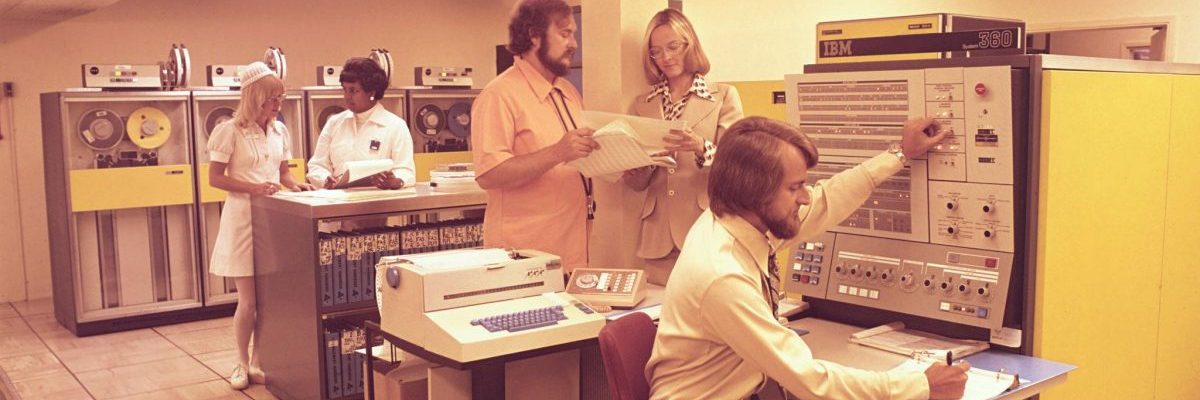
 For decades, we built organizations around a convenient illusion: that technology lived somewhere else.
Down the corridor.
Behind a ticketing system.
Inside the “IT department.”
That illusion is now collapsing.
Not because IT failed—but because it succeeded too well.
The Great Misplacement of Intelligence
We treated technology as a toolset—servers, networks, applications—something to be deployed, maintained, and occasionally fixed. The IT department became the custodian of this machinery: provisioning access, patching vulnerabilities, restoring what was broken.
But something fundamental changed.
Technology stopped being infrastructure and became cognition.
Algorithms don’t just execute—they decide.
Systems don’t just store—they interpret.
Platforms don’t just connect—they shape behavior.
And yet, we are still organizing ourselves as if “thinking with machines” were a specialized function delegated to a single department.
It is not.
It never was.
The Quiet Death of the IT Department
Let’s be precise: the IT department is not disappearing—it is shrinking into its lowest form.
What remains is the maintenance layer:
- Fixing malfunctioning systems
- Managing outages
- Ensuring compliance
- Keeping legacy alive
This is the dark side of technology—not morally dark, but structurally regressive.
A cost center of entropy management.
But the real power of technology has moved elsewhere.
Not into a new department.
Into every department.
The Rise of Distributed Intelligence
Marketing is now algorithmic experimentation.
Finance is probabilistic modeling.
HR is behavioral analytics.
Operations is optimization under uncertainty.
Every function is becoming a computational discipline.
This is not about “using AI tools.”
It is about adopting:
- Algorithmic reasoning
- Data-driven decision structures
- Feedback loops instead of static processes
- Simulation instead of intuition alone
In other words: technology is no longer a layer—it is the logic of the organization itself.
From Utopia to Acceleration
This is not a new idea.
Years ago, I described this as a kind of organizational utopia—a system where technology would dissolve into the fabric of decision-making, where departments would no longer “use” systems but think through them.
At the time, it sounded abstract. Premature. Even unrealistic.
What has changed is not the vision.
What has changed is the speed of its realization.
Artificial Intelligence is not the origin of this shift—it is the accelerator.
It compresses timelines.
It exposes structural weaknesses.
It forces organizations to confront what was previously avoidable.
What was once theoretical is now unavoidable.
CXOs Are Next …
If IT as a centralized function is dissolving, the same fate awaits the traditional CxO model.
Because CxOs were designed to coordinate silos.
But when intelligence becomes distributed, silos become incoherent.
The organization becomes a single cognitive system.
And in a cognitive system, fragmented authority is friction.
From Authority to Architecture
The future is not “more powerful IT” or “smarter executives.”
It is better architecture.
Not org charts – but:
- Decision architectures
- Data architectures
- Governance architectures
- Learning architectures
The question is no longer:
“Who owns technology?”
But:
“How is intelligence structured across the organization?”
The New Literacy
There is one implication most organizations are still unwilling to face.
If technology is the language of modern organizations, then every person must be literate in it.
Not as specialists.
Not as developers.
But as participants in a cognitive system.
Just as reading and writing became non-negotiable during the industrial and post-industrial eras, algorithmic and technological understanding becomes the new baseline literacy.
Every department.
Every role.
Every individual.
Because you cannot operate inside a system you do not understand.
And you cannot make decisions inside a system that is making decisions with you—if you cannot interpret its logic.
The Real Transformation
Most organizations will resist.
They will:
- Rename IT to “Digital”
- Create AI task forces
- Launch innovation labs
All of this preserves the illusion.
Because it keeps intelligence localized, instead of making it universal.
The real transformation is harsher:
It demands that thinking itself becomes a shared, structured, and technologically mediated capability across the entire organization.
A Final Provocation
If your IT department disappeared tomorrow, would your organization stop functioning?
If the answer is yes, you have a dependency problem.
If the answer is no, you may already be transitioning.
But here is the harder truth:
If your people cannot read the systems they rely on,
cannot question the outputs they receive,
cannot reason with the tools they use—
then the organization is not evolving.
It is being operated.
The IT department is not the future.
It is the residue of a past where technology was external.
The future belongs to organizations where technology is indistinguishable from reasoning itself –
and where every individual is expected to think in that language.