The Arrive
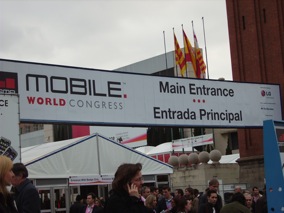
Mobile World Congress 2009 – Main Entrance
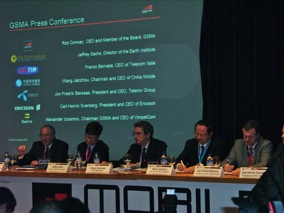
- Rob Conway, CEO of the GSMA
- Alexander Izosimov, Chairman of the GSMA and CEO of VimpelCom
- Wang Jianzhou, Chairman and CEO of China Mobile
- Jeffrey Sachs, Director of The Earth Institute and Special Advisor to United Nations Secretary-General Ban Ki-moon
- Jon-Fredrik Baksaas, President and CEO of Telenor
- Carl-Henric Svanberg, President and CEO of Ericsson
- Franco Bernabè, CEO of Telecom Italia
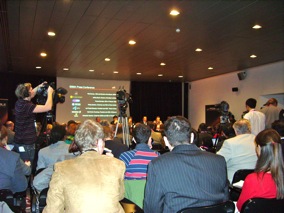 The discussion centred on strategies for sustaining economic growth. They explored how widespread mobile broadband adoption could stimulate growth and aid global recovery from the economic crisis. Wang Jianzhou, CEO of China Mobile, discussed his company’s investment in mobile infrastructure in China and its advantages.
A new report by Professor Leonard Waverman and consultancy LECG for the GSMA, representing the global mobile industry, predicts that the introduction of new spectrum for mobile broadband services in 2009 will boost China’s GDP by $211 billion and India’s by $95 billion. This rollout will create hundreds of thousands of jobs, foster new businesses across the value chain, enhance productivity and increase consumer spending.
Given the mobile industry’s limited capacity to provide economic stimulus, governments must adopt policies that encourage investment in mobile services and networks. Ideally, governments should establish a stable regulatory environment and license spectrum on favourable terms to stimulate spending on network infrastructure and services, ultimately driving economic growth.
Furthermore, harmonising spectrum allocation among governments in a region is crucial. This harmonisation allows compatible devices to be used across various countries, enabling manufacturers to achieve economies of scale and lower prices for consumers.
The transition to digital television presents a unique opportunity to make low-frequency spectrum – radio waves that travel long distances and penetrate building walls – accessible for mobile broadband services. This spectrum, freed up by the analogue TV switch-off, includes 400MHz. The GSMA suggests allocating 100MHz to facilitate the development of affordable mobile broadband networks.
For instance, deploying a mobile broadband network on 700MHz spectrum can be 70% cheaper than using the 2100MHz spectrum supporting most current 3G networks. This makes rural areas and other underserved regions economically viable for mobile broadband. Furthermore, providing mobile broadband coverage is significantly more cost-effective than installing a new fixed-line connection.
The discussion centred on strategies for sustaining economic growth. They explored how widespread mobile broadband adoption could stimulate growth and aid global recovery from the economic crisis. Wang Jianzhou, CEO of China Mobile, discussed his company’s investment in mobile infrastructure in China and its advantages.
A new report by Professor Leonard Waverman and consultancy LECG for the GSMA, representing the global mobile industry, predicts that the introduction of new spectrum for mobile broadband services in 2009 will boost China’s GDP by $211 billion and India’s by $95 billion. This rollout will create hundreds of thousands of jobs, foster new businesses across the value chain, enhance productivity and increase consumer spending.
Given the mobile industry’s limited capacity to provide economic stimulus, governments must adopt policies that encourage investment in mobile services and networks. Ideally, governments should establish a stable regulatory environment and license spectrum on favourable terms to stimulate spending on network infrastructure and services, ultimately driving economic growth.
Furthermore, harmonising spectrum allocation among governments in a region is crucial. This harmonisation allows compatible devices to be used across various countries, enabling manufacturers to achieve economies of scale and lower prices for consumers.
The transition to digital television presents a unique opportunity to make low-frequency spectrum – radio waves that travel long distances and penetrate building walls – accessible for mobile broadband services. This spectrum, freed up by the analogue TV switch-off, includes 400MHz. The GSMA suggests allocating 100MHz to facilitate the development of affordable mobile broadband networks.
For instance, deploying a mobile broadband network on 700MHz spectrum can be 70% cheaper than using the 2100MHz spectrum supporting most current 3G networks. This makes rural areas and other underserved regions economically viable for mobile broadband. Furthermore, providing mobile broadband coverage is significantly more cost-effective than installing a new fixed-line connection.
Supporting Quotes
“For mobile broadband to be a mass-market service worldwide and powerful engine of economic growth, the mobile industry needs both a stable regulatory climate and access to the right spectrum on the right terms,” said Rob Conway, CEO and Member of the Board of the GSMA. “Wherever possible, governments need to allocate the same chunks of spectrum as other countries in their region, enabling equipment manufacturers to gain economies of scale by producing mobile broadband handsets, computers and other devices that will work in many different markets.” “If the mobile industry can continue to grow and develop at the rate it has over the past 15 years, it could act as one of the few locomotives which can help pull our economies out of the current slump,” said Alexander Izosimov, Chairman of the GSMA and CEO of VimpelCom. “Governments need to adopt policies that nurture this potential, rather than stifling it.” “The rolling out and operation of 3G networks in China will create 300,000 job opportunities directly and indirectly,” said Wang Jianzhou, Chairman and CEO of China Mobile. “On the one hand, 3G investments will directly boost the development of the telecom manufacturing industry; on the other hand, 3G handsets and 3G applications will drive consumer spending and help companies through the difficulties brought by the financial crisis.”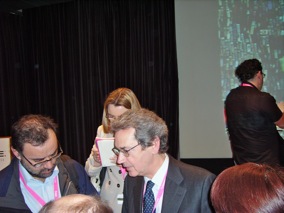
Franco Bernabe’ with the Press
On Tuesday morning at the GSMA Mobile World Congress, three mobile operator leaders addressed the question of whether to halt future investments or expansion or adopt new growth strategies amidst uncertain economic conditions. César Alierta, executive chairman of Telefónica, Vittorio Colao, CEO of Vodafone and Jon Fredrik Baksaas, president and CEO of Telenor all agreed that mobile telecoms will be crucial to economic recovery and the industry must continue its growth plans.
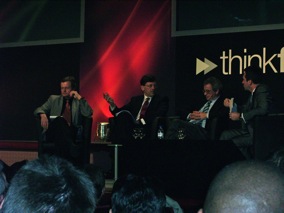 “We are the perfect ally for governments to lead global economic growth,” said Alierta, “and there is an unclear estimation of our ability to improve the economic situation.” Central to this perspective was that mobile operators must deliver what the customer wants. “Our success will come from providing the consumer with a much better experience based upon providing value,” said Alierta. This theme received support from Vodafone’s Colao, who said that operators have many of the essential assets to deliver customer value. “These are a combination of affordability, trust, ease-of-use and relevance, together with speed and ubiquity. We must also be smarter in how we co-operate with content suppliers, device vendors and equipment manufacturers.” Looking at the investment options, Colao warned about putting the brakes on. “We should have a common technology roadmap, and look more closely at sharing towers and possibly fibre.” However, he warned about the need for a level-playing field with regard to competition. “We should not ask for protection, this might lead to short-term gains, but it undermines trust.”
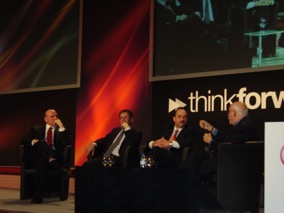 Then Steve Ballmer was participating in the panel discussion on the “open mobile ecosystem”, alongside Nokia chief Olli-Pekka Kallasvuo and AT&T head Ralph de la Vega, who used the occasion to inadvertently announce Dell’s imminent smartphone.
“Open means different things to different people,” Ballmer said. “To some people, open means open source. It means more than that and different than that to me. Open can mean an open platform that people can extend, or it can mean open standards that are baked in. Ultimately the companies that succeed will be open, maybe in different ways and at different times.”
To Ballmer, “open” refers to “the power and success of the partner ecosystem approach [that Microsoft] pioneered at the beginning of the PC revolution”.
Then Steve Ballmer was participating in the panel discussion on the “open mobile ecosystem”, alongside Nokia chief Olli-Pekka Kallasvuo and AT&T head Ralph de la Vega, who used the occasion to inadvertently announce Dell’s imminent smartphone.
“Open means different things to different people,” Ballmer said. “To some people, open means open source. It means more than that and different than that to me. Open can mean an open platform that people can extend, or it can mean open standards that are baked in. Ultimately the companies that succeed will be open, maybe in different ways and at different times.”
To Ballmer, “open” refers to “the power and success of the partner ecosystem approach [that Microsoft] pioneered at the beginning of the PC revolution”.
NFC & QR Code status
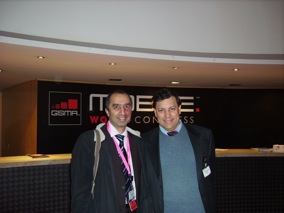
Francesco Iarlori & Nav Bains
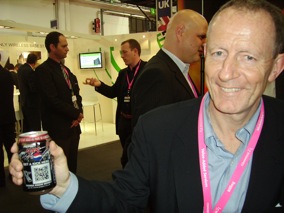
Many people have reported manifesting out of the Congress over the past few days. Could there be a more suitable location for the antennas and electromagnetic pollution?
.jpg)
Telefonica Workers
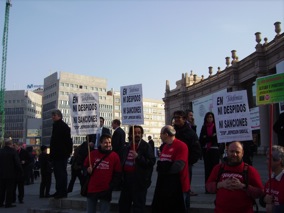
Telefonica Workers