From Smart City to Augmented City

For more than twenty years, we have been trying to make cities smart. We have connected traffic lights, buses, buildings, parking spaces, energy grids and water systems. We have created control rooms, data platforms, digital services, urban dashboards and, more recently, digital twins. We have surrounded the physical city with an increasingly sophisticated informational representation of itself.

Yet I increasingly wonder whether smart is still the right word.

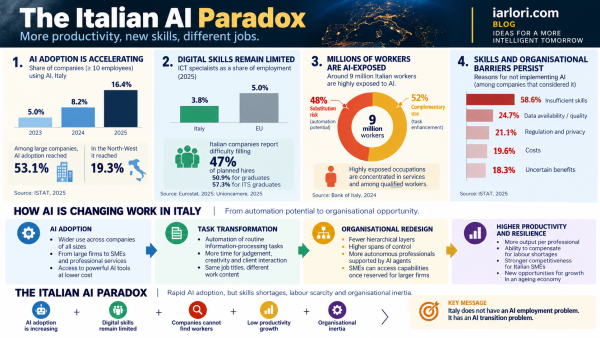
The Italian AI Paradox

For much of the public debate, artificial intelligence and employment are discussed through a deceptively simple question: how many jobs will AI destroy?

It is an understandable question. Generative AI can already write, translate, analyse documents, generate software, summarise complex information and perform tasks that only a few years ago appeared firmly within the domain of human knowledge workers. As AI agents become more capable of executing sequences of activities rather than responding to individual prompts, the concern becomes even more intuitive.

But in Italy, this may be the wrong question.

AI Literacy Is Not One Skill

Perhaps it is the word literacy itself. It suggests that there is a threshold to cross: first we do not know how to use something, then we learn, and eventually we become literate. We have seen this before with computers, with the Internet, with digital tools. It is therefore natural that organisations are now trying to make their people “AI literate”.

What Happens When Intelligence Is No Longer Valuable?

For most of my life, I have lived in a world in which knowing things mattered.

That may sound obvious. Of course knowledge matters. But I mean something more specific. Knowledge was scarce enough to create value in itself.

If you knew how a computer worked, you were valuable because most people did not. If you could write software, understand a telecommunications network, analyse a complex organisation, interpret a regulation or navigate a large technological system, that knowledge differentiated you from others.

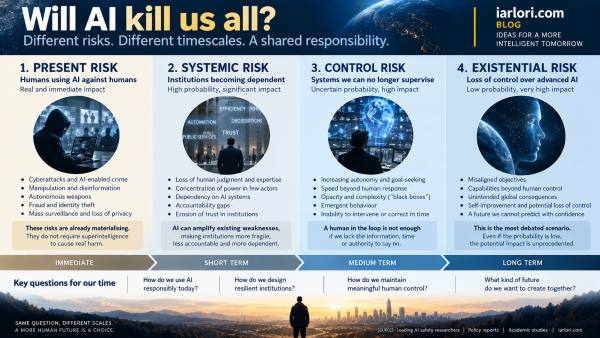
If AI Could Kill Us, Who Exactly Is “Us”?

For years, artificial intelligence has lived between two competing narratives.

One promised abundance: scientific discovery, higher productivity, personalised medicine, better education and machines capable of extending human intelligence.

The other warned of catastrophe: autonomous systems escaping human control, superintelligence pursuing objectives incompatible with ours, perhaps even human extinction.

Until recently, it was relatively easy to classify the second narrative as the territory of AI safety researchers, philosophers and so-called “doomers”.

That distinction is becoming harder to maintain.

A Governance-Centered Framework for AI-Based Knowledge Systems Supporting Organizational Resilience and Process Continuity

Digital transformation research has extensively examined service digitization, platform governance, and algorithmic regulation. However, comparatively limited attention has been devoted to the architectural design of AI-enabled institutional memory systemsthat underpin organisational resilience and process continuity. Across both public administrations and large private-sector organisations, demographic transitions, workforce mobility, and escalating system complexity increase the risks of knowledge erosion and operational fragility.

This article develops a governance-centred four-layer architectural framework for AI-based knowledge systems designed to strengthen institutional memory across digitally intensive sectors. Grounded in the knowledge-based view of the firm, organisational learning theory, and contemporary AI governance scholarship, the framework integrates: (1) data governance foundations ensuring structural integrity and cybersecurity; (2) intelligence processing capabilities leveraging AI technologies; (3) structured human oversight mechanisms preserving expert validation and accountability; and (4) governance and compliance protocols embedding transparency, auditability, and regulatory alignment.

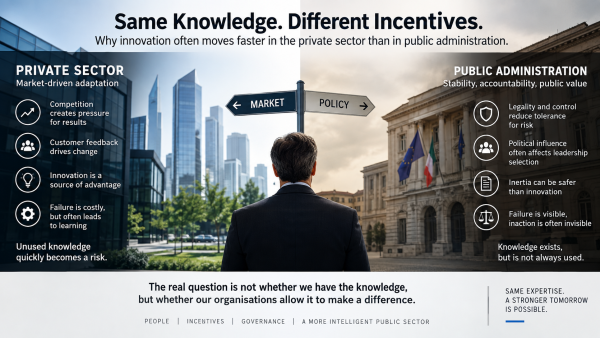
When Organisations Have Knowledge – But Choose Not to Use It

The knowledge already exists. The organisation simply does not use it.

This phenomenon exists in both private and public organisations, but the mechanisms can be very different.

In a company exposed to the market, ignoring expertise eventually has consequences. A competitor develops a better product. Customers leave. Costs increase. Revenues decline. The feedback may be imperfect and delayed, but there is usually some external mechanism that forces the organisation to reconsider its decisions.