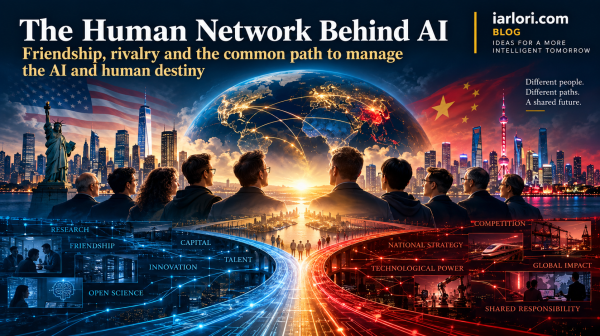
The Human Network Behind AI

Peter Thiel, Elon Musk and Reid Hoffman emerged from overlapping Silicon Valley entrepreneurial networks. Musk and Sam Altman became part of the group that created OpenAI in 2015, together with Greg Brockman, Ilya Sutskever and others. Sutskever would eventually leave OpenAI and establish Safe Superintelligence. Dario and Daniela Amodei left OpenAI and created Anthropic. Demis Hassabis, Mustafa Suleyman and Shane Legg had already created DeepMind in London; Google acquired the company, while Suleyman’s subsequent journey took him through Inflection AI and eventually to Microsoft.
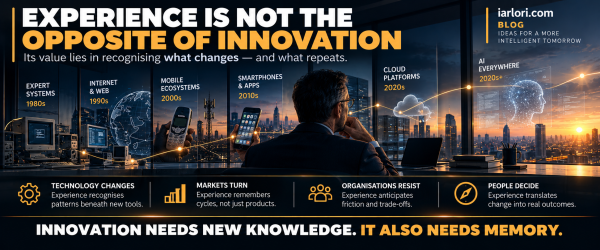

The Speed of Knowledge in a Slow Organisation

When expertise moves faster than authority

There is a paradox I have become increasingly interested in.

I have spent much of my professional life around technology, from the early Internet to mobile communications, payments, digital transformation and now artificial intelligence. Over those decades, almost everything about the production and circulation of knowledge has accelerated.

From Smart City to Augmented City

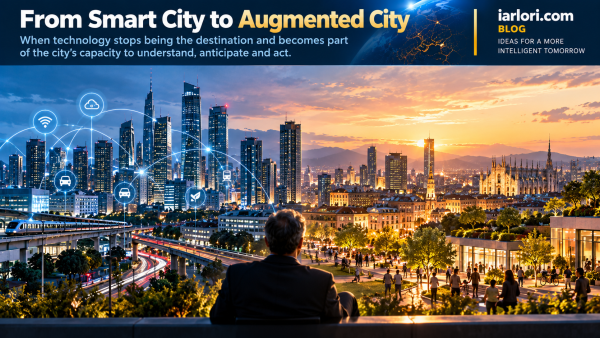
For more than twenty years, we have been trying to make cities smart. We have connected traffic lights, buses, buildings, parking spaces, energy grids and water systems. We have created control rooms, data platforms, digital services, urban dashboards and, more recently, digital twins. We have surrounded the physical city with an increasingly sophisticated informational representation of itself.

Yet I increasingly wonder whether smart is still the right word.

The Italian AI Paradox

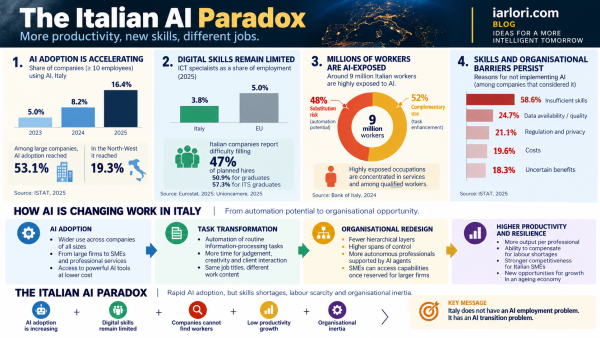
For much of the public debate, artificial intelligence and employment are discussed through a deceptively simple question: how many jobs will AI destroy?

It is an understandable question. Generative AI can already write, translate, analyse documents, generate software, summarise complex information and perform tasks that only a few years ago appeared firmly within the domain of human knowledge workers. As AI agents become more capable of executing sequences of activities rather than responding to individual prompts, the concern becomes even more intuitive.

But in Italy, this may be the wrong question.

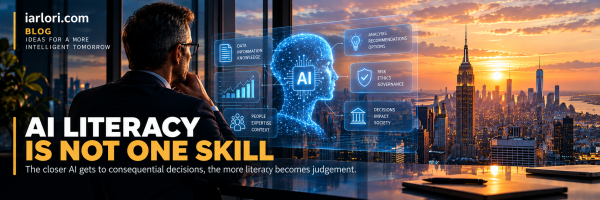
AI Literacy Is Not One Skill

Perhaps it is the word literacy itself. It suggests that there is a threshold to cross: first we do not know how to use something, then we learn, and eventually we become literate. We have seen this before with computers, with the Internet, with digital tools. It is therefore natural that organisations are now trying to make their people “AI literate”.

What Happens When Intelligence Is No Longer Valuable?

For most of my life, I have lived in a world in which knowing things mattered.

That may sound obvious. Of course knowledge matters. But I mean something more specific. Knowledge was scarce enough to create value in itself.

If you knew how a computer worked, you were valuable because most people did not. If you could write software, understand a telecommunications network, analyse a complex organisation, interpret a regulation or navigate a large technological system, that knowledge differentiated you from others.