/

November 25, 2026

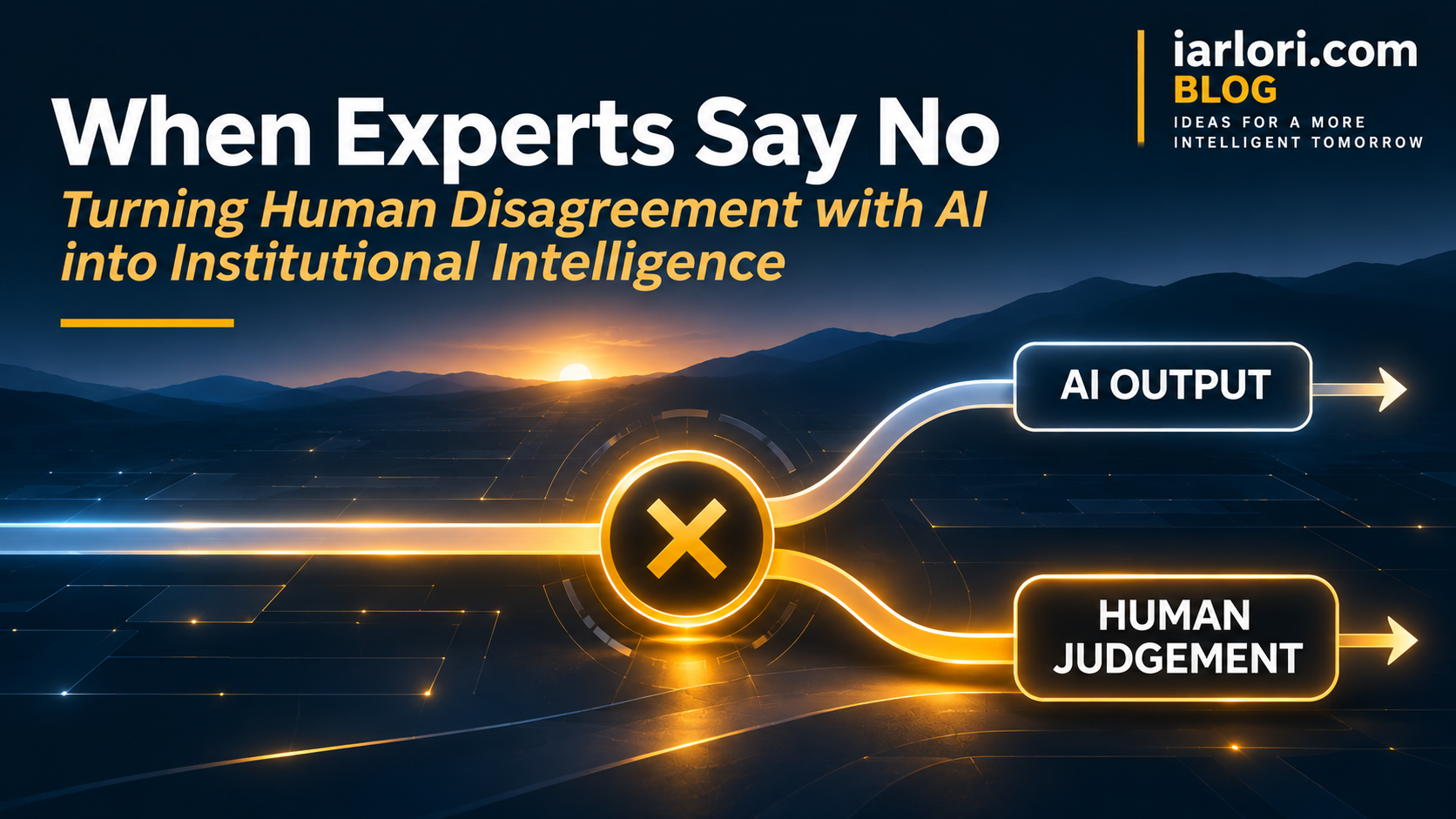
When Experts Say No: Turning Human Disagreement with AI into Institutional Intelligence

Shares

Human disagreement with artificial intelligence is not merely a safeguard against error. It can reveal knowledge that the organisation has never explicitly captured.


Why the most valuable knowledge in an AI-enabled organisation may emerge from the moments when humans refuse to follow the machine.

1. The Answer We Refused

Imagine an experienced professional sitting in front of an artificial intelligence system.

The system has analysed a collection of documents, interpreted the available information and produced a recommendation. The answer appears coherent, logically structured and supported by relevant evidence.

Yet the professional decides not to follow it.

Something is missing.

Perhaps a particular regulation has been interpreted without sufficient attention to its context. Perhaps an apparently ordinary situation contains an exception that only years of experience make recognisable. Perhaps the system has reached a technically reasonable conclusion that would produce undesirable consequences in the real world.

The professional intervenes, modifies the recommendation and continues with the task.

From an operational perspective, the process has worked. Human oversight has prevented a potentially inappropriate decision.

But from an organisational perspective, something much more interesting has happened.

Knowledge that previously existed within an individual has briefly become visible.

A fragment of professional experience, institutional memory or contextual understanding has emerged through disagreement with the machine.

What happens to that knowledge?

In many information systems, the final decision would be recorded. The original recommendation might also be retained for auditing purposes.

But the reasoning that connected the two could disappear.

And with it, the organisation loses an opportunity to understand something about itself.

The most valuable record in an AI-enabled organisation may not be the answer the machine produced, but the answer its experts refused.

2. Beyond Human Oversight

Human oversight has become one of the central principles of responsible artificial intelligence.

We expect people to supervise automated systems, verify their outputs, intervene when necessary and retain responsibility for consequential decisions.

These are essential safeguards.

But they represent only one dimension of the relationship between human judgement and artificial intelligence.

The conventional interpretation of human oversight is primarily defensive. Its purpose is to prevent errors, reduce risks and ensure that automated systems remain within acceptable operational and ethical boundaries.

The human is positioned as a final layer of protection.

This interpretation is necessary, but incomplete.

When a knowledgeable professional intervenes, the intervention may reveal something that neither the AI system nor the organisation’s formal information architecture adequately represents.

It may expose an ambiguity in a procedure, an inconsistency between two policies, an undocumented exception or a dependency on knowledge that has never been explicitly captured.

Human oversight therefore has the potential to become something more than a control mechanism.

It can become an instrument of organisational discovery.

The distinction is important.

A control mechanism asks whether the system has behaved correctly.

A learning mechanism asks what the intervention reveals about the system, the organisation and the knowledge required to make a better decision.

The first protects the organisation.

The second helps it evolve.

A mature approach to artificial intelligence should accommodate both.

3. The Invisible Architecture of Expertise

Over several decades of technological and organisational transformation, I have repeatedly encountered a characteristic that information systems rarely capture adequately.

Organisations know considerably more than their databases suggest.

Some of this knowledge exists in formal documents, procedures, regulations and information systems.

But a significant part resides within people.

It exists in the professional who understands why a particular procedure cannot always be applied literally.

In the colleague who remembers why a decision was made ten years earlier.

In the engineer who recognises that an apparently insignificant technical anomaly may indicate a much larger problem.

In the manager who understands that a formally correct decision could undermine a relationship on which the organisation depends.

This knowledge is often described as tacit knowledge.

Michael Polanyi famously explored the idea that human beings possess knowledge they cannot always fully articulate. Ikujiro Nonaka subsequently examined how interactions between tacit and explicit knowledge contribute to organisational knowledge creation.

Artificial intelligence introduces a new dimension to this longstanding challenge.

When a system produces a recommendation, it makes a particular interpretation of organisational reality explicit.

When an experienced professional challenges that recommendation, a second interpretation becomes visible.

The encounter between these two interpretations creates an opportunity.

The machine has produced an answer that can be examined. The human has identified a reason why that answer may be insufficient.

The disagreement provides a concrete occasion for articulating knowledge that might otherwise remain implicit.

This is not because artificial intelligence understands everything that humans know.

It is because artificial intelligence can make the boundaries of its own knowledge more visible through interaction with people.

Disagreement can reveal the invisible architecture of expertise.

4. When the Decision Survives but the Reasoning Disappears

Modern organisations are remarkably effective at recording certain kinds of information.

They preserve transactions, documents, approvals, operational events and final decisions.

Information systems are generally designed to establish what happened, when it happened and who was responsible.

These records are indispensable.

Yet they do not necessarily explain why a particular decision was made.

Consider a hypothetical AI-assisted process in which a system recommends option A and an experienced professional selects option B.

The final record indicates that option B was approved.

An audit log may show that the automated recommendation was overridden.

But neither record necessarily captures the knowledge that justified the intervention.

Was the recommendation rejected because the underlying information was incomplete?

Because a regulation had changed?

Because the situation represented an unusual exception?

Because the professional understood a consequence that the system had not considered?

Or because the professional simply preferred a familiar approach?

These distinctions matter.

Without them, an organisation may know that human intervention occurred without understanding whether the intervention revealed a weakness in the AI system, an inadequacy in organisational knowledge or a limitation in human judgement.

The final decision survives.

The intellectual process that produced it disappears.

This is a particularly important distinction for organisations seeking to preserve knowledge across generations of employees.

When an experienced professional leaves, the organisation may retain thousands of decisions made during that person’s career.

But it may lose the ability to understand how those decisions were reached.

Artificial intelligence could either reinforce this problem or provide a new opportunity to address it.

The outcome depends on how we design the relationship between automated recommendations and human judgement.
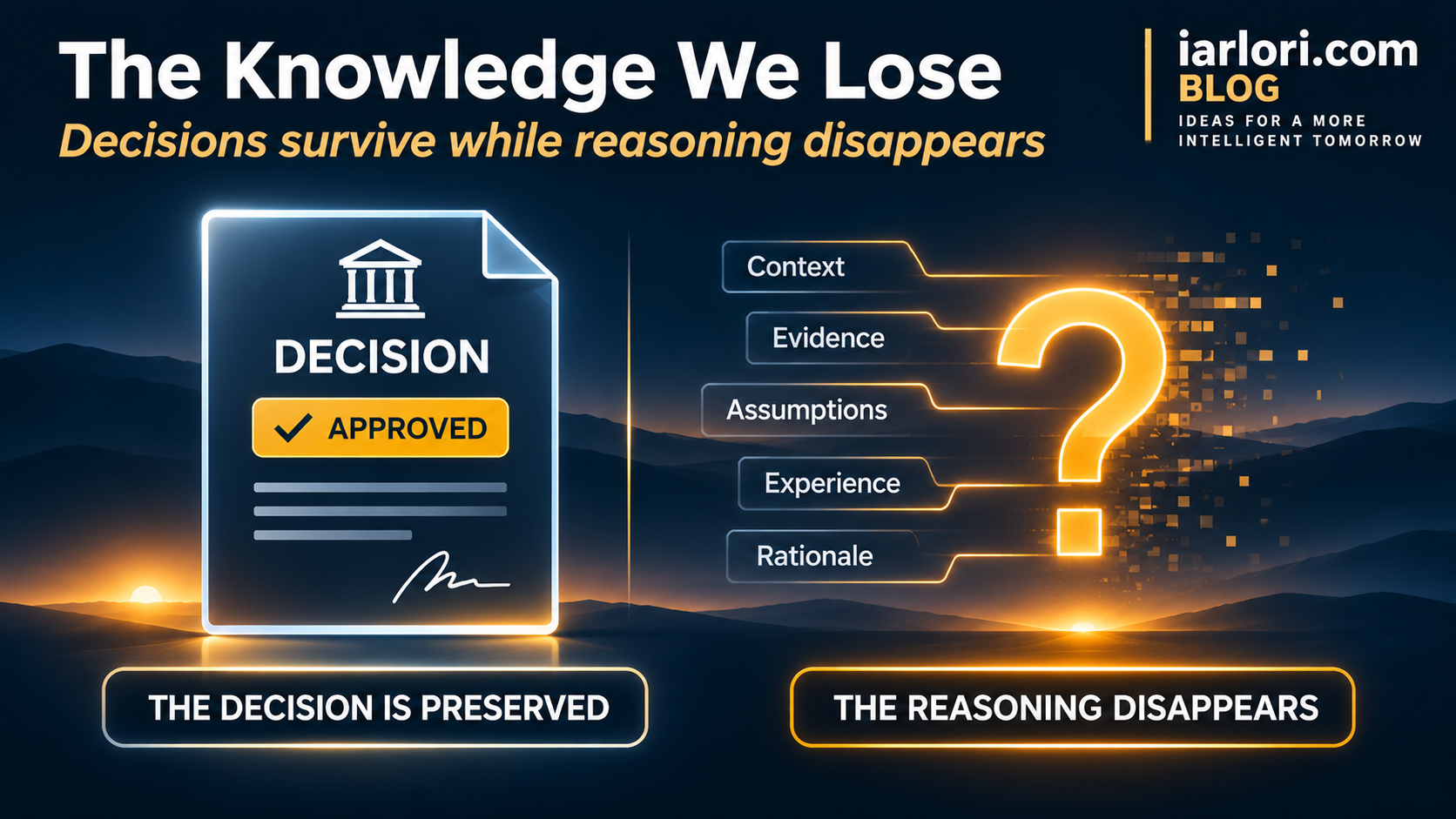
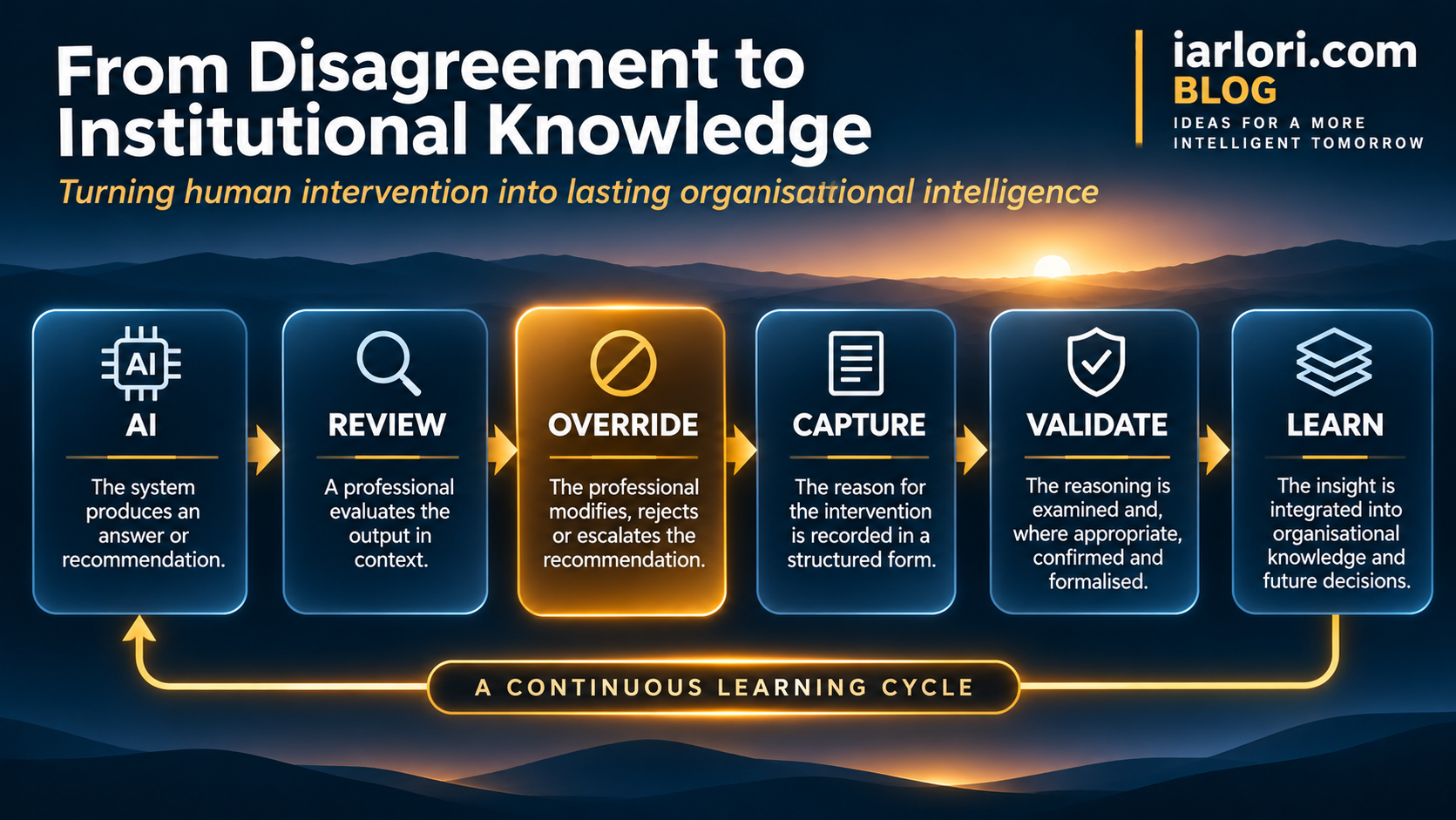
Figure 1 — The invisible loss of organisational knowledge. Information systems may preserve the final decision while losing the context, evidence, assumptions and professional experience that justified it.

5. Disagreement Is Not Proof That the Human Is Right

There is an important qualification.

Human judgement is not infallible.

Experience can produce expertise, but it can also reinforce assumptions, habits and cognitive biases.

An experienced professional may reject a valid recommendation because it conflicts with established practices. A manager may resist an unfamiliar interpretation because it challenges an existing distribution of responsibilities. An expert may simply be mistaken.

An organisation should therefore avoid replacing technological determinism with an equally simplistic belief in human superiority.

The fact that a human disagrees with an AI system does not establish that the human is correct.

Equally, the fact that a system has analysed more information does not establish that its recommendation is appropriate.

The value lies in making the disagreement examinable.

What evidence supports each interpretation?

Which assumptions are being made?

What information is missing?

Which consequences have been considered?

What is the legitimate basis for the final decision?

These questions transform disagreement from an operational interruption into an epistemic event: an opportunity to examine how knowledge is produced, interpreted and applied.

Sometimes the examination will reveal a weakness in the AI system.

Sometimes it will reveal a weakness in the organisation’s procedures.

Sometimes it will reveal a weakness in human judgement.

All three outcomes can contribute to organisational learning.

The objective is not to establish a permanent hierarchy between human and machine intelligence.

It is to create an environment in which different forms of reasoning can be examined, challenged and improved.

6. A New Source of Institutional Memory

Imagine an organisation that systematically captures significant human interventions in AI-assisted processes.

Not every correction to a generated email. Not every stylistic preference or minor adjustment.

Rather, interventions that reveal consequential knowledge.

An expert identifies a regulatory ambiguity.

A professional recognises that an apparently standard situation requires exceptional treatment.

A manager discovers that a recommendation is based on outdated organisational information.

A specialist challenges an automated assessment because its underlying assumptions do not reflect operational reality.

Each of these interventions could generate a structured knowledge record.

Such a record might preserve:

  • The original AI recommendation.
  • The relevant context and supporting information.
  • The reason for the human intervention.
  • The alternative interpretation or decision.
  • The evidence supporting that interpretation.
  • The outcome of any subsequent review.
  • The implications for future decisions.

The resulting collection would not simply be a database of errors.

It would be a repository of examined disagreements.

Over time, recurring patterns might become visible.

Perhaps multiple professionals repeatedly challenge recommendations concerning the same regulation.

Perhaps interventions reveal that a particular procedure is difficult to interpret consistently.

Perhaps several departments encounter the same gap in organisational knowledge.

Perhaps the AI system repeatedly performs well technically but struggles with a particular category of contextual judgement.

These patterns could inform improvements to information architecture, procedures, training, governance and the AI systems themselves.

The organisation would begin to accumulate knowledge not only about what it does, but about where and why its own understanding is incomplete.

This is the beginning of a different form of institutional memory.

One that preserves reasoning rather than merely recording activity.

7. From Feedback to Knowledge Architecture

Contemporary AI systems already incorporate various feedback mechanisms.

Users can indicate whether an answer was helpful. Developers can collect examples of incorrect outputs. Organisations can monitor performance and identify recurring failures.

These mechanisms are useful, but they should not be confused with institutional knowledge management.

A negative rating tells us that someone was dissatisfied with an answer.

It does not necessarily tell us why.

A corrected output provides an alternative answer.

It does not necessarily explain the reasoning behind the correction.

A model evaluation can identify a performance weakness.

It does not necessarily reveal whether the organisation itself needs to change.

The knowledge created through expert intervention must therefore be treated differently from ordinary product feedback.

It belongs within a broader knowledge architecture.

Consider an AI-based knowledge assistant operating across a complex organisation.

If experts repeatedly correct answers because internal documents contain contradictory information, improving the model alone may not solve the problem.

The organisation needs to establish which information is authoritative, who owns it and how contradictions should be resolved.

If an AI assistant fails to recognise legitimate exceptions, the organisation may need to document how those exceptions are identified and governed.

If different professionals consistently disagree about the correct interpretation of a procedure, the problem may require institutional clarification rather than technical optimisation.

In these situations, human overrides reveal weaknesses in the organisation’s knowledge infrastructure.

The AI system has become a diagnostic instrument.

Its limitations expose the limitations of the environment in which it operates.

This suggests an important architectural principle:

Not every AI error is an AI problem.

Some errors originate in fragmented information, unclear responsibilities, contradictory policies or knowledge that has never been formally preserved.

Treating every intervention as a model-performance issue risks overlooking the deeper organisational opportunity.

8. Designing a Disagreement-to-Knowledge Framework

How might an organisation translate these principles into practice?

I propose a framework consisting of six interconnected stages.

Stage 1 – Recommendation

The AI system produces an answer, assessment or recommendation within a defined operational context.

Where appropriate, the system preserves the information sources, relevant configuration and version necessary to reconstruct the recommendation.

The objective is not to expose inaccessible internal model reasoning, but to retain enough observable evidence to understand the circumstances in which the output was produced.

Stage 2 – Professional review

A human professional evaluates the recommendation.

The review considers not only technical correctness, but also contextual appropriateness, professional responsibilities, applicable rules and possible consequences.

The professional must have sufficient authority, competence and practical opportunity to challenge the recommendation.

Human oversight without these conditions risks becoming a procedural formality.

Stage 3 – Meaningful disagreement

The professional identifies a significant reason to modify, reject or escalate the recommendation.

The intervention is classified according to its nature.

Possible categories include:

  • Missing or outdated information.
  • Contextual misunderstanding.
  • Regulatory or procedural ambiguity.
  • Unrecognised exceptions.
  • Ethical or operational risk.
  • Conflicting evidence.
  • Professional disagreement.

These categories should remain adaptable to the organisation’s particular responsibilities.

Stage 4 – Reason capture

The reasoning behind the intervention is recorded in a proportionate and accessible form.

This does not require professionals to produce lengthy reports for every correction.

A short structured explanation, accompanied by relevant evidence when necessary, may be sufficient.

The essential requirement is that the intervention remains intelligible beyond the immediate situation.

Stage 5 – Validation and institutionalisation

Significant interventions are reviewed.

The organisation determines whether they reveal a verified knowledge gap, a legitimate exception, an unresolved disagreement or a mistaken human intervention.

Validated findings can then inform authoritative knowledge resources, revised procedures, professional training or improvements to AI systems.

Unresolved disagreements should remain identifiable as such rather than being prematurely converted into established knowledge.

Stage 6 – Organisational learning

The organisation examines patterns across interventions.

It identifies recurring uncertainties, structural weaknesses and opportunities for improvement.

The lessons become available to future professionals and AI-enabled processes.

This closes the learning loop.

The intervention no longer belongs exclusively to the individual who made it.

It contributes to the organisation’s collective capability.

The framework can be summarised as a progression:

AI recommendation → Human review → Disagreement → Reason capture → Validation → Institutional learning.

Figure 2 – The proposed Disagreement-to-Knowledge Framework. Six interconnected stages transform meaningful human interventions into validated institutional knowledge, establishing a continuous organisational learning cycle.

The critical transition occurs between reason capture and validation.

Without it, the organisation risks accumulating opinions rather than knowledge.

9. The Governance of Disagreement

A disagreement-to-knowledge architecture introduces important governance questions.

Who determines which interventions are worth preserving?

Who validates the reasoning?

Who resolves conflicting interpretations?

Who is authorised to modify institutional knowledge?

How are sensitive information, professional confidentiality and personal data protected?

And how can an organisation prevent the knowledge-capture process from becoming another instrument of employee surveillance?

These questions cannot be delegated entirely to technology.

They concern institutional authority, professional autonomy and accountability.

The NIST AI Risk Management Framework and its accompanying Playbook provide a useful foundation for thinking about oversight, documentation and risk management.

Similarly, Article 14 of the European Union’s AI Act establishes human oversight requirements for high-risk AI systems, including the ability, where appropriate, to disregard, override or reverse system outputs.

But the ability to intervene is only the beginning of the organisational opportunity.

An organisation must also decide how the knowledge emerging from interventions should be governed.

A responsible approach would distinguish between operational records, sensitive case information, unvalidated professional interpretations and verified institutional knowledge.

These categories require different access controls, retention policies and validation procedures.

Not every disagreement should become part of a shared knowledge base.

Not every employee should have access to every intervention.

And not every correction should automatically influence the future behaviour of an AI system.

The architecture must preserve the provenance of knowledge and make its status clear.

A professional interpretation is not necessarily an established institutional rule.

An exceptional decision is not necessarily a precedent.

A recurring pattern is not necessarily evidence of a systemic problem.

Governance is what enables the organisation to distinguish between these possibilities.

10. Creating the Conditions for People to Disagree

There is also a human dimension that no technical architecture can resolve on its own.

An organisation may provide employees with the formal ability to override an AI system while creating a culture in which they are reluctant to exercise it.

Consider a professional whose performance is measured partly through processing speed.

Accepting an automated recommendation may take seconds.

Challenging it may require additional analysis, documentation and discussion.

If the organisation rewards speed without recognising the value of justified intervention, employees may gradually learn that disagreement is professionally inconvenient.

A similar problem can arise when AI adoption is presented as a strategic priority and challenging its outputs is interpreted as resistance to innovation.

In both cases, the organisation formally preserves human oversight while informally discouraging its exercise.

This is dangerous.

A human-in-the-loop arrangement is meaningful only when the human can exercise independent judgement.

People must feel able to question automated recommendations without being treated as obstacles to efficiency.

They must also understand that the purpose of documenting disagreement is collective learning, not individual performance monitoring.

Amy Edmondson’s research on psychological safety provides a relevant organisational perspective here. Learning depends in part on whether people feel able to raise concerns, acknowledge uncertainty and challenge assumptions.

Artificial intelligence makes these conditions increasingly important.

The organisation needs professionals who are willing to say:

I do not understand this recommendation.

I believe something is missing.

I disagree with this interpretation.

I need to examine the evidence further.

These statements should not automatically be celebrated as correct.

But neither should they be discouraged.

They represent the exercise of professional responsibility.

An organisation that discourages disagreement may achieve greater apparent efficiency while progressively weakening its capacity for judgement.

11. Measuring the Intelligence of an Organisation

How should we evaluate an AI-enabled organisation?

The most familiar measures concern adoption, productivity, accuracy, cost reduction and user satisfaction.

These are relevant indicators.

But they reveal relatively little about whether the organisation is becoming better at understanding itself.

A more complete measurement framework could examine the quality of its learning processes.

For example:

  • How often are significant interventions accompanied by intelligible reasoning?
  • How many validated interventions reveal previously undocumented knowledge?
  • How effectively are recurring knowledge gaps resolved?
  • How long does it take to translate a validated finding into an updated procedure or knowledge resource?
  • Are lessons from one department available to other relevant parts of the organisation?
  • Can future professionals reconstruct the reasoning behind consequential decisions?

The number of overrides alone is not a meaningful measure of organisational intelligence.

A high number might indicate poor system performance, appropriate professional scrutiny or an unusually complex operating environment.

A low number might indicate a reliable system, excessive confidence in automation or a culture that discourages intervention.

The interpretation depends on context.

The objective should not be to maximise or minimise disagreement.

It should be to improve the organisation’s ability to understand and learn from consequential disagreement.

This represents a shift from measuring technological performance alone towards evaluating the quality of human–AI collaboration.

An organisation becomes more intelligent not simply when its systems provide better answers, but when it becomes better at examining the answers it receives.

12. Expertise as a Collective Resource

There is a further implication for the future of professional expertise.

Much of the discussion surrounding artificial intelligence focuses on whether experienced professionals will become less necessary as machines acquire increasingly sophisticated capabilities.

But perhaps we should also ask whether AI can create new opportunities to make professional expertise more accessible.

For decades, organisations have struggled to transfer knowledge between experienced employees and younger colleagues.

Mentoring, professional communities, training programmes and documentation all contribute to this process.

Yet much expertise remains difficult to transfer because it becomes visible only in specific situations.

An experienced professional may not be able to explain every principle guiding their work in advance.

But when presented with a concrete recommendation, they may immediately recognise what is missing.

AI-generated outputs can provide occasions for this kind of knowledge articulation.

A junior professional might use an AI system to prepare an initial assessment.

An experienced colleague might then challenge one aspect of the assessment.

Rather than simply correcting the answer, the colleague explains why the correction matters.

The reasoning is examined and, where appropriate, preserved.

The interaction becomes more than a quality-control exercise.

It becomes an opportunity for professional learning.

The junior colleague acquires a deeper understanding of the subject.

The organisation captures a fragment of expertise.

The AI-enabled process becomes better informed.

And the experienced professional contributes not only to the immediate task, but to the development of collective capability.

This is a more constructive vision of the relationship between artificial intelligence and human expertise.

AI does not simply replace knowledge or distribute existing information.

Under the right organisational conditions, it can help create situations in which knowledge becomes visible, discussable and transferable.

13. The Organisation That Remembers Why

One of the central challenges facing contemporary institutions is continuity.

Technologies change. Professionals retire. Leadership teams are replaced. Organisational structures evolve.

Documents may survive these transitions.

But the reasoning behind decisions often becomes increasingly difficult to reconstruct.

An institution may remember that a particular procedure exists without remembering why it was designed in that way.

It may retain a policy without understanding the circumstances that originally justified it.

It may preserve decisions while losing the experience required to interpret them.

Artificial intelligence creates both a risk and an opportunity in this context.

The risk is that organisations become increasingly dependent on automated systems that reproduce formal knowledge while obscuring the contextual reasoning required to use it responsibly.

The opportunity is to develop knowledge systems that connect information, professional judgement and institutional memory.

In such an organisation, the AI system is not merely a repository of answers.

It participates in an environment where knowledge is continuously examined, challenged, validated and renewed.

Human interventions become part of that environment.

They reveal where existing knowledge is insufficient.

They help identify assumptions that need reconsideration.

They preserve contextual understanding that might otherwise disappear.

And they create opportunities for future professionals to learn from earlier decisions.

The institution does not simply remember what happened.

It develops the capacity to remember why.

14. Beyond Human-in-the-Loop

The expression human-in-the-loop has become familiar in discussions about responsible AI.

It conveys an important principle: humans should remain involved where their judgement, authority and accountability are required.

But the expression also suggests a particular architecture.

The machine performs a task.

The human intervenes.

The process continues.

What happens to the knowledge created through that intervention is often left unspecified.

Perhaps we need to extend the concept.

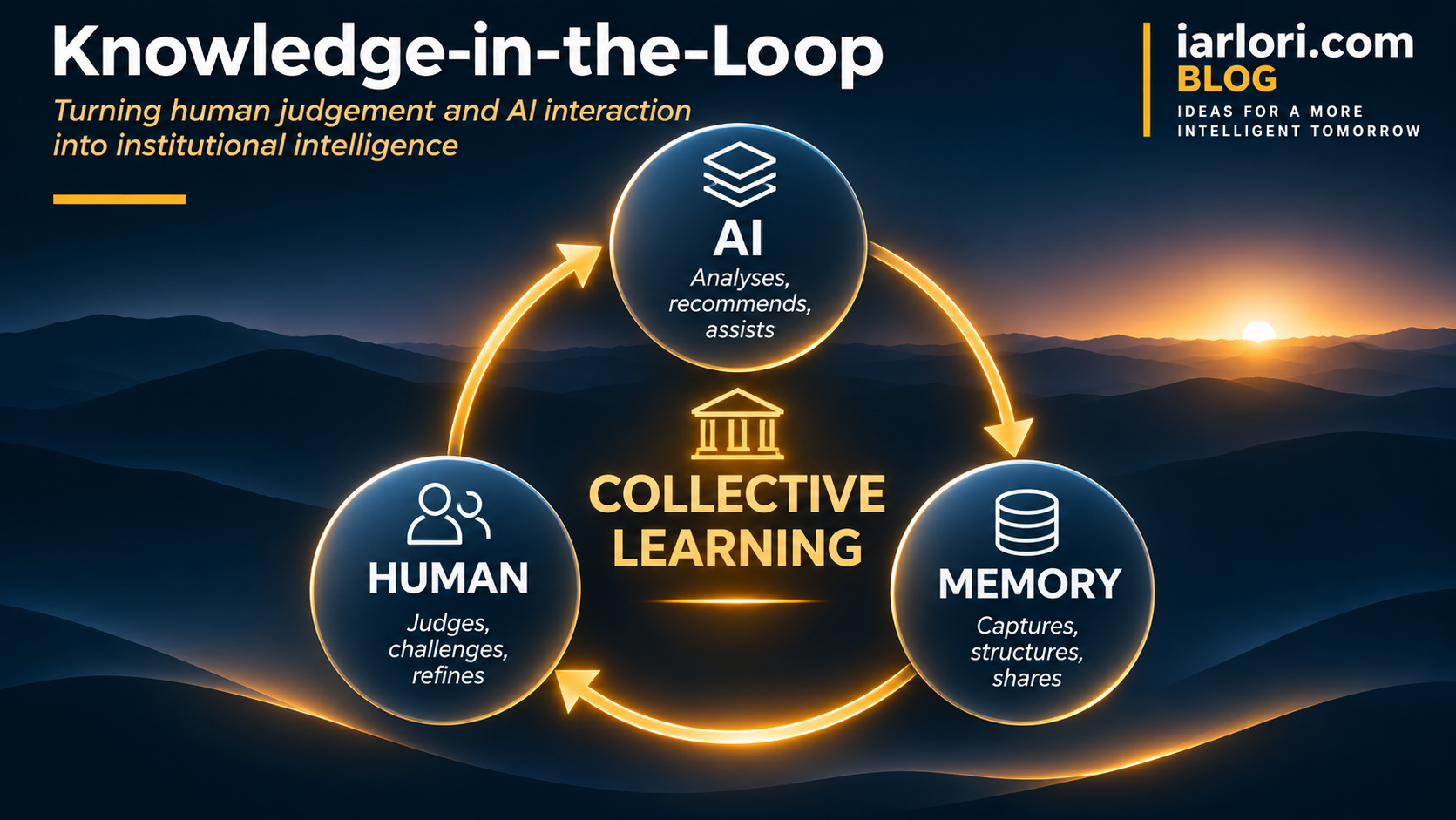
From human-in-the-loop to knowledge-in-the-loop.

The human intervention should not necessarily be the end of the oversight process.

Where the intervention produces meaningful and validated knowledge, that knowledge should be able to inform future decisions.

The loop becomes an institutional learning mechanism.

This does not mean automatically retraining AI models on every human correction.

Nor does it mean transforming every professional disagreement into a permanent organisational rule.

It means establishing a governed pathway through which significant interventions can be examined and their lessons preserved.

The result is an architecture in which artificial intelligence, human expertise and institutional knowledge interact continuously.

AI produces recommendations.

Professionals examine them.

Disagreements reveal uncertainties.

Validated reasoning enriches organisational knowledge.

And future decisions benefit from what the institution has learnt.

The intelligence of the organisation resides not exclusively in the machine or in the individual.

It emerges from the quality of the relationships between them.

Figure 3 – The proposed Knowledge-in-the-Loop architecture. Artificial intelligence, human judgement and institutional memory interact continuously, transforming validated individual insights into collective learning and sustainable organisational intelligence.

15. The Courage to Say No

Artificial intelligence will become increasingly capable of producing persuasive answers.

It will process larger quantities of information, operate across more complex environments and participate in activities that once depended almost entirely on human expertise.

These developments will create extraordinary opportunities.

But they will also make the capacity to challenge an answer increasingly important.

The danger is not only that machines may produce incorrect recommendations.

It is that organisations may gradually lose the habit of examining recommendations that appear convincing.

A professional who says no to an AI system is not necessarily defending the past against the future.

That person may be identifying something the future needs to understand.

An exception.

A responsibility.

A forgotten experience.

A consequence that has not been considered.

A fragment of knowledge that has never found its way into an information system.

Throughout my experience with technological transformation, I have become increasingly convinced that the most important innovations are not always the technologies we introduce.

Sometimes they are the organisational capabilities we discover while introducing them.

Artificial intelligence offers an opportunity to reconsider how organisations understand expertise, preserve knowledge and exercise judgement.

But realising that opportunity requires more than deploying increasingly sophisticated models.

It requires institutions capable of listening to the people who challenge them.

The intelligent organisation of tomorrow will not necessarily be the one in which humans disagree least with machines.

It may be the one that learns most effectively from their disagreement.

Because human oversight should not only protect the organisation.

It should help the organisation remember.


References and further reading

From the same category

Never miss an article (subscribe for updates)