Reflections from the Enactus World Cup, Sugarloaf Mountain and Christ the Redeemer — on young people, innovation, human encounters and the unexpected pleasure of discovering what we thought we already knew.
There are journeys we plan around an event, a professional commitment or a place we have always wanted to visit. And then there are journeys that leave us with something quite different from what we expected.
Brazil was a little of both.
I travelled to São Paulo to participate as a judge in the Top 16 round of the Enactus World Cup 2026. A few days later, I was in Rio de Janeiro, looking at mountains, water and a statue I had recognised since childhood without ever having seen them in person.
On paper, the two experiences had very little in common.
One involved students, social entrepreneurship, presentations, questions and decisions. The other involved walking, observing, taking photographs and occasionally doing nothing more ambitious than enjoying a view.
Yet, as I travelled home, I found myself thinking about the connection between them.
Both reminded me how easily we mistake familiarity for understanding.
We recognise a problem and assume we know its solution. We recognise a landscape and assume we know what it looks like. We meet someone whose experience differs from ours and instinctively interpret their ideas through what we have already learned.
Sometimes we are right.
But often the most interesting part begins when we discover what we have overlooked.
São Paulo: Learning to Listen Again
I already knew Enactus through my involvement as a mentor in Italy.
What I appreciate about the organisation is its insistence that entrepreneurship can be something more than the creation of a company or the pursuit of a financial return. It can begin with a problem that matters to a community, an attempt to understand that problem and the determination to do something practical about it.
That is an attractive proposition, particularly at a time when innovation is so frequently discussed through technology, investment, scalability and market opportunities.
Those elements certainly matter. I have spent much of my professional life working with them.
But they do not tell the whole story.
In São Paulo, I had the opportunity to see young people presenting projects developed around real social, economic and environmental challenges.
I was there as a judge, which is quite different from being a mentor.
A mentor has the privilege of continuity. You can meet a team, discuss an idea, return several weeks later and discover what has changed. You can challenge assumptions, suggest alternatives and occasionally watch an idea develop in a direction nobody initially expected.
A judge has a much shorter window.
You listen to a presentation, examine the evidence, ask questions and form a judgement within a limited amount of time.
The responsibility is considerable, precisely because the time is so short.
Behind a few minutes of presentation there may be years of work, unsuccessful experiments, difficult conversations, changes of direction and personal sacrifices.
A polished presentation can make a complicated journey appear almost inevitable.
But innovation is rarely inevitable when you are actually living through it.
I found myself trying to look beyond the presentation and understand the experience behind it.
Not simply what the students had achieved, but how they had learned.
- What had surprised them?
- Which assumptions had proved wrong?
- Who had challenged their original idea?
And, perhaps most importantly, what had happened when their solution encountered the people it was supposed to help?
When an Idea Begins to Belong to Someone Else
There is a question I brought home from São Paulo.
What would the people who live with the problem say about the solution?
A team can explain how a product works, how much it costs, how many people it reaches and how it might expand.
These are important measures.
But I am increasingly interested in what happens after the presentation is over.
Imagine someone using a solution for the first time, without a student or project leader standing beside them to explain what to do.
- Do they understand it?
- Do they use it as intended?
- Do they adapt it to their circumstances?
- Do they discover a better way?
And does the team have the humility to change its original approach when the people using the solution reveal something unexpected?
For me, that is one of the most interesting moments in the development of an innovation.
It is the moment when an idea begins to belong to someone other than its creators.
The project is no longer simply a demonstration of ingenuity. It becomes part of somebody’s everyday life.
And everyday life has a remarkable ability to expose the weaknesses of even the most elegant solutions.
I have seen something similar throughout my career.
Technology can be designed, tested and presented with considerable sophistication. Yet its real value emerges only when people incorporate it into their activities, sometimes in ways its designers never anticipated.
Innovation is not complete when something works. It begins to matter when someone finds a reason to make it part of their life.
This is why I find initiatives such as Enactus particularly meaningful.
They encourage young people to move beyond the idea itself and confront the more difficult question of what an idea actually changes.
The Privilege – and the Limits – of Experience
After more than thirty years working with technology, innovation and organisations, I have accumulated a considerable collection of experiences.
Some successful. Others less so.
Experience is useful because it helps us recognise patterns. We can identify familiar mistakes, anticipate difficulties and sometimes offer a perspective that would otherwise take years to develop.
But experience also creates a risk.
We become very good at recognising situations we think we have already encountered.
And occasionally we begin answering before someone else has finished asking the question.
I have caught myself doing that.
Not because I believe younger people have less to contribute, but because the mind naturally searches for what it already knows.
Sitting in front of the Enactus teams was a useful reminder that knowledge is not distributed according to age or professional seniority.
The students knew things I could not possibly know from my seat.
They had spoken to people I had never met, worked in environments I had never visited and encountered constraints that were not part of my experience.
My responsibility was not simply to apply what I knew.
It was also to recognise what I did not know.
That distinction matters well beyond a competition.
In organisations, we often speak about transferring knowledge from experienced professionals to younger colleagues. We invest in mentoring, training and succession planning.
All of that is valuable.
But the movement of knowledge should not be one-directional.
Younger generations bring experiences, sensitivities and ways of interpreting the world that cannot simply be derived from the past.
The challenge is to create opportunities for these different forms of knowledge to meet.
Experience should help us ask better questions, not merely provide faster answers.
Perhaps that is one of the most useful things an experienced professional can offer a younger entrepreneur: not a ready-made solution, but the ability to recognise a question worth exploring.
And perhaps one of the most valuable things a younger entrepreneur can offer an experienced professional is the opportunity to reconsider something that once seemed obvious.
The People Beyond the Competition
An international event is usually described through its programme, speakers, participants and results.
Those elements provide the formal structure.
But they are not necessarily what remains most vividly in our memories.
In São Paulo, I met people who had travelled from different parts of the world, bringing different professional backgrounds, experiences and reasons for participating.
We had a common purpose, but our conversations did not always remain within the boundaries of the competition.
That was part of the pleasure.
A conversation can begin with a project and continue towards education, culture, technology, the future of work or simply the experience of living in another country.
Sometimes the most memorable exchange is not the most formal one.
I have attended many international events over the years. Some were large and prestigious, others much smaller.
What I remember most clearly is not always the presentation I delivered or the programme I followed.
It is often a person.
Someone who introduced an unexpected perspective, challenged an assumption or simply made a conversation enjoyable enough that I wanted it to continue.
Saying goodbye to the group in São Paulo reminded me of that.
We had come together for a particular event, but the relationships did not have to end when the event concluded.
The competition gave me a reason to travel to Brazil.
The people I met gave me a reason to want to return.
And then the journey continued towards Rio de Janeiro.
Rio: The Difference Between Recognising and Seeing
There are places we know long before we visit them.
We recognise their monuments, landscapes and skylines from photographs, films, television and the countless images circulating through our digital lives.
Rio de Janeiro is certainly one of them.
For as long as I can remember, I have associated the city with two extraordinary landmarks: Sugarloaf Mountain and Christ the Redeemer.
- I knew their shapes.
- I knew their names.
- I had seen them photographed from almost every imaginable angle.
And yet, arriving in Rio, I realised how little that familiarity had prepared me for the experience of actually being there.
It is a curious sensation.
You look at something you have known for decades and discover that you are seeing it for the first time.
Sugarloaf Mountain and the Geography of Wonder
Pão de Açúcar, Sugarloaf Mountain, has one of the most recognisable silhouettes in the world.
Its outline is almost impossibly simple.
A massive granite formation rising from the landscape, surrounded by water, mountains and the urban fabric of Rio.
In a photograph, it can appear as a single extraordinary object.
But standing there, I found myself looking less at the mountain itself and more at everything around it.
- The relationship between the rock and Guanabara Bay.
- The coastline.
- The buildings following the contours of the landscape.
- The movement of boats.
- The changing light.
The mountain was exactly where I expected it to be.
What surprised me was the setting.
A photograph selects a perspective. It determines what belongs inside the frame and what remains outside it.
Standing in front of the landscape, I was free to move my eyes.
I could follow the shoreline, look towards the city, return to the mountain and discover details that would never have attracted my attention in a carefully composed image.
The landscape was not static.
It changed with the light, with the weather and with the movement of the city below.
And perhaps that is what I enjoyed most.
I had arrived expecting to admire a famous mountain.
Instead, I found myself discovering the geography of an entire city.
Christ the Redeemer: A Gesture Across a City
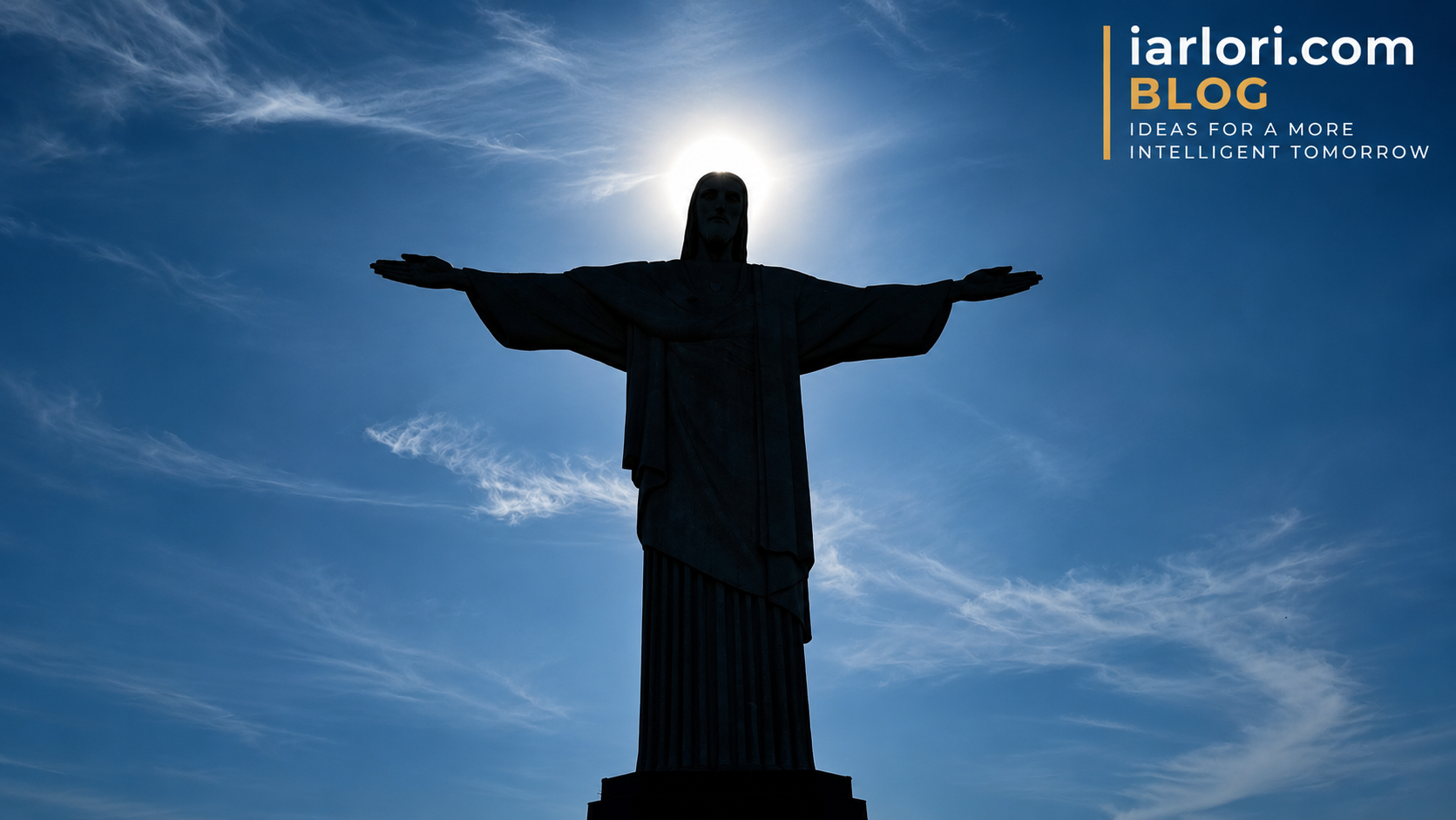
Cristo Redentor, Christ the Redeemer, offered a different experience.
The statue is so familiar that it almost risks becoming an abstraction.
We have seen those open arms reproduced on postcards, advertisements, television programmes and travel websites.
The image has become inseparable from the identity of Rio.
I wondered whether that familiarity would reduce the emotional impact of seeing it in person.
For me, the opposite happened.
What struck me was the simplicity of the gesture.
Two open arms.
Nothing particularly complicated.
Yet the gesture remains perfectly recognisable from a remarkable distance.
It is an interesting example of how something visually simple can communicate across different cultures and personal experiences.
People approach Christ the Redeemer for different reasons.
For some, it is a deeply religious place.
For others, it is a cultural monument, an architectural achievement or simply one of the most spectacular viewpoints in the world.
I was interested in the coexistence of those different interpretations.
The same figure can hold different meanings without requiring everyone to share the same understanding.
Perhaps that is part of its enduring fascination.
At a time when so many public conversations seem to demand that we choose a single interpretation, I found something appealing in a place that accommodates many.
And beyond the monument itself, there was the city.
From Corcovado, Rio appears as an extraordinary encounter between human settlement and natural geography.
Mountains, beaches, bays, forests and buildings occupy the same visual field.
It is difficult to decide where the city ends and the landscape begins.
Perhaps that is not a distinction worth making.
What a Photograph Cannot Tell Us
I spend much of my professional life thinking about knowledge.
- How it is created.
- How it travels.
- How it is preserved.
- And how organisations can make better use of what people have learned.
Brazil offered me a rather personal illustration of something that is easy to forget.
Information can travel much more easily than experience.
A presentation can carry a student project across continents.
We can understand its objectives, examine its results and appreciate its potential.
But the presentation cannot fully reproduce the circumstances in which the project was developed.
It cannot contain every conversation, every hesitation or every unexpected discovery.
In the same way, a photograph can make a distant place familiar long before we arrive.
We can recognise Sugarloaf Mountain without ever having travelled to Brazil.
We can identify Christ the Redeemer in a fraction of a second.
But recognition is not the same as experience.
A photograph cannot reproduce the feeling of standing in front of an enormous landscape, deciding where to look, noticing something unexpected or simply allowing the moment to unfold.
This is not a criticism of technology.
Quite the opposite.
Technology has given us extraordinary opportunities to discover places, people and ideas that previous generations could scarcely have imagined.
But perhaps its greatest value lies in encouraging curiosity rather than replacing it.
- The image should make us want to see.
- The presentation should make us want to understand.
- The information should make us want to ask another question.
And that brings me back to São Paulo.
The Unexpected Connection
At first, the Enactus World Cup and the landscapes of Rio seemed like two entirely separate parts of my journey.
One professional, the other personal.
One concerned with innovation and social impact, the other with beauty, culture and discovery.
But I now see a connection.
In São Paulo, I was reminded that understanding a project requires listening beyond the presentation.
In Rio, I discovered that understanding a place requires looking beyond the photograph.
Both experiences challenged the comfortable assumption that recognising something means knowing it.
And both reminded me that curiosity is not simply a quality associated with youth.
It is something we can preserve throughout our lives, provided we remain willing to encounter things without immediately reducing them to what we already understand.
That may sound like a modest lesson.
Perhaps it is.
But after decades spent in professional environments where expertise, efficiency and the ability to provide answers are constantly valued, I find increasing pleasure in experiences that encourage me to ask questions instead.
Sometimes the most interesting discovery is not something entirely new.
It is something familiar, seen differently.
What I Bring Home
I did not return from Brazil with a grand theory about innovation, education or the future of humanity.
I returned with something more personal.
From São Paulo, I bring a question I want to ask more often when mentoring young entrepreneurs:
What would the people who live with the problem say about your solution?
From the Enactus World Cup, I bring renewed appreciation for the intelligence, determination and commitment of young people who are willing to take responsibility for problems beyond their immediate interests.
From the people I met, I bring conversations I hope will continue across countries and professional boundaries.
And from Rio, I bring the memory of the water around a mountain whose outline I thought I knew, the open arms of a statue above a remarkable city and the pleasure of discovering that a familiar image can still surprise me.
I have spent much of my life travelling for technology, innovation and professional commitments.
Over time, I have learned that the most valuable part of those journeys is not always the reason we originally made them.
Sometimes it is what happens between the scheduled appointments.
- A conversation that continues longer than expected.
- A different perspective.
- A landscape that makes us stop.
Or the simple realisation that, despite everything we have seen and learned, there is still a great deal we do not know.
And that is a rather wonderful reason to keep travelling.
Obrigado, Brasil.
And to the people I met along the way: I hope our conversations will continue.