
How the technology debate became an economy of visibility, connections and manufactured authority — and why independent expertise is paying the price.
There was a time when being recognised as an expert in technology required something rather demanding: understanding it.
Not necessarily inventing a new processor, developing an operating system or writing millions of lines of code. But at least understanding the principles, limitations, architectures and consequences of the technologies one claimed to represent.
Expertise was something accumulated through study, experimentation, implementation, failure and experience. It was built over years, sometimes decades, often far away from conference stages and public recognition.
Today, the situation appears remarkably different.
You have used a technology? You can explain its future.
You have sold it? You can describe its strategic implications.
You have managed a procurement contract? You can deliver a keynote on digital transformation.
You have attended enough conferences, acquired the appropriate vocabulary and developed a sufficiently impressive LinkedIn profile?
Congratulations. You may now be considered a thought leader.
And if you happen to know the right people, the stage is practically guaranteed.
This is not simply a question of professional vanity. It is becoming a structural problem in how our societies discuss, evaluate and govern technological change.
We are increasingly confusing exposure to technology with knowledge of technology, commercial success with intellectual authority, and public visibility with genuine expertise.
And perhaps even more troubling, we have constructed an ecosystem in which those distinctions are rarely challenged.
1. Everyone has become a technology expert
Technology has become the universal language of contemporary leadership.
Politicians discuss artificial intelligence. Executives explain quantum computing. Consultants predict the future of work. Public administrators describe digital transformation. Communication professionals interpret technological disruption.
There is nothing inherently wrong with any of this.
Technology is no longer the exclusive domain of engineers and computer scientists. Its implications are economic, cultural, political, ethical and organisational. A meaningful discussion requires contributions from different disciplines.
Indeed, one of the great achievements of the digital age has been to make technology accessible to people who would never have approached it through traditional technical education.
But accessibility is not expertise.
And participation is not authority.
There is a profound difference between understanding how to use a technological product, understanding how that product works, understanding the ecosystem that makes it possible, and understanding its long-term consequences for organisations and society.
These are different levels of knowledge.
All can be valuable. None should automatically substitute for the others.
Driving a car does not make someone an automotive engineer.
Using a banking application does not make someone an expert in payment infrastructures.
Selling cloud subscriptions does not necessarily mean understanding distributed systems, data sovereignty or architectural resilience.
And using ChatGPT every day does not make someone an expert in artificial intelligence.
Yet in public discussions, these distinctions frequently disappear.
The person who has purchased technology, the person who has sold it, the person who has implemented it and the person who has designed it are often presented under the same generic label: expert.
Sometimes, the person who has merely talked about it is given the most prominent position.
We have democratised access to technology. But we have also democratised the claim to expertise, without necessarily democratising the competence behind it.
2. The difference between selling technology and understanding it
One of the most interesting transformations of the technology industry has been the progressive displacement of technical knowledge by commercial narratives.
Technology has always needed people capable of explaining its value, translating complex concepts into business language and identifying opportunities for adoption.
Good commercial professionals are essential.
Good consultants are essential.
Good communicators are essential.
But their expertise is not interchangeable with that of those who design, build, operate and critically evaluate technological systems.
A professional who has spent twenty years selling enterprise software may possess extraordinary knowledge of customers, procurement processes, competitive positioning and market dynamics.
That is legitimate expertise.
But it does not automatically make that person an authority on software architecture, cybersecurity, artificial intelligence or the future of computing.
The same distinction applies in reverse: an exceptional engineer is not necessarily qualified to explain macroeconomic policy or organisational behaviour.
The problem begins when we stop recognising these boundaries.
When commercial visibility becomes the primary indicator of competence, the people most capable of explaining technological limitations may become less visible than those most capable of promoting technological possibilities.
And promotion has an obvious advantage over critical analysis.
It is simpler.
It is more reassuring.
It produces attractive presentations.
It rarely requires admitting uncertainty.
A vendor can describe an exciting technological future without dwelling on the architectural compromises, implementation failures, hidden dependencies or operational costs that make that future difficult to achieve.
An experienced technologist, by contrast, may feel compelled to introduce precisely those complications.
And complications are not always welcome when the objective is to inspire an audience, satisfy sponsors or celebrate an institutional initiative.
The result is a subtle but consequential inversion.
Those who know how to sell technological promises may receive more attention than those who know how to evaluate whether those promises can be fulfilled.
3. The conference industry and the economy of familiar faces
Consider the programmes of technology conferences, innovation forums, institutional roundtables and public events.
How often do we encounter the same names?
The same executives.
The same representatives of large organisations.
The same institutional figures.
The same consultants moving from one stage to another, discussing artificial intelligence in the morning, digital sovereignty after lunch and the future of society before dinner.
The subject changes.
The vocabulary adapts.
The faces remain remarkably familiar.
This repetition is not always evidence of poor selection. Some professionals deserve repeated invitations because their experience, research or contributions are genuinely exceptional.
But it is legitimate to ask whether excellence is consistently the principal selection criterion.
Or whether other mechanisms are at work.
Professional relationships.
Political proximity.
Institutional affiliations.
Corporate sponsorship.
Mutual invitations.
Personal recommendations.
The ability to bring a recognisable logo to the programme.
These factors do not automatically invalidate a speaker’s contribution. But they can create a self-reinforcing system in which visibility generates more visibility, independently of the originality or depth of the ideas being presented.
An organiser invites an established figure because the name adds prestige.
The speaker accepts because the event adds visibility.
The institution promotes the participation because it reinforces its public image.
Other organisers observe the appearance and interpret it as evidence of authority.
The cycle repeats.
Eventually, being frequently invited becomes one of the reasons for being invited again.
The stage becomes both the consequence and the apparent proof of expertise.
This is an efficient mechanism for distributing visibility.
It is not necessarily an efficient mechanism for identifying knowledge.
And it creates a particularly difficult environment for independent researchers, experienced professionals, unconventional thinkers and emerging voices who lack institutional sponsors or access to established networks.
They may possess valuable ideas.
They may have contributed to technologies that millions of people use.
They may have spent decades working through complex technical and organisational problems.
But they are not part of the circuit.
And the circuit has little incentive to discover them.
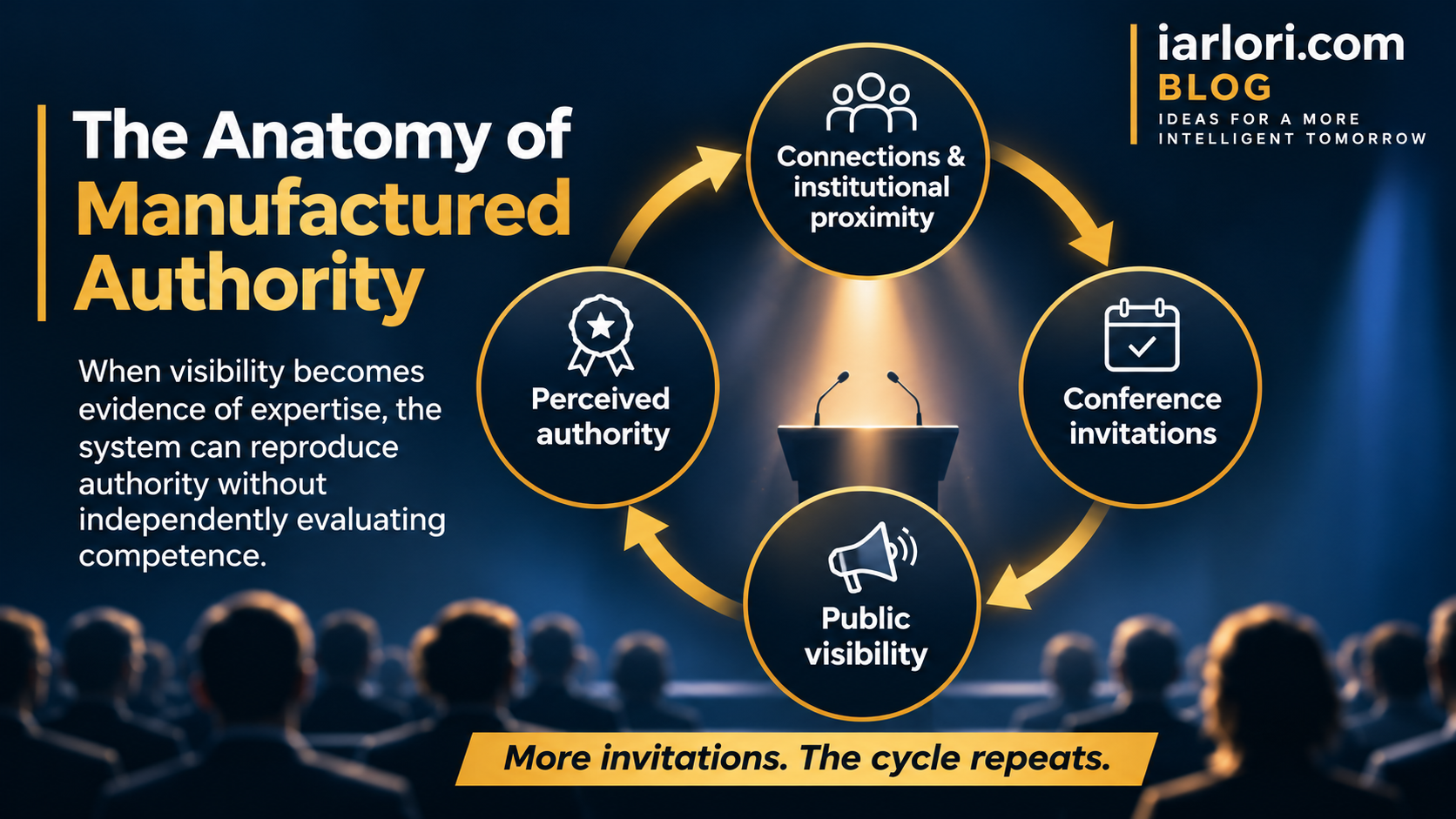

Figure 1 – How professional connections, conference invitations and public visibility can create a self-reinforcing cycle of perceived authority, independently of demonstrated competence.
4. When politics decides who gets a microphone
The relationship between politics, institutions and technological expertise deserves particular attention.
Public institutions have an essential role in shaping technological development. They define policies, allocate resources, establish priorities and represent the interests of society.
Politicians and institutional leaders must therefore participate in debates about technology.
But participation is not the same as determining who is entitled to contribute.
A problem emerges when institutional events become environments in which professional recognition is influenced more by political proximity or personal relationships than by the quality of ideas.
A familiar speaker may be invited because they are considered reliable.
A representative of a well-connected organisation may be selected because their presence strengthens an institutional relationship.
A critical independent voice may be overlooked because it does not fit the expected narrative.
There need not be an explicit instruction to exclude anyone.
No formal censorship.
No prohibition.
No visible act of discrimination.
Exclusion can occur simply through the repeated selection of the same trusted networks.
This is perhaps the most effective form of intellectual marginalisation because it is almost invisible.
Nobody tells independent experts that they cannot speak.
They are simply never invited.
Nobody prevents unconventional thinkers from publishing their ideas.
Their ideas simply remain outside the conversations where decisions are influenced.
Nobody explicitly declares that institutional relationships matter more than competence.
But the composition of the stage can sometimes communicate precisely that impression.
The result is a form of selective pluralism.
Many voices are present, but they often belong to the same professional and institutional ecosystem.
Different organisations are represented, yet the underlying assumptions remain largely uncontested.
The debate appears open.
Its boundaries may already have been decided.
The most effective way to silence an independent voice is not necessarily to prohibit it from speaking. It is to make sure nobody gives it a microphone.
5. Independent expertise is inconvenient
Why are independent voices sometimes so difficult to accommodate?
One possible explanation is that genuine independence introduces uncertainty.
A corporate representative may have an interest in presenting a particular technological solution positively.
An institutional speaker may be expected to support an established programme.
A consultant may need to preserve relationships with current or potential clients.
A political figure may prefer narratives that reinforce an existing strategy.
These interests do not mean that their contributions are dishonest. Nor do they mean that independent professionals are automatically more objective.
Everyone has assumptions, incentives and limitations.
But independence can create the freedom to ask questions that others may find uncomfortable.
Why are we adopting this technology?
What problem are we actually solving?
Who benefits economically?
What alternatives have been considered?
What happens if the supplier changes its commercial conditions?
Who owns the data?
What capabilities will remain inside the organisation after the consultants leave?
What happens when the demonstration ends and the system must operate reliably for thousands or millions of users?
These are not necessarily questions that generate applause.
They may interrupt an attractive narrative.
They may expose inconsistencies.
They may reveal that an initiative described as transformational is primarily a procurement exercise.
Or that an ambitious artificial intelligence strategy is little more than a collection of disconnected experiments.
But these are precisely the questions that serious technological governance requires.
An experienced professional who has witnessed projects fail may be less enthusiastic than someone encountering a technology for the first time.
That scepticism is not necessarily resistance to innovation.
Sometimes it is the result of understanding what innovation actually demands.
Experience does not always make people more optimistic. It often makes their optimism more selective.
And selective optimism is rarely the easiest product to sell from a conference stage.
6. Artificial intelligence has accelerated the inflation of expertise
If the problem was already visible during previous waves of digital transformation, artificial intelligence has made it almost impossible to ignore.
The speed with which AI expertise has proliferated is extraordinary.
A few years ago, machine learning was primarily discussed by researchers, engineers, data scientists and specialised practitioners.
Today, artificial intelligence appears in virtually every professional biography, consultancy offering, conference programme and strategic presentation.
People who have never trained a model discuss the future of machine learning.
People who have never designed an AI architecture advise organisations on autonomous systems.
People whose principal experience consists of interacting with generative AI interfaces explain how artificial intelligence will transform entire industries.
Again, there is nothing wrong with learning quickly.
A professional does not need to have developed a foundation model to understand its business applications.
Nor does every AI strategy require a doctorate in machine learning.
The problem is the absence of intellectual humility and the tendency to treat a limited experience as universal competence.
Using a generative AI system is one kind of knowledge.
Understanding model behaviour, evaluation, limitations and failure modes is another.
Designing a reliable enterprise AI architecture is another.
Integrating artificial intelligence into organisational processes, governance structures and human decision-making is another still.
These domains overlap.
They are not identical.
Yet public discussion often compresses them into a single undifferentiated category called AI expertise.
This matters because artificial intelligence is not merely another productivity tool.
It is increasingly influencing decisions, organisational structures, information flows and the distribution of cognitive work.
When people with superficial knowledge acquire disproportionate authority over these discussions, the risks are not confined to inaccurate conference presentations.
They can affect investment decisions, public policy, institutional governance and the expectations of entire organisations.
A poorly informed technology debate can become a poorly informed technology strategy.
And a poorly informed strategy can produce dependencies and failures that last for years.
7. The illusion of technological transformation
Having worked across different generations of digital technology, I have observed a recurring pattern.
Every technological wave arrives accompanied by promises of radical transformation.
- New architectures will eliminate complexity.
- New platforms will make organisations agile.
- New interfaces will change everything.
- New intelligent systems will finally solve problems that previous technologies could not.
Sometimes these promises are justified.
Many technologies have genuinely transformed industries, services and everyday life.
But transformation rarely occurs because an organisation purchases a new product or adopts a fashionable vocabulary.
It requires architectural understanding, organisational adaptation, governance, skills, investment, continuity and a realistic assessment of constraints.
It also requires institutional memory: the capacity to understand why previous decisions were made, what succeeded, what failed and what should not be repeated.
Unfortunately, public narratives often concentrate on the announcement rather than the implementation.
- On the launch rather than the outcome.
- On the technology rather than the organisational capability required to use it effectively.
The people who have participated in difficult implementations may have a less spectacular story to tell than those who present an idealised vision.
They may discuss integration problems, legacy systems, security, maintenance, resistance to change, supplier dependencies and the gap between a successful pilot and sustainable operation.
These are not glamorous subjects.
But they are the substance of technological transformation.
There is a world of difference between demonstrating that something is possible and ensuring that it works reliably, economically and responsibly over time.
Innovation is not what happens when someone announces a new technology. Innovation is what remains after the announcement has been forgotten.
Yet our public conversation often rewards the announcement more than the result.
A Personal Perspective: When Technology Had to Work, Not Just Impress
Over several decades, I have had the opportunity to work across telecommunications, digital payments, mobility infrastructures and, more recently, artificial intelligence and organisational transformation.
From the early development of mobile services to contactless payments and large-scale digital infrastructures, I have witnessed technologies move from ambitious concepts to systems serving millions of people.
And one lesson has remained remarkably consistent.
There is an enormous difference between presenting a technology for twenty minutes and making it work reliably for twenty years.
When you participate in the development of real technological infrastructures, enthusiasm is not enough.
Systems must communicate. Standards must be respected. Security must be designed, not merely promised. Different organisations must cooperate. Legacy technologies must coexist with new architectures. Commercial interests must be reconciled with operational realities.
And when something fails, a convincing presentation will not repair it.
I have seen technological innovations succeed not because someone delivered an inspiring speech, but because professionals from different disciplines spent years resolving problems that the audience at the launch event would never see.
This is why I find the contemporary inflation of technological expertise so fascinating – and occasionally frustrating.
We seem increasingly interested in those who can explain how technology will change the world, while paying less attention to those who have already helped change it.
I do not believe that experience gives anyone an exclusive right to speak about the future. Nor should past achievements exempt anyone from continuous learning.
But experience should count for something.
- Not as a title.
- Not as a privilege.
As a source of evidence, judgement and perspective.
Because there is a difference between having an opinion about what technology might do and having accepted responsibility for what technology actually does.
And perhaps our public debates would benefit from remembering that distinction.

Figure 2 – A twenty-minute presentation can generate applause. Building technological infrastructures requires years of engineering, accountability and measurable results.
8. The paradox of the invisible pioneers
There is another contradiction worth considering.
Many of the people who helped create the technological foundations of contemporary society are not necessarily those who dominate today’s public discussions.
Think about the professionals who designed early digital payment systems, telecommunications infrastructures, distributed computing environments, secure identification mechanisms, transport technologies or large-scale information systems.
Their work was often complex, collaborative and invisible to the final user.
They operated in environments where reliability mattered more than publicity.
Where a failure could affect millions of transactions.
Where technological choices had consequences lasting decades.
Where innovation was measured not by the number of conference appearances but by whether a system actually worked.
Some of these professionals have become prominent public figures.
Many others have not.
Their knowledge may be scattered across organisations, projects, technical communities and personal experience.
It does not always translate naturally into a marketable personal brand.
And the contemporary attention economy does not necessarily reward those who possess the deepest understanding.
It rewards those who can communicate frequently, simplify aggressively, cultivate visibility and remain present in the networks that distribute attention.
Communication is a valuable skill. It should not be dismissed.
But communication should amplify substance, not replace it.
When it becomes the principal measure of authority, we risk losing access to precisely the knowledge that could help us avoid repeating old mistakes.
The irony is striking.
We live in an era obsessed with artificial intelligence, knowledge management and organisational memory.
Yet we frequently fail to recognise the human knowledge accumulated through decades of technological experience.
We build systems designed to preserve information while allowing experienced voices to disappear from public conversation.
9. The professionalisation of technological enthusiasm
There is now an entire professional ecosystem built around explaining why the next technological revolution is inevitable.
Its vocabulary is familiar.
- Disruption.
- Acceleration.
- Paradigm shift.
- Exponential change.
- Transformation.
- Reinvention.
The future is always arriving faster than expected.
Every organisation must act immediately.
Every leader must embrace the next wave.
Every hesitation is interpreted as a risk of being left behind.
This narrative is commercially effective because it creates urgency.
Urgency generates attention.
Attention generates consulting opportunities, investment, procurement and sponsorship.
But urgency can also reduce the space for critical examination.
When everyone is expected to celebrate innovation, asking whether a proposed solution is appropriate may be interpreted as conservatism.
When every technology is described as revolutionary, distinguishing genuine breakthroughs from incremental improvements becomes increasingly difficult.
And when every speaker is expected to inspire, the person who introduces doubt may be considered unsuitable for the programme.
We should be concerned when technological optimism becomes a professional obligation.
Innovation requires imagination, but it also requires criticism.
Progress depends on experimentation, but experimentation requires the possibility of failure.
A mature technological culture should be capable of celebrating achievements without turning every product announcement into a historical turning point.
The future does not need more professional enthusiasts. It needs more people capable of distinguishing possibility from probability, demonstration from deployment, and marketing from evidence.
10. Who selects the experts?
Perhaps the most important question is not who speaks, but who decides who speaks.
Conference organisers, institutional communication teams, professional associations, corporate sponsors and political networks all influence the composition of public debate.
This influence carries responsibility.
A serious conference should not simply assemble a collection of prestigious titles.
It should create the conditions for meaningful intellectual exchange.
That requires diversity of expertise, not merely diversity of organisational affiliation.
It requires people who understand different layers of the technological problem.
Researchers who can explain scientific developments.
Engineers who understand implementation.
Business leaders who can discuss economic implications.
Social scientists who can evaluate human and institutional consequences.
Policymakers who can address public interests.
Independent professionals who can challenge assumptions without needing to defend a corporate or institutional position.
It also requires an element that many public events seem reluctant to embrace: disagreement.
A panel in which every speaker confirms the previous speaker’s argument may be pleasant.
It may be easy to moderate.
It may produce attractive photographs and positive social media posts.
But it does not necessarily generate knowledge.
A genuine debate should expose competing interpretations, different experiences and conflicting evidence.
It should allow a younger researcher to challenge a senior executive.
An independent engineer to question a vendor.
An experienced practitioner to disagree with an academic.
A social scientist to challenge a technological assumption.
And a speaker without an impressive institutional title to make the strongest argument in the room.
The objective should not be to distribute prestige.
It should be to improve understanding.
Conference organisers might therefore ask themselves three uncomfortable questions.
Are we selecting speakers because of what they know, or because of whom they know?
Are we creating opportunities for genuine disagreement, or simply organising public confirmation of established narratives?
And how many potentially valuable voices never reach our programmes because they are outside our professional networks?
The answers would reveal a great deal about the actual openness of our technological culture.
11. The difference between authority and reputation
Reputation is not meaningless.
It can reflect genuine achievements, accumulated experience and the recognition of professional communities.
But reputation is an imperfect indicator of expertise.
It can also reflect organisational position, media exposure, institutional relationships and the ability to communicate effectively.
Authority, in a serious intellectual sense, should be something different.
It should emerge from the quality of reasoning, the strength of evidence, the depth of experience and the willingness to acknowledge limitations.
A recognised expert should be capable not only of explaining what they know, but also of identifying what they do not know.
This is particularly important in artificial intelligence, where technological capabilities evolve rapidly and even leading researchers disagree about fundamental questions.
The most credible voice is not necessarily the one that makes the most confident predictions.
It may be the one that explains why a prediction is uncertain.
Nor is expertise a permanent certificate.
Someone who was exceptionally knowledgeable about one generation of technology does not automatically understand every subsequent development.
Experience provides perspective, not immunity from learning.
The same standard should apply to everyone, including those with long careers and impressive professional histories.
We should neither worship novelty nor romanticise seniority.
We should evaluate contributions.
That is precisely what an ecosystem based primarily on visibility often fails to do.
12. The cost of excluding independent voices
The exclusion of independent expertise is not simply unfair to individual professionals.
It has consequences for the quality of collective decisions.
When public debate repeatedly draws from the same networks, it becomes vulnerable to shared assumptions.
- The same technologies are promoted.
- The same strategies are repeated.
- The same risks are underestimated.
- The same vocabulary becomes accepted without sufficient examination.
This creates a form of intellectual concentration.
Not necessarily because participants agree on everything, but because they often operate within similar professional incentives and institutional expectations.
Independent voices can help interrupt this process.
They may introduce historical perspectives that the current debate has forgotten.
They may question the economic interests behind apparently neutral recommendations.
They may reveal operational limitations that promotional narratives ignore.
They may propose alternatives that do not fit established commercial models.
They may simply ask a question that nobody inside the dominant network has thought to ask.
Their value is not that they are always correct.
Independence is not a guarantee of wisdom.
Their value is that they can expand the range of possibilities being considered.
And in a period of profound technological change, reducing the range of perspectives available to decision-makers is an unnecessary risk.
An ecosystem that systematically privileges familiar voices may appear stable and authoritative.
But it can become intellectually fragile.
13. We need fewer ceremonies and more intellectual friction
The solution is not to exclude non-technical professionals from technological debates.
Nor is it to replace one elite with another.
Technology is too important to be monopolised by any professional category.
The solution is to distinguish between different forms of expertise, recognise their limits and create genuine opportunities for them to interact.
We need more interdisciplinary conversations.
But interdisciplinary should not mean superficial.
We need more accessible discussions.
But accessible should not mean intellectually empty.
We need more public engagement.
But engagement should not become a substitute for evidence.
Above all, we need to rediscover the value of intellectual friction.
A good discussion is not one in which everyone leaves feeling reassured.
It is one in which participants leave understanding something they did not understand before.
- Perhaps because someone challenged a widely accepted assumption.
- Perhaps because a practical experience contradicted a fashionable theory.
- Perhaps because an independent voice introduced a perspective that had been excluded from the dominant narrative.
This kind of discussion requires courage from organisers.
It means inviting people who may disagree with sponsors.
- People who may question institutional decisions.
- People who may challenge celebrated success stories.
- People who are not necessarily famous, but have something substantial to contribute.
And it requires audiences willing to distinguish between an entertaining presentation and a meaningful argument.
The objective should not be to fill a stage with prestigious names.
It should be to fill a discussion with valuable ideas.
14. The stage is not a certificate of competence
We are entering a period in which technological decisions will increasingly shape economic opportunities, institutional autonomy, employment, education, public services and human relationships.
Artificial intelligence is accelerating this transformation, but the underlying challenge is much older.
Who has the authority to explain technological change?
Who determines which perspectives deserve public attention?
And what happens when the mechanisms that distribute visibility are disconnected from the mechanisms that produce knowledge?
These questions cannot be answered by looking at conference programmes alone.
But conference programmes reveal something about our priorities.
When the same networks dominate the conversation, when promotional narratives crowd out critical examination, and when independent expertise struggles to obtain recognition, we should question whether our public debate is serving society or merely reproducing existing hierarchies.
Being invited to speak does not prove competence.
Having thousands of followers does not demonstrate understanding.
Selling a technology does not mean knowing how to design it.
Representing an institution does not guarantee intellectual authority.
And spending decades building systems does not automatically make someone right about the future.
All these experiences can contribute to understanding.
None should be confused with a universal qualification.
The test should be the substance of the contribution.
What has this person actually done?
What do they genuinely understand?
What evidence supports their claims?
Can they distinguish facts from forecasts?
Can they recognise the limitations of their own knowledge?
And, perhaps most importantly, can they offer something beyond the familiar vocabulary of technological enthusiasm?
- We do not need fewer people discussing technology.
- We need more demanding conversations about it.
- We need to recognise the difference between experience and exposure, between competence and connections, between intellectual independence and institutional visibility.
- And we need to remember that some of the most valuable voices may belong to people who have never mastered the art of being invited.
Because the future of technology should not be explained exclusively by those who have learned how to occupy the stage.
It should also be shaped by those who have spent their lives understanding what happens behind it.
The real question is not why so many people are speaking about technology.
It is why, in a world supposedly obsessed with knowledge, we are still so poor at recognising who actually possesses it.