
The hidden politics of artificial intelligence, public participation and the institutional responsibility to preserve disagreement.
Democracy Is Not a Summarisation Problem
There is something profoundly revealing about the way artificial intelligence is entering the relationship between citizens and public institutions.
For years, digital transformation has promised to make government more accessible, efficient, transparent and responsive. We have invested in digital services, online platforms, open data, electronic identification and increasingly sophisticated systems for collecting information from society.
Artificial intelligence now offers another promise: the ability to understand what large numbers of people are saying.
A public consultation that once required weeks of reading and analysis can potentially be processed in hours. Thousands of comments can be classified, translated, clustered and summarised. Recurring concerns can be identified, arguments compared and extensive contributions transformed into concise reports for decision-makers.
These capabilities are genuinely interesting. They could help institutions engage with a volume and diversity of contributions that traditional administrative processes struggle to accommodate.
But they also introduce a question that deserves considerably more attention than it currently receives.
When artificial intelligence summarises what citizens say, who determines what their words mean?
The question is not simply about technological accuracy. It concerns the relationship between language, interpretation, representation and democratic legitimacy.
Democracy is not merely a mechanism for collecting opinions. Nor is it simply a process for identifying the most frequent preference within a population.
It is also a way of recognising disagreement, negotiating competing interests, challenging assumptions and making collective decisions in circumstances where reasonable people may hold fundamentally different views.
Reducing a democratic conversation to a summary may therefore involve something more consequential than reducing the length of a document.
It may change the structure of the conversation itself.
And when that summary is produced by artificial intelligence, the architecture of the system becomes part of the architecture through which democratic participation is understood.
From Listening to Processing
Public institutions have always faced a practical difficulty when attempting to engage with large populations.
The more people participate, the more complex the task of understanding their contributions becomes.
A consultation involving a few dozen participants can be examined closely by a relatively small group of professionals. Individual arguments can be read in context, ambiguities explored and competing perspectives discussed.
A consultation involving tens of thousands of participants creates a different challenge.
Contributions may vary enormously in length, language, relevance, specificity and quality. Some participants provide detailed evidence. Others describe personal experiences. Some express broad political preferences, while others identify highly specific technical or procedural problems.
Institutions must somehow transform this diversity into information that can support public decisions.
Traditionally, this transformation has involved human analysts, thematic coding, qualitative interpretation, statistical analysis and the preparation of synthesis reports.
These methods are not neutral either. Human analysts make choices about categories, relevance, terminology and the relative importance of different contributions.
The introduction of AI does not create interpretation where none previously existed.
It changes the scale, speed and visibility of interpretation.
A generative AI system can process a large collection of contributions and produce a coherent account of the dominant themes.
The resulting report may appear comprehensive, balanced and objective.
But its apparent coherence can conceal a series of interpretative choices.
- Which contributions were grouped together?
- Which distinctions were considered important?
- Which arguments were treated as variations of the same concern?
- Which positions were described as marginal?
- Which disagreements were preserved?
- Which were absorbed into broader categories?
These decisions may be influenced by the language model, the instructions given to it, the classification framework, the data preparation process and the people reviewing its output.
In other words, the summary is not simply a compressed version of the consultation.
It is a representation constructed through a particular method.
That distinction matters because the people making decisions may never read the original contributions.
They may encounter the consultation primarily through its summary.
And the summary may become the practical reality of what the institution believes citizens have said.
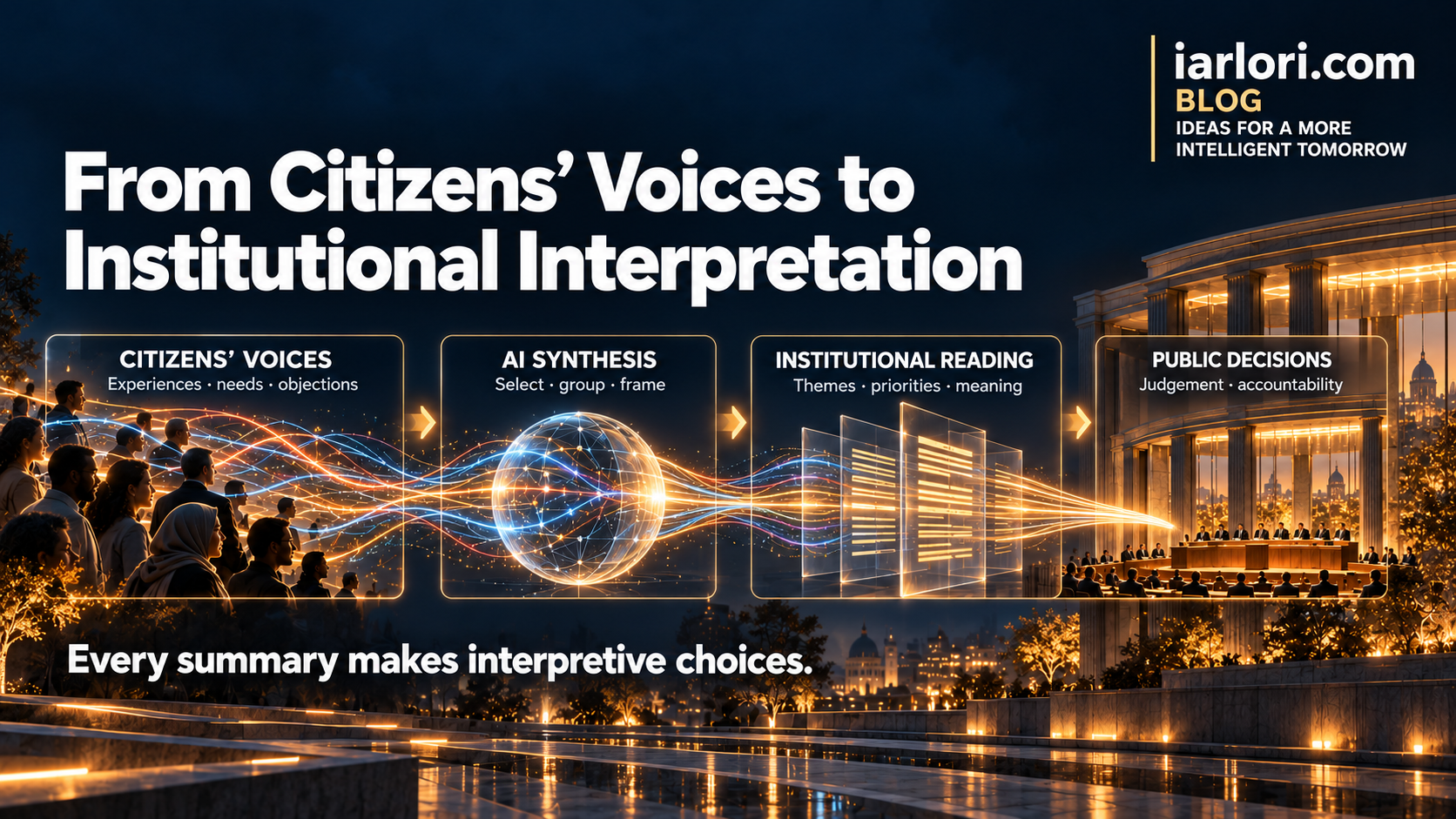
Between participation and public decisions, synthesis shapes what becomes visible. Traceability connects an institutional interpretation back to the citizens’ voices from which it was formed.
The Difference Between Majority and Significance
One of the most important limitations of summarising democratic participation is the tendency to confuse frequency with significance.
Imagine a public consultation concerning a new transport infrastructure project.
A large majority of respondents supports the proposal because it promises shorter journeys, improved accessibility and economic benefits.
A smaller group raises concerns about the consequences for a particular neighbourhood.
Perhaps the project would divide an established community, affect vulnerable residents or create an accessibility problem that the original design failed to consider.
An automated summary might accurately report that the proposal enjoys broad support and that some participants expressed local concerns.
Nothing in that statement is necessarily false.
Yet it may be profoundly inadequate.
The minority’s objections could reveal a significant problem that the majority has no reason to recognise.
The importance of those objections cannot be established simply by counting how often they appear.
This is a fundamental distinction.
Democratic significance is not always proportional to numerical frequency.
Majority preferences matter, particularly where democratic procedures require decisions based on collective choice.
But democratic legitimacy also depends on the treatment of rights, the consideration of evidence, procedural fairness and the ability of affected groups to make their circumstances understood.
A concern expressed by relatively few people may deserve serious attention because those people bear a disproportionate consequence.
An argument may be important because it identifies a legal constraint, a factual error or a previously unrecognised risk.
A minority position may also challenge an assumption that has become so widely accepted that most participants no longer question it.
A summarisation system optimised primarily to identify recurring themes may not automatically recognise these distinctions.
Even when it preserves minority concerns, it may describe them in language that reduces their significance.
There is a substantial difference between saying that a small group expressed reservations and explaining that a group identified a potentially serious consequence requiring further investigation.
The first formulation describes a distribution of opinion.
The second recognises an issue that may require institutional judgement.
Artificial intelligence can assist with both tasks, but only if the system is designed and evaluated to distinguish them.
Otherwise, the technology risks transforming a democratic conversation into a statistical portrait of its most frequent expressions.
The Politics of Categories
Every information system relies on categories.
Documents are classified, data is structured, events are labelled and observations are grouped according to rules that make them easier to process.
These operations are essential to information management.
But categories are never entirely innocent when they concern social and political realities.
Consider a consultation in which participants raise concerns about a proposed public service.
Some describe the proposal as unfair. Others question its accessibility. Others worry about discrimination, cost, geographical inequality or the practical consequences for people with limited digital skills.
An AI system may group these contributions under a broad category such as service accessibility.
That category may be useful for reporting.
But it can also obscure differences between fundamentally distinct concerns.
A problem of geographical access is not necessarily equivalent to a problem of discrimination.
A financial barrier is not the same as an administrative barrier.
And a concern about procedural fairness cannot always be addressed through the same measures as a concern about usability.
When different experiences are placed under a common label, their individual meanings may become less visible.
This is not necessarily a defect of the technology. Classification always involves abstraction.
The problem arises when abstraction is mistaken for understanding.
A useful democratic synthesis should therefore preserve the relationship between general themes and the specific arguments from which those themes were constructed.
Decision-makers should be able to move from the summary back to the underlying contributions, subject to appropriate privacy protections.
They should be able to understand why certain arguments were grouped together and where important distinctions remain.
The objective should not be to eliminate categories.
It should be to prevent categories from becoming invisible political decisions.
This is particularly important because the language used in institutional reports influences how problems are subsequently addressed.
A concern classified as an implementation difficulty may invite a technical response.
The same concern understood as an issue of rights or fairness may require a different form of institutional attention.
The classification does not merely describe the problem.
It can influence the range of solutions considered appropriate.
Artificial Consensus
One of the most seductive characteristics of generative AI is its ability to produce coherent narratives from fragmented information.
Given a collection of comments, a language model can identify common themes, connect related arguments and produce a fluent synthesis.
The result may be easier to read than the original material.
It may also appear more internally consistent.
But democratic conversations are not always coherent.
Citizens may disagree about objectives, values, evidence and acceptable trade-offs. Some positions may be incompatible. Others may reflect experiences that cannot be reconciled through a common formulation.
A good democratic process does not necessarily eliminate these contradictions.
It makes them visible so that institutions can address them responsibly.
AI-generated summaries can create what I would call artificial consensus: the appearance of agreement produced through the compression of differences into a unified narrative.
This does not require the system to invent information.
It may arise simply because the summarisation process favours general themes over specific disagreements.
Imagine a consultation in which one group argues that a proposed policy should prioritise economic growth, while another believes environmental protection should take precedence even at significant economic cost.
A summary might state that participants broadly supported sustainable economic development.
That formulation sounds balanced and constructive.
Yet it may conceal the central political disagreement.
The participants did not necessarily agree on a shared objective.
They disagreed about the trade-off.
By replacing that disagreement with a more agreeable formulation, the summary may produce an impression of consensus that did not exist.

A smooth summary can make a contested consultation appear more settled than it is. Reduced visibility of disagreement should never be mistaken for increased public agreement.
This is not merely a linguistic issue.
It can influence the decisions that follow.
If institutional leaders believe that broad agreement exists, they may underestimate the need for further deliberation, negotiation or explanation.
The technology has not formally made the decision.
But it may have shaped the institutional understanding on which the decision is based.
A system can influence democracy without ever being authorised to make a democratic decision.
That is one of the reasons AI governance must examine more than automated decision-making.
It must also examine automated interpretation.
The Difference Between Hearing and Understanding
There is an important distinction between giving people an opportunity to speak and ensuring that their contributions can meaningfully influence institutional understanding.
Digital participation platforms have made it easier to collect large numbers of responses.
AI may now make it easier to process them.
But neither development automatically guarantees that institutions listen well.
Listening is not simply the act of receiving information.
It involves recognising the context in which something is said, understanding the experience behind it and determining whether it challenges existing assumptions.
This is particularly relevant when citizens describe circumstances that do not fit established administrative categories.
A person may explain that a service is technically available but practically inaccessible.
Another may describe how a procedure creates difficulties because of the interaction between several institutional requirements.
A third may identify a consequence that is not visible in aggregate performance indicators.
These contributions may be statistically uncommon.
Yet they can reveal important weaknesses in the way institutions understand the people they serve.
The danger of automated summarisation is not necessarily that such contributions will disappear completely.
It is that their significance may be reduced during the transformation from individual experience to institutional report.
A statement describing a serious personal consequence may become one example within a general theme.
The emotional, social or practical context that made it important may be lost.
Of course, public institutions cannot make decisions solely on the basis of individual narratives.
They must consider evidence, competing interests, resources, legal obligations and broader consequences.
But neither should they assume that aggregate patterns provide a complete understanding of social reality.
The challenge is to connect different forms of knowledge.
Quantitative evidence can reveal distributions and trends.
Qualitative contributions can explain experiences, mechanisms and circumstances.
Professional expertise can evaluate feasibility and consequences.
Democratic deliberation can expose competing values and legitimate disagreements.
AI can support the integration of these perspectives.
But it should not collapse them into a single apparently objective account.
The objective is not simply to hear more citizens.
It is to develop a better institutional capacity to understand what their contributions reveal.
When the Summary Becomes the Decision-Maker’s Reality
One of the most consequential aspects of institutional information systems is that senior decision-makers rarely encounter all the original information on which their decisions depend.
They receive reports, dashboards, presentations, recommendations and summaries prepared by others.
This is unavoidable in complex organisations.
No executive, minister, university rector or institutional leader can personally examine every document, consultation response or operational event.
Decision-making therefore depends on intermediate processes that select and interpret information.
These processes create what might be called an architecture of attention.
They influence which issues become visible, which alternatives appear credible and which uncertainties receive consideration.
Artificial intelligence can become a powerful component of that architecture.
When an AI-generated synthesis is used to brief institutional leaders, the system may influence the framing of the problem before any formal decision takes place.
This is a subtle form of authority.
The AI does not need to issue instructions or approve a policy.
It may simply determine which aspects of a complex conversation are presented as important.
The decision-maker remains formally responsible.
But the information environment within which that responsibility is exercised has already been shaped.
This creates a challenge for conventional approaches to human oversight.
It is not enough to say that a human reviews the final report.
The reviewer must have a meaningful opportunity to examine how the report was constructed, identify omitted perspectives and challenge the interpretation presented.
Otherwise, human oversight risks becoming a formal endorsement of a narrative whose underlying assumptions remain invisible.
This problem is not unique to AI. Human-produced reports can also omit evidence, simplify disagreement or frame issues selectively.
The difference is that AI can perform these operations at greater speed and scale, potentially making them routine across a much wider range of institutional activities.
The apparent objectivity of a computational process may also discourage the scepticism that would normally accompany a visibly subjective interpretation.
The challenge is therefore to preserve human judgement not merely at the final moment of approval but throughout the construction of institutional understanding.
The Institutional Memory of Disagreement
Organisations tend to preserve decisions more systematically than disagreements.
A final policy may be documented. A resolution may be recorded. An approved recommendation may enter the institutional archive.
But the competing arguments, rejected alternatives, uncertainties and minority positions that preceded the decision are often less carefully preserved.
Over time, the organisation may remember what it decided without remembering why the decision was contested.
This is a significant weakness of institutional memory.
Disagreement contains knowledge.
It reveals the assumptions that were challenged, the risks that were anticipated and the alternatives that were considered.
It also provides future decision-makers with a way to understand whether the circumstances underlying an earlier decision have changed.
Artificial intelligence introduces both an opportunity and a danger in this area.
The opportunity is that AI could help institutions preserve a richer record of deliberation.
Instead of producing only a final synthesis, a system could help identify competing arguments, map areas of agreement and disagreement, link conclusions to supporting contributions and record unresolved questions.
It could help make institutional reasoning more traceable.
The danger is that AI may be used primarily to produce shorter, cleaner and more manageable summaries.
In that case, the technology could accelerate the disappearance of precisely the information that makes institutional memory valuable.
The distinction reflects a broader issue in knowledge management.
Preserving the answer is not the same as preserving the reasoning.
And preserving the reasoning requires attention to disagreement, uncertainty and context.
This is particularly important in democratic institutions because disagreement is not simply a problem to be resolved.
It is part of the information through which collective decisions acquire meaning.
A responsible institution should be able to explain not only which position prevailed but also which concerns were considered, which alternatives were rejected and why.
AI could make that form of accountability more practical.
But only if preserving disagreement is treated as a design objective rather than an inconvenience to be removed during summarisation.
The Architecture of Democratic Interpretation
If AI is to support democratic participation responsibly, its design must reflect the difference between information processing and institutional interpretation.
The objective should not be to create an automated system that determines what citizens collectively mean.
It should be to develop tools that help institutions examine contributions more systematically while preserving the possibility of alternative interpretations.
This suggests several architectural principles.
First, the system should preserve traceability between its summaries and the underlying evidence.
A conclusion should not appear as an isolated statement of public opinion. It should be possible to examine the contributions and analytical choices supporting it, within appropriate confidentiality and data-protection boundaries.
Second, the system should distinguish frequency from significance.
A recurring concern deserves attention because it affects many participants. A less frequent concern may deserve attention because it identifies a serious consequence, a legal issue or a previously overlooked perspective.
These are different reasons for institutional relevance.
Third, the system should make disagreement visible rather than treating it as a defect in the data.
Where participants hold incompatible positions, the synthesis should explain the nature of the disagreement instead of automatically constructing a common formulation.
Fourth, uncertainty should be preserved.
A model may be unable to determine whether two contributions express the same concern. It may encounter ambiguous language, irony, cultural references or incomplete context.
Such uncertainty should not always be resolved through an apparently definitive classification.
Fifth, the system should remain open to human challenge.
Subject-matter experts, participation professionals and, where appropriate, representatives of affected communities should be able to question the categories and interpretations produced.
Finally, the institution should retain responsibility for the meaning it assigns to the consultation.
The AI system can assist with analysis.
It cannot legitimately replace the institution’s obligation to interpret contributions, justify decisions and remain accountable to the public.
These principles are not simply technical safeguards.
They express a particular understanding of democratic participation: one in which the purpose of analysis is to support responsible judgement, not to manufacture a convenient representation of public opinion.

Democratic understanding requires more than compression: themes must remain traceable, disagreement and context must stay visible, and institutions must remain answerable for their interpretation.
The Risk of Excluding Voices Twice
There is another dimension to the problem that deserves attention.
Not everyone participates in public consultations under equal conditions.
Differences in education, language, digital access, available time, disability, institutional trust and familiarity with administrative procedures can influence who participates and how their contributions are expressed.
A consultation dataset is therefore not necessarily a representative portrait of society.
It reflects the people who participated, the channels available to them and the conditions under which they were able to contribute.
AI does not automatically correct these limitations.
Indeed, if institutions treat a large collection of responses as a comprehensive representation of public opinion, the apparent sophistication of the analysis may conceal the limitations of the underlying participation process.
There is also a second risk.
Even among those who participate, certain forms of expression may be easier for automated systems to interpret than others.
A clearly structured argument written in standard language may be easier to classify than a fragmented account, a regional expression, an emotionally complex narrative or a contribution containing culturally specific references.
This can create two levels of exclusion.
The first occurs when people are unable or unlikely to participate.
The second occurs when the contributions of those who do participate are poorly represented during analysis.
A system may process every submitted response while still giving unequal interpretative weight to different forms of expression.
This is why inclusiveness cannot be measured solely by the number of contributions processed.
It must also concern whether the analytical process preserves the diversity of experiences and ways of expressing them.
For institutions, the challenge is to understand the limitations of both the participation process and the AI system used to analyse its results.
The presence of sophisticated technology should not create an illusion of representativeness that the underlying evidence cannot support.
From Artificial Intelligence to Institutional Intelligence
The questions raised by AI-assisted public participation connect directly with a broader argument I have been developing about the nature of intelligent organisations.
For many years, technological innovation has been associated with increasing the capacity to collect, store, process and distribute information.
We have built increasingly powerful systems for managing transactions, analysing data and coordinating activities.
Artificial intelligence extends these capabilities into areas that previously required substantial human interpretation.
It can summarise, classify, compare, translate and generate explanations.
But the existence of these capabilities does not automatically make an institution more intelligent.
An institution can process enormous quantities of information while remaining unable to recognise the significance of an unusual event.
It can produce sophisticated reports while preserving assumptions that should be challenged.
It can measure public preferences without understanding the experiences that produced them.
And it can generate apparently coherent accounts of social reality while overlooking contradictions that deserve institutional attention.
The distinction between artificial intelligence and institutional intelligence is therefore fundamental.
Artificial intelligence concerns, among other things, the capabilities of computational systems.
Institutional intelligence concerns the ability of organisations to connect relevant knowledge, interpret circumstances, exercise judgement and act responsibly.
The two can reinforce one another.
AI can help institutions discover patterns that would otherwise remain hidden, examine larger bodies of evidence and identify relationships across fragmented information.
But it can also amplify existing institutional weaknesses.
An organisation that values agreement over disagreement may use AI to produce increasingly polished consensus reports.
An institution that treats participation primarily as a procedural requirement may use AI to complete consultations more efficiently without strengthening their influence on decisions.
A governance culture that discourages uncertainty may prefer confident summaries even when the evidence remains contested.
Technology does not automatically correct these tendencies.
It may make them more efficient.
This is why the design of AI systems cannot be separated from the institutional purposes they are intended to serve.
The relevant question is not merely whether AI can summarise citizens accurately.
It is whether the institution has developed the capacity to use those summaries responsibly.
The Democratic Value of an Uncomfortable Voice
There is a tendency in organisational life to treat disagreement as a source of inefficiency.
Disagreement slows meetings, complicates decisions and makes consensus more difficult to achieve.
Technology is often introduced with the promise of reducing such complexity.
But disagreement can also be an essential cognitive resource.
It exposes assumptions, reveals alternative interpretations and prevents dominant perspectives from becoming invisible rules.
In democratic institutions, this function is particularly important.
A citizen who challenges a widely supported proposal may not represent a large constituency.
Yet that challenge may reveal something that the majority, the experts or the institution itself has failed to recognise.
The democratic value of the contribution cannot always be determined by its popularity.
Nor can it always be captured through a thematic category.
Sometimes its value lies precisely in the fact that it does not fit comfortably within the dominant interpretation.
This raises a provocative possibility.
Perhaps one of the most important capabilities of AI-assisted democratic participation should be the ability to identify the arguments that resist summarisation.
Not because every unusual opinion is correct.
Not because minority positions should automatically prevail.
But because the contributions that do not fit the dominant narrative may contain information essential to responsible decision-making.
An intelligent institution should be capable of recognising when a disagreement deserves further examination rather than immediate reconciliation.
It should be able to distinguish between noise, misinformation, legitimate difference and evidence that challenges established assumptions.
These distinctions require judgement.
AI can assist by identifying patterns, inconsistencies and unusual contributions.
But the responsibility for evaluating their democratic significance remains human and institutional.
What Should We Measure?
The introduction of AI into citizen participation will inevitably produce new performance indicators.
Institutions may measure the number of contributions processed, the time required to prepare consultation reports, the cost of analysis and the consistency of classification.
These measures can be useful.
They may demonstrate that AI reduces administrative burdens and makes large-scale participation more manageable.
But they are insufficient as indicators of democratic value.
A consultation analysed in one day is not necessarily better understood than one analysed in three weeks.
A summary that accurately captures the most frequent themes may still fail to identify the most consequential objection.
A system that produces consistent classifications may consistently reproduce an inappropriate analytical framework.
The more interesting evaluation questions concern what the institution has learnt.
Did the analysis reveal perspectives that were previously overlooked?
Were minority concerns preserved and examined?
Could decision-makers trace important conclusions to their supporting evidence?
Were competing interpretations made visible?
Did the institution explain how public contributions influenced its decision?
Could participants recognise their concerns in the final account, even when the institution ultimately chose a different course of action?
These questions are more demanding than conventional efficiency metrics.
They also reflect the actual purpose of democratic participation.
The objective is not simply to collect opinions and process them efficiently.
It is to improve the quality, legitimacy and responsiveness of public decisions.
AI should be evaluated against that objective.
Otherwise, institutions risk optimising the administrative management of participation while neglecting its democratic meaning.
The Responsibility to Preserve What Cannot Be Averaged
The relationship between artificial intelligence and democracy is often discussed in terms of misinformation, manipulation, electoral influence and automated decision-making.
These are important concerns.
But there is another, quieter transformation taking place.
AI is beginning to influence how institutions interpret the information they receive from society.
This influence may occur long before a formal decision is made.
It may be embedded in the categories used to classify contributions, the summaries prepared for officials, the themes highlighted in reports and the disagreements that remain visible.
The technology may never be authorised to make a political decision.
Yet it can shape the understanding on which political and administrative decisions depend.
That is why the governance of AI-assisted participation must go beyond technical accuracy.
It must address the quality of interpretation, the preservation of disagreement and the institutional responsibility to explain how public contributions have been understood.
We should welcome technologies that make participation more accessible and help institutions examine larger bodies of evidence.
There is no democratic virtue in making public consultation unnecessarily slow or administratively expensive.
But neither should we confuse faster analysis with better listening.
The purpose of democratic participation is not to transform thousands of voices into the shortest possible report.
It is to help institutions understand the society they serve, including the experiences, interests and disagreements that resist easy reconciliation.
Artificial intelligence can contribute to that understanding.
It can help reveal patterns, connect perspectives and make previously inaccessible information available to decision-makers.
But it should not be allowed to replace the complexity of democratic life with the convenience of an artificially coherent narrative.
After decades of observing how technology changes organisations, I remain convinced that the most consequential transformations are not always those that automate visible activities.
They are often those that quietly change what an organisation notices, remembers and considers important.
AI-assisted democratic participation belongs to this category.
It changes the architecture through which citizens’ contributions become institutional knowledge.
And that architecture deserves the same attention we devote to the technologies themselves.
Because the real question is not whether artificial intelligence can produce an accurate summary of what citizens have said.
It is whether institutions can use that summary without losing the disagreements, experiences and meanings that made participation valuable in the first place.
Democracy does not require every voice to prevail.
It requires that voices are not made invisible simply because they are difficult to summarise.
And perhaps the greatest contribution AI can make to democratic participation is not helping institutions reach consensus more quickly.
It is helping them understand, with greater precision and responsibility, why consensus sometimes does not exist.
References and further reading
These sources provide an evidence base for the essay. The arguments concerning artificial consensus, the architecture of democratic interpretation and the institutional memory of disagreement are my conceptual interpretation, not findings attributed directly to the research.
1. OECD (2026) — Artificial Intelligence and the Future of Citizen Participation. Examines 50 applications across 22 countries, including AI-supported sense-making, translation, facilitation and participation governance.
2. OECD (2022) — OECD Guidelines for Citizen Participation Processes. Establishes principles for meaningful participation, transparency, inclusion, accountability and feedback to participants.
3. OECD (2026) — Mapping the Risks and Challenges of Using AI for Citizen Participation. Discusses representativeness, democratic risks and the limits of early experimental deployments.
4. People Powered (2026) — AI Is Changing Citizen Participation: Are We Ready?. Provides a practitioner-oriented discussion of AI-assisted participation and its democratic implications.