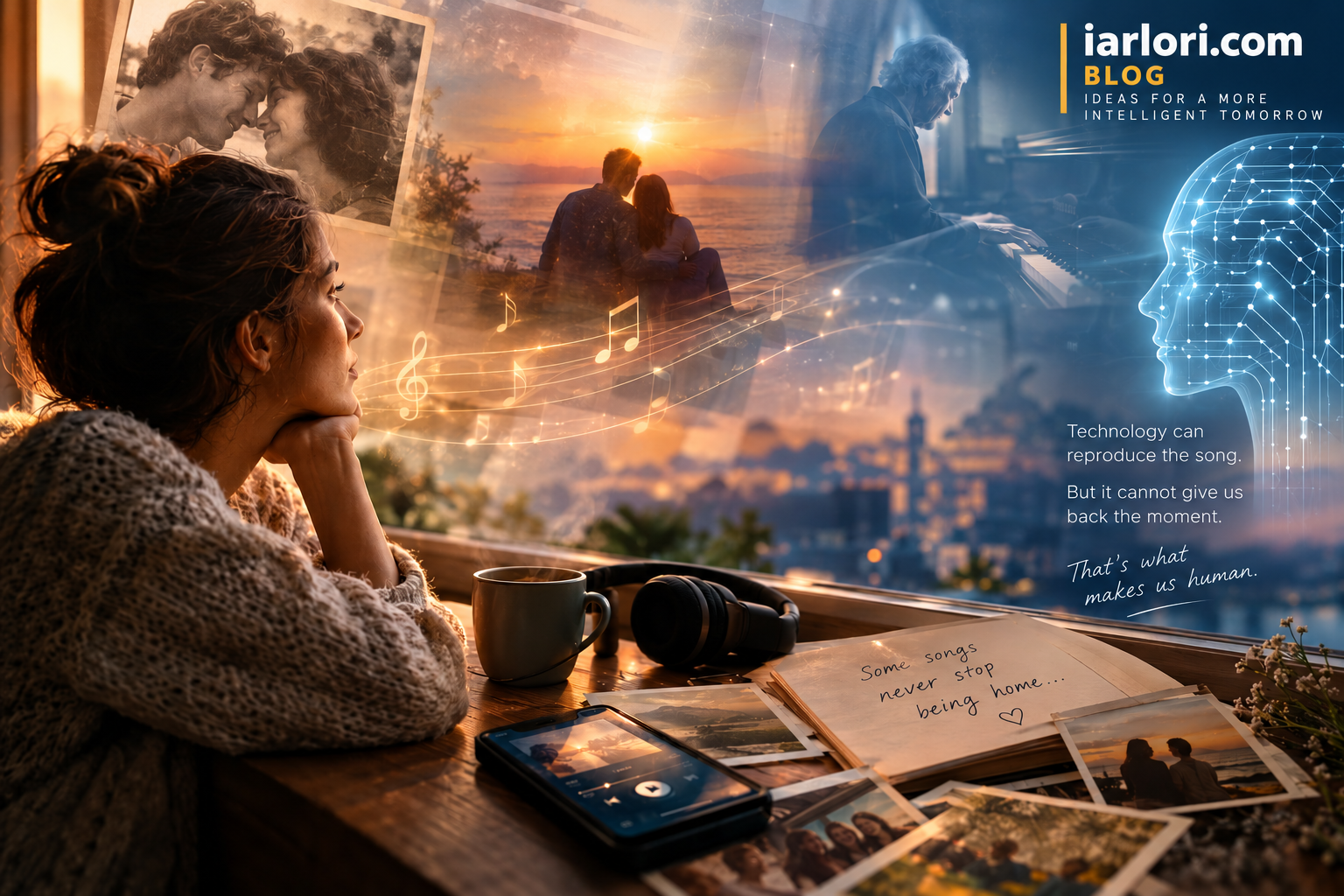
On music, love, memory, and the fragile beauty of being human in an increasingly artificial world
There are songs that belong to a particular moment in our lives. We may not have listened to them for years, perhaps decades, and yet the moment they begin, something extraordinary happens. A few notes are enough to bring back a face, a place, a feeling we thought had disappeared. We remember the light in a room, the atmosphere of an evening, the excitement of a journey, or the presence of someone who once meant everything to us. Sometimes the memory is joyful; sometimes it carries a sadness that has never entirely left us. More often, it is a mixture of both, because the most meaningful experiences of life rarely belong to a single emotion.
Music has this extraordinary capacity to make the past present again. It does not simply remind us of what happened. It allows us, briefly, to inhabit the emotional world in which those events occurred. We hear a melody and discover that something of the person we once were is still alive inside us.
I find this particularly fascinating in an age when technology is acquiring capabilities that, until recently, we would have considered almost unimaginable. We can generate music with artificial intelligence, reconstruct voices, restore old recordings, and create compositions that imitate the styles of artists who lived generations ago. We can analyse the mathematical structure of a melody, identify the emotional patterns associated with particular harmonies, and predict which songs someone might enjoy.
Yet none of these extraordinary achievements fully explains why a familiar piece of music can suddenly make us cry.
The explanation is not hidden exclusively in the notes. It lies in the relationship between those notes and a life that has been lived.
And perhaps this is where a deeper reflection about technology, intelligence, love, and human existence should begin.
The emotional architecture of memory
Throughout my professional life, I have been fascinated by the evolution of technology and by the way each new generation of systems changes our understanding of what is possible. I experienced the emergence of the Internet as a space of connection, watched digital technologies transform the organisation of work and society, and now observe artificial intelligence challenging some of our most established assumptions about knowledge, creativity, and intelligence itself.
There is something remarkable about this historical progression. Technologies that once seemed extraordinary become ordinary, almost invisible, while new capabilities continue to extend the boundaries of what machines can accomplish.
But the more sophisticated our systems become, the more interesting I find the things that resist purely technical explanation.
Human memory is one of them.
We often imagine memory as a kind of biological archive, a repository in which experiences are stored and subsequently retrieved. This analogy has been reinforced by decades of computing, where memory means the ability to preserve information and access it when required. Yet human memory is not simply a recording of the past. It is a reconstruction, influenced by emotion, context, identity, and the meaning we have gradually attributed to our experiences.
A photograph may preserve the appearance of a moment, but it does not preserve the entirety of what we felt. A recording may capture a voice, but it cannot contain everything that voice represented to us. An old message may reproduce the exact words someone wrote, while leaving us with the painful awareness that the circumstances in which those words were exchanged can never return.
Music is especially powerful because it connects sensory experience with autobiographical memory. A melody heard during adolescence can remain associated with the discovery of love, freedom, friendship, or the first realisation that life might be larger than the world we had known until then. Years later, the same melody can bring back not only the event but the emotional atmosphere surrounding it.
And there is something profoundly moving about this.
The song may have been played millions of times, heard by millions of people, and reproduced by countless technologies. But for each listener, it may carry an entirely different universe.
For one person, it represents the beginning of a relationship. For another, its end. For someone else, a parent, a childhood home, a distant country, or a friend who is no longer alive.
The musical information is essentially the same. The human meaning is not.
Perhaps this distinction between information and meaning is one of the most important boundaries we must understand as artificial intelligence becomes increasingly integrated into our lives.
Love is not an optimisation problem
We are becoming accustomed to describing human behaviour through the language of data, patterns, preferences, and predictions. Digital platforms attempt to understand our interests, anticipate our decisions, and personalise our experiences. Artificial intelligence extends this approach into areas that once seemed resistant to automation, including conversation, creativity, emotional expression, and companionship.
There is nothing inherently wrong with trying to understand human behaviour. On the contrary, technology can help people communicate, overcome isolation, discover common interests, and maintain relationships across distances that once made regular contact almost impossible.
I have seen how the Internet transformed the meaning of distance. Friendships and professional relationships that would once have faded because of geography can now continue across continents. Families can see one another despite living thousands of kilometres apart. Music, photographs, and messages can travel instantly between people whose lives have taken very different directions.
These are genuine achievements, and we should not underestimate their human value.
But there is a temptation to believe that because we can increasingly describe the patterns of human relationships, we can also reproduce their meaning.
Love challenges this assumption.
When we love someone, we do not simply respond to a collection of desirable characteristics. We become attached to a particular person, with a particular history, a particular way of looking at the world, and a collection of imperfections that may be as important to us as their qualities.
Love is rarely efficient. It is often inconvenient, unpredictable, and occasionally irrational. It asks us to accept uncertainty, to expose ourselves emotionally, and to recognise that another person’s freedom is inseparable from the possibility of disappointment.
We cannot control whether someone will love us. We cannot guarantee that affection will remain unchanged. We cannot optimise a relationship into permanent harmony without risking the disappearance of the very individuality that makes the relationship meaningful.
And yet, we continue to love.
Perhaps because love is not primarily about receiving the responses we desire. It is about discovering that another person’s existence has become part of the meaning of our own.
An artificial system may learn to recognise our moods, remember our preferences, and respond with remarkable sensitivity. Such interactions may provide comfort, and the comfort itself should not be dismissed simply because it has a technological origin.
But there remains an important difference between a system designed to respond to us and another human being who freely chooses to share a part of their life with ours.
The value of that choice is inseparable from the possibility that it might never have happened.
We sometimes fall in love because of an unexpected conversation, a shared laugh, an awkward silence, or a moment of vulnerability that neither person had planned. These experiences cannot be reduced to compatibility scores or behavioural predictions. Their significance emerges through the history that two people gradually create together.
And often, when that history becomes a memory, music is what remains to carry it.
The songs that belong to people who are no longer beside us
As we grow older, our relationship with music changes. The songs of our youth no longer represent only discovery and possibility. They also become connected with the passage of time and with the people who have entered and left our lives.
There is a particular sadness in hearing a song that once belonged to a shared experience and realising that we can no longer share it with the same person.
Sometimes that person has died. Sometimes life has simply taken us in different directions. There may have been no dramatic separation, no final disagreement, not even a conscious decision to lose contact. The years passed, circumstances changed, and what once seemed permanent quietly became part of the past.
We may still remember a journey together, an evening spent talking, or a concert where the music was almost secondary to the pleasure of being there with someone.
At the time, we did not know that these moments would eventually become memories.
That is one of the most poignant aspects of human existence. We rarely recognise the last time something happens while it is happening.
The last dinner with a friend. The last conversation with a parent. The last time we hear a familiar voice speaking casually about ordinary things. The last time we listen to a particular song together.
These moments do not announce themselves as final. They arrive disguised as everyday life.
Only later do we understand their importance.
Technology has given us unprecedented tools to preserve traces of our existence. We store photographs, videos, messages, and recordings in quantities that previous generations could hardly have imagined. Increasingly, artificial intelligence allows us to reconstruct missing details, enhance deteriorated recordings, and even create simulations of people based on the information they left behind.
I can understand the emotional appeal of such possibilities. The desire to hear again the voice of someone we loved is deeply human. So is the wish to preserve the stories, gestures, and memories that made that person unique.
But there is a profound distinction between preserving a trace of someone and recovering their presence.
A reconstructed voice may sound familiar, but it cannot bring back the future conversations that never took place. A digital representation may reproduce remembered expressions, but it cannot restore the unpredictable evolution of a living relationship.
What we miss most is often not what a person said or did in the past. It is everything that person might still have said or done if life had allowed us more time.
And perhaps this is why an old song can sometimes be more emotionally powerful than the most sophisticated digital reconstruction.
The song does not pretend that the past has returned. It simply opens a door through which we can remember.
It leaves the absence intact, while allowing love to remain present.
The difference between creating music and living through it
Artificial intelligence is already transforming musical creation. It can generate melodies, arrange compositions, imitate instruments, and produce performances that sound increasingly convincing. For musicians, these capabilities may become extraordinary creative instruments. For people without formal musical training, they may open opportunities for expression that were previously inaccessible.
I see no reason to regard these developments only as threats. Throughout history, technology has changed how music is composed, performed, distributed, and experienced. Recording transformed the relationship between performance and audience. Electronic instruments expanded the possibilities of sound. Digital production made sophisticated musical creation accessible to far more people.
Artificial intelligence is another transformation, although potentially a much more profound one.
Nevertheless, music is not merely an acoustic product.
When we listen to a musician perform, we may be responding to something beyond the arrangement of sounds. We may hear the experience of a person who has spent years learning an instrument, the emotional intensity of someone expressing a loss, or the vulnerability of an artist sharing something deeply personal.
A slightly imperfect performance may move us more than a technically flawless one because it reveals effort, fragility, and presence.
Think of an elderly pianist playing a melody they first learned as a child. The notes may be identical to those printed on the original score, but the person playing them is not the same. Decades of experiences have passed through those hands. There have been relationships, disappointments, achievements, losses, and moments of happiness.
We cannot necessarily hear each of these experiences individually, but knowing something about the person can transform how we listen.
The performance becomes more than music. It becomes a meeting between a life and a listener.
This does not mean that AI-generated music cannot be beautiful or emotionally significant. A melody created by a machine may become associated with a deeply personal event and acquire exactly the kind of meaning I have described. The emotions experienced by the listener are real, regardless of the origin of the composition.
But it suggests that the value of music does not reside exclusively in its creation.
It also emerges from the lives of those who listen, the circumstances in which they listen, and the relationships through which the music becomes meaningful.
A machine may generate a song in seconds.
A human being may spend a lifetime giving that song its meaning.
When greater intelligence does not necessarily mean a better life
Our contemporary fascination with artificial intelligence is understandable. We are witnessing the development of systems that challenge established assumptions about human cognitive superiority. Machines can already perform tasks that require sophisticated reasoning, pattern recognition, language generation, and creative synthesis.
The possibilities for science, education, healthcare, industry, and society are enormous.
Yet I sometimes wonder whether our public conversation about technological progress has become too narrowly focused on capability.
We ask what machines will be able to do, which professions will change, how productivity will increase, and how organisations should restructure themselves to exploit the opportunities of artificial intelligence.
These are important questions, and they are closely connected with much of the work I have pursued throughout my career.
But another question deserves at least as much attention: what kind of human life are we trying to make possible?
If technology allows us to complete in minutes work that previously required hours, what will we do with the time we recover?
Will we use it to cultivate relationships, explore ideas, create music, spend time with our families, and rediscover the pleasure of experiences that have no measurable economic objective?
Or will we simply fill the available space with additional tasks, expectations, and obligations?
There is a paradox in modern technological progress. We have created systems intended to save time, yet many people experience life as increasingly accelerated. We have developed unprecedented communication capabilities, yet loneliness remains a significant social concern. We can access more music, literature, and information than any previous generation, yet our attention is constantly divided among competing demands.
We have become extraordinarily effective at increasing the availability of experiences without necessarily improving our capacity to experience them deeply.
This is not an argument against technology. It is an argument for a more ambitious understanding of its purpose.
Intelligence, whether human or artificial, should not be evaluated only by its capacity to solve problems. We should also consider whether it helps create the conditions in which human beings can live meaningful lives.
And meaningful lives are built through much more than efficiency.
They are built through relationships, memories, creativity, curiosity, affection, and the sense that our existence matters to someone beyond ourselves.
An organisation may become more productive through automation while becoming less humane in the way it treats its people. A society may become more technologically advanced while weakening the social relationships that sustain trust and belonging.
Progress in capability does not automatically produce progress in meaning.
We must consciously connect the two.
The importance of being imperfect
There is something else that concerns me about the ideal of perfect technological performance.
Much of human beauty emerges from imperfection.
A voice trembling during an emotional conversation. A musician missing a note during a performance. Two people struggling to find the right words after years apart. A handwritten letter containing a sentence crossed out and rewritten because the writer was uncertain how to express a feeling.
These imperfections are not always obstacles to communication. Sometimes they are the most authentic part of it.
We recognise ourselves in the hesitation of others because we know what it means to be uncertain.
We are moved by vulnerability because we have experienced it.
We value forgiveness because relationships inevitably involve mistakes.
Technology often promises to remove friction from our experiences. We are encouraged to communicate more clearly, decide more quickly, eliminate errors, and optimise outcomes.
These objectives are valuable in many contexts. Nobody should romanticise avoidable suffering, unnecessary difficulty, or systems that fail people.
But human intimacy operates according to a different logic.
A relationship in which every disagreement is prevented, every response anticipated, and every uncomfortable silence eliminated might be remarkably smooth. It might also lose something essential: the discovery of another person as someone genuinely different from ourselves.
Love requires us to encounter another consciousness that we cannot fully predict or control.
Music, too, often gains emotional intensity from the unexpected. A pause that lasts slightly longer than anticipated, a change in tempo, a voice that breaks at the end of a phrase.
These are reminders that being human is not equivalent to performing perfectly.
We are unfinished beings, continually shaped by experiences we cannot entirely control.
And perhaps this incompleteness is not simply a limitation of human intelligence.
Perhaps it is one of the sources of human meaning.
The future should leave room for a song
I remain optimistic about technology. I believe artificial intelligence can expand human capabilities, democratise access to knowledge, support creativity, and help us address problems that have resisted traditional approaches.
But optimism should not prevent us from questioning the direction of progress.
For too long, we have treated technological development as though greater capability were an objective sufficient in itself. We have learned to measure performance with increasing sophistication while struggling to evaluate the broader human consequences of the systems we create.
The future of artificial intelligence will not be determined exclusively by engineers, researchers, or technology companies. It will also depend on the choices made by organisations, institutions, educators, artists, and ordinary people.
We will have to decide what we want to automate and what we want to preserve as a human experience.
Not because machines are necessarily incapable of performing certain tasks, but because the act of performing them ourselves may be part of what makes them valuable.
Writing a personal letter, choosing a song for someone we love, preparing a meal together, or spending an evening in conversation may not be the most efficient ways to communicate information or satisfy practical needs.
Their value lies partly in the time, attention, and personal involvement they require.
When someone dedicates time to us, they are offering something that cannot be recovered or reproduced.
A portion of their life.
And that may be one of the most precious gifts one human being can give another.
I would like to imagine a future in which artificial intelligence helps us recover more of that time rather than consuming it. A future in which technology reduces unnecessary burdens and allows people to devote more attention to creativity, friendship, affection, and the relationships that make existence worthwhile.
A future in which becoming more intelligent does not mean becoming less sensitive.
In which we remember that the purpose of progress is not merely to produce more, know more, or move faster.
It is also to live better, and perhaps to love more deeply.
What remains when the music stops
One day, the technologies that fascinate us today will seem old-fashioned. The devices we consider revolutionary will disappear, replaced by systems we cannot yet imagine. The language we use to describe artificial intelligence may become as historically distant as the vocabulary of the first computers or the early Internet.
But I suspect that certain human experiences will remain remarkably familiar.
- Someone will fall in love unexpectedly.
- Someone will wait anxiously for a message.
- Someone will sit beside a hospital bed, holding the hand of a person they cannot bear to lose.
- Someone will hear an old song and remember a summer evening from many years before.
- Someone will discover that a melody they had almost forgotten can bring back a person whose absence has become part of their life.
And someone, somewhere, will realise that the most important moment of their day was not an achievement, a transaction, or a successful decision, but an ordinary conversation with someone they love.
Perhaps this is what we should remember when discussing the future of intelligence.
We are not building technology for an abstract humanity. We are building it for people who carry memories, experience loneliness, search for affection, fear losing those they love, and hope that their lives will leave some meaningful trace in the lives of others.
I have spent many years trying to understand how technology can transform the world, how intelligence can be organised, and how increasingly sophisticated systems can extend what human beings are capable of achieving.
I still believe these questions matter enormously.
But with time, I have become increasingly convinced that the deepest question is not how intelligent our machines will become.
It is whether we will remain capable of recognising what makes our own lives worth living.
Perhaps, many years from now, someone will sit alone in a quiet room. Around them, technology will be almost invisible, anticipating needs, responding to questions, and generating whatever music they wish to hear.
And yet they will choose an old song.
Not because it is technically superior. Not because an algorithm has identified it as the optimal choice for their emotional state.
But because, long ago, they listened to it with someone they loved.
As the first notes begin, they will remember a smile, a familiar voice, perhaps a hand resting gently on theirs. They will remember a moment that seemed ordinary at the time and that now feels impossibly precious.
The person may no longer be there. The place may have changed. The world may have become almost unrecognisable.
But the feeling will return.
And in that moment, surrounded by the most advanced intelligence humanity has ever created, what will matter most will not be the extraordinary power of the technology.
It will be the memory of having loved and having been loved.
Because technology may help us preserve the music, reproduce the voice, and reconstruct the image. But it is our lives, our relationships, and our memories that give those things their meaning.
And perhaps, when everything else has changed, that will remain one of the most beautiful truths about being human.
We do not remember life by the number of things we accomplished. We remember it through the people who mattered, the moments we shared, and the music that still brings them back.
Francesco Iarlori
iarlori.com – Ideas for a More Intelligent Tomorrow