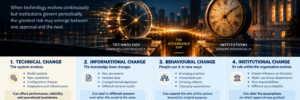
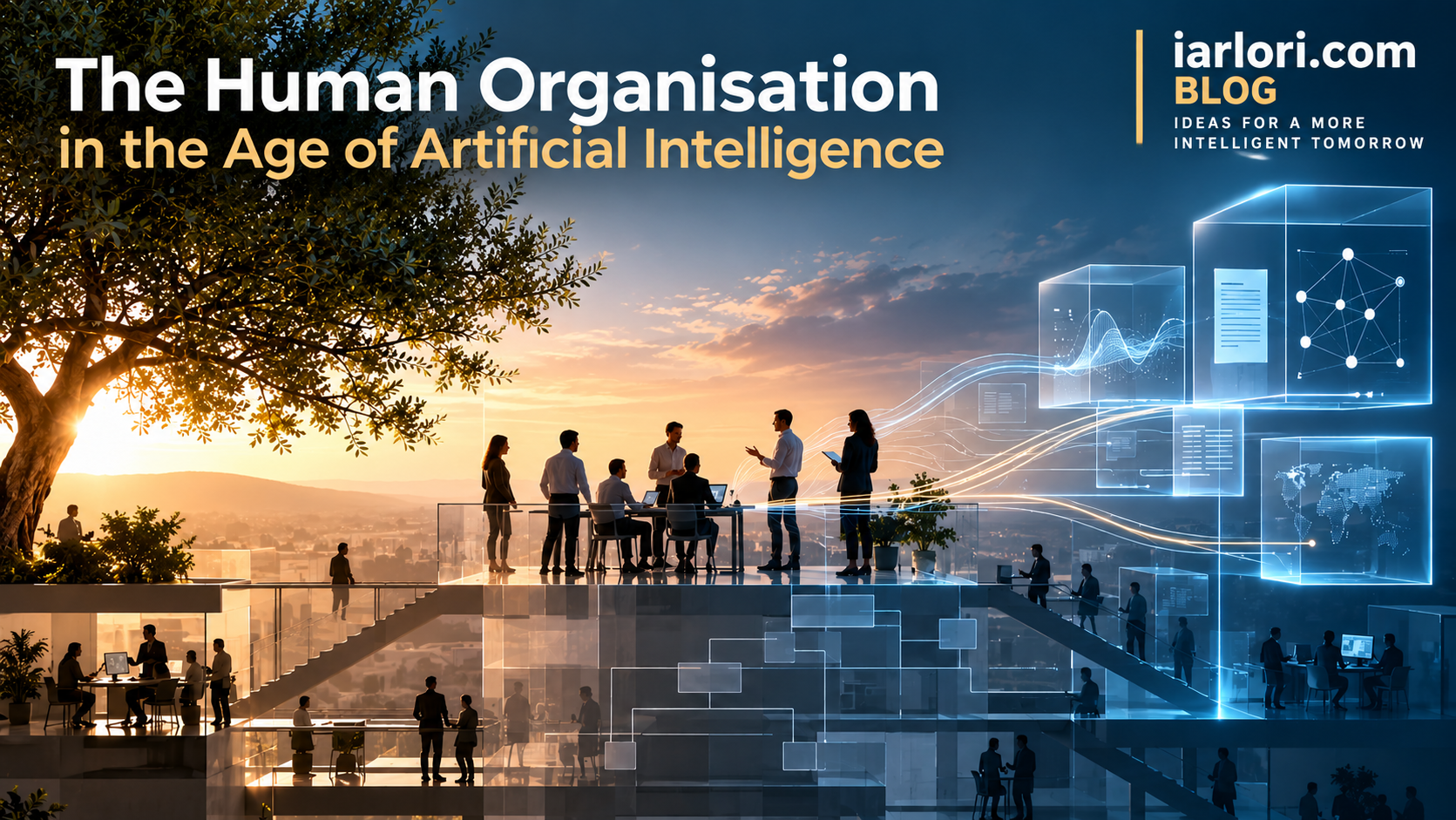
 Why the future of organisational transformation is not about technology, hierarchies, or efficiency alone, but about people, knowledge, trust, and collective intelligence.
The organisation is changing. But are we changing the right things?
For decades, organisations have been reorganising themselves in the name of efficiency, competitiveness, innovation, and transformation.
Departments have been merged, management layers reduced, responsibilities redistributed, processes redesigned, and new technologies introduced. Every generation of management has developed its own vocabulary to describe these changes: restructuring, business process reengineering, digital transformation, agile organisation, platform organisation, and now AI-driven transformation.
The terminology changes. The underlying ambition often remains remarkably similar: making organisations faster, cheaper, more productive, and more responsive.
Yet one fundamental question has received surprisingly little attention.
What actually makes an organisation intelligent?
Is it the intelligence of its employees? The quality of its management? The information available to decision-makers? The sophistication of its technological systems? Or something more difficult to measure: the ability of people to combine knowledge, challenge assumptions, cooperate, and produce outcomes that none of them could achieve individually?
I have spent much of my professional life observing how technologies enter organisations, how they transform processes, and how frequently their potential is constrained by structures, habits, and assumptions inherited from an earlier era.
From the early Internet to distributed computing, enterprise architectures, digital platforms, and now artificial intelligence, one pattern has repeatedly emerged.
Technology evolves much faster than the organisations expected to use it.
And sometimes, while technology changes radically, organisations continue to reproduce the same behaviours, conflicts, and limitations.
Artificial intelligence brings this contradiction into sharper focus.
For the first time, organisations can introduce systems capable of performing activities traditionally associated with human intellectual work: interpreting information, producing analyses, developing arguments, generating alternatives, and supporting decisions.
The immediate temptation is to ask how many tasks can be automated, how much productivity can be gained, or how many positions might become unnecessary.
These are legitimate economic questions. But they are not sufficient organisational questions.
The more important challenge is understanding how AI changes the relationships between people, knowledge, authority, responsibility, and collective action.
Because reorganising an organisation is not the same as making it more intelligent.
Organisations are not machines
Modern management has inherited much of its conceptual language from the industrial age.
Organisations are often represented as structures composed of functions, departments, processes, resources, and reporting relationships.
People appear in organisational charts as positions. Their activities are represented as tasks. Their contributions are measured through performance indicators.
This representation is useful, but profoundly incomplete.
An organisation is also a social system.
It is composed of relationships, expectations, memories, professional identities, informal agreements, cultural conventions, and networks of trust.
A great deal of organisational knowledge is never formally documented.
Experienced professionals know whom to consult when a problem crosses departmental boundaries. They understand why certain procedures exist, which exceptions matter, and how apparently unrelated events can influence one another.
They recognise the difference between a technically correct answer and an appropriate decision.
This kind of knowledge is difficult to reduce to a database or procedure because it is embedded in experience and relationships.
The philosopher Michael Polanyi famously explored the importance of tacit knowledge: knowledge that people possess but cannot always fully articulate.
In organisations, this dimension is fundamental.
The real functioning of an organisation is rarely identical to the structure described in its official documentation.
Two organisations may possess similar technologies, employ equally qualified professionals, and adopt comparable management models, yet perform very differently.
The difference often lies in their capacity to connect people, interpret situations, resolve disagreements, and transform individual expertise into collective action.
AI does not eliminate this social dimension.
It makes understanding it even more important.
The illusion of reorganisation
When an organisation encounters difficulties, restructuring is often among the most visible responses.
A new organisational chart can be produced relatively quickly. Responsibilities can be reassigned, departments combined, and management positions modified.
These interventions create a visible impression of change.
But do they necessarily improve the organisation’s ability to understand problems, share knowledge, make decisions, or learn from experience?
Not always.
An organisation can reduce the number of management layers without improving communication.
It can centralise decision-making without developing a shared understanding of its objectives.
It can create cross-functional teams while preserving the incentives that encourage departments to defend their own interests.
It can introduce advanced AI tools while leaving unchanged the procedures, authority structures, and cultural assumptions that prevented previous technologies from delivering their expected value.
This is the difference between structural reorganisation and genuine organisational transformation.
Structural reorganisation changes the arrangement of organisational components.
Transformation changes the way those components interact and produce value.
The distinction becomes especially important when artificial intelligence enters the picture.
If an organisation merely introduces AI into existing processes, it may automate inefficiencies rather than eliminate them.
If it gives employees more powerful tools without reconsidering decision rights, it may accelerate work while leaving responsibility ambiguous.
If it replaces human interactions with automated exchanges without understanding their social function, it may improve transactional efficiency while weakening cooperation.
The objective should not be to make the existing organisation run faster. It should be to reconsider how the organisation creates intelligence and value.
Why Knowing an Organisation Is Not the Same as Understanding It
One of the most persistent paradoxes of organisational transformation is that organisations are populated by people who know them extremely well, yet frequently struggle to change.
Managers understand their responsibilities. Employees know their activities, procedures, and operational constraints. Executives understand strategic objectives, financial priorities, and competitive pressures.
Today, many of these same people also understand the basic capabilities of artificial intelligence.
So why should organisational transformation remain so difficult?
The answer may lie in the distinction between knowing the individual components of a system and understanding the relationships that make the system behave as it does.
An experienced professional may know their department extraordinarily well without fully understanding how its decisions influence other departments. A senior executive may understand the formal organisational structure without seeing the informal relationships through which knowledge, influence, and cooperation actually circulate.
This is not necessarily a failure of competence.
It is a consequence of how organisations distribute knowledge, responsibilities, and authority.
Every organisational role provides a particular perspective. And every perspective, however valuable, is necessarily incomplete.
Organisations therefore possess a remarkable amount of knowledge without always possessing the collective capacity to connect it.
The challenge is not simply to acquire more information.
It is to make existing knowledge visible, connect perspectives that rarely meet, question established assumptions, and develop a shared understanding of how the organisation functions as a whole.
This is also why external perspectives can sometimes be valuable.
Not because an external advisor necessarily knows the organisation better than the people who work within it, but because someone who is not embedded in its daily routines, established hierarchies, and historical assumptions may be better positioned to question relationships that have gradually become invisible.
However, an external perspective alone is insufficient. It becomes useful only when combined with the knowledge, experience, and participation of the people who actually constitute the organisation.
Artificial intelligence introduces a further dimension.
AI can make information more accessible, reveal patterns, connect previously separated sources of knowledge, and support the exploration of alternative organisational arrangements.
But it cannot automatically determine which relationships should change, which responsibilities should remain human, or which forms of cooperation are essential to the organisation’s purpose.
These are questions of organisational design, leadership, and collective judgement.
The real opportunity is therefore not simply to combine organisational knowledge with artificial intelligence.
It is to develop the capacity to examine how human intelligence, institutional knowledge, and artificial intelligence interact.
Knowing an organisation means understanding its components. Transforming an organisation requires understanding — and sometimes redesigning — the relationships between them.
This is where organisational intelligence becomes something more than the sum of individual expertise or technological capabilities.
It becomes the capacity of an organisation to understand itself, question its assumptions, learn collectively, and deliberately change the way it creates value.
When expertise is no longer exclusively human
For much of modern organisational history, expertise has been a source of professional identity and authority.
People develop knowledge through education, experience, mistakes, observation, and interaction with colleagues.
Over time, this expertise becomes part of their identity.
An experienced engineer is not simply someone who knows technical formulas. An experienced manager is not merely someone familiar with management procedures. An experienced professional often understands relationships, exceptions, historical decisions, and the consequences of actions that may appear reasonable in isolation.
Now imagine an employee who has spent twenty years developing this knowledge.
Colleagues regularly seek their advice. Their judgement is trusted. Their professional identity is closely connected to the value of their expertise.
Then an AI system is introduced.
Suddenly, many questions previously directed to that employee can be answered almost instantly by a machine.
The organisation may perceive this as a productivity improvement.
The employee may experience something more complex.
If knowledge can be accessed without consulting the person who developed it, what happens to the recognition associated with that expertise?
And if professional recognition changes, what happens to motivation, identity, and belonging?
This does not mean that AI necessarily diminishes expertise.
On the contrary, it may allow experienced professionals to concentrate on more complex problems and enable less experienced colleagues to learn faster.
Research by Erik Brynjolfsson, Danielle Li, and Lindsey Raymond on generative AI in customer support found that AI assistance improved productivity, with particularly substantial gains among less experienced workers.
The study suggests that AI can help distribute practices and knowledge previously concentrated among more experienced employees.
But this raises an interesting organisational paradox.
AI can democratise access to expertise while simultaneously changing the social value traditionally attached to possessing that expertise.
The question for organisations is therefore not only how to distribute knowledge more efficiently.
It is how to preserve professional development, recognition, mentoring, and meaningful contribution when access to information becomes increasingly automated.
The paradox of individual empowerment and collective intelligence
One of the most attractive promises of AI is individual empowerment.
A professional can analyse information more rapidly, prepare documents, explore alternatives, develop presentations, or perform tasks that previously required specialised support.
Small teams can accomplish work that once required much larger structures.
Individuals can become more autonomous.
At first sight, this appears entirely positive.
But organisations do not exist merely to maximise individual autonomy.
They exist because collective action can produce results that isolated individuals cannot achieve.
And here an important paradox emerges.
What if AI makes every individual more capable while making the organisation less capable of thinking collectively?
Consider a simple situation.
A junior employee encounters an unfamiliar problem.
Traditionally, they might consult an experienced colleague. The conversation could produce an answer, but it might also reveal the history of the problem, the reasons behind existing procedures, and the informal relationships necessary to resolve similar situations in the future.
The interaction transfers more than information.
It transmits organisational memory.
It develops trust.
It creates a relationship.
Now imagine that the employee asks an AI assistant instead.
The answer may arrive faster. It may even be more comprehensive.
But the human interaction may never take place.
Repeated across hundreds or thousands of employees, such changes could gradually alter the social fabric of an organisation.
Knowledge might become more accessible while relationships become weaker.
Individual productivity might increase while opportunities for mentoring decline.
Employees might become more independent while developing a less complete understanding of the organisation as a whole.
This is not an inevitable consequence of AI. It is a risk that depends on how technology is introduced and how work is organised.
The real opportunity is to use AI to remove unnecessary administrative dependencies while strengthening the interactions that contribute to learning, judgement, creativity, and trust.
But this requires distinguishing between interactions that are merely transactional and interactions that create organisational value.
Not every meeting is useful. Not every conversation produces knowledge. Not every human intervention deserves preservation.
Yet not every interaction that can be automated should necessarily disappear.
Organisational loneliness: an underestimated risk
We frequently discuss the possibility of AI replacing jobs.
We discuss less frequently the possibility of AI replacing relationships within jobs.
An organisation could eventually become a collection of highly productive individuals interacting extensively with intelligent systems but increasingly less with one another.
Each employee might possess an AI assistant capable of providing immediate support, answering questions, generating documents, and recommending actions.
From a narrow operational perspective, this could appear efficient.
But what would happen to the informal conversations through which people build confidence, develop shared perspectives, and understand the motivations of their colleagues?
What would happen to the social dimension of professional development?
And what would happen to organisational belonging?
Work is not simply an economic transaction.
For many people, it is also a source of recognition, relationships, personal development, and social identity.
An organisation that neglects these dimensions may discover that technological productivity does not automatically translate into commitment, cooperation, or institutional resilience.
The problem is not the presence of machines.
It is the possibility that organisations may fail to recognise the value of human interaction until some of its benefits have disappeared.
An intelligent organisation should therefore ask not only which activities AI can perform, but which human relationships are essential to its long-term capacity to learn and adapt.
Authority, responsibility, and the new organisational hierarchy
Knowledge and authority have always been closely related.
Those who understand complex problems often influence decisions, even when they do not occupy the highest positions in the formal hierarchy.
Artificial intelligence introduces a new element into this relationship.
A system may produce recommendations that appear more complete, more consistent, or more analytically sophisticated than those of individual employees.
Managers may increasingly rely on AI-generated assessments when evaluating alternatives.
Employees may become reluctant to challenge recommendations presented as the result of extensive data analysis.
Yet the production of a convincing answer is not equivalent to the exercise of responsible judgement.
An AI system may generate an analysis, but it does not possess organisational accountability in the same sense as a human decision-maker.
It does not carry the professional, legal, or social responsibility associated with the consequences of an institutional decision.
This creates a fundamental design problem.
Who has the authority to challenge an AI recommendation?
Who decides when human judgement should override automated analysis?
How are disagreements between professional experience and machine-generated recommendations resolved?
And who remains accountable when decisions produce unintended consequences?
These questions cannot be solved exclusively through technical governance.
They require organisational design.
Decision rights, escalation mechanisms, professional autonomy, and accountability must be reconsidered in an environment where intelligence is increasingly distributed across human and artificial actors.
The challenge is not to create organisations in which machines replace managerial authority.
It is to create organisations in which better access to intelligence improves the quality, transparency, and legitimacy of human decisions.
From the organisational chart to the architecture of intelligence
The traditional organisational chart describes reporting relationships.
It tells us who manages whom, how departments are structured, and where formal authority resides.
But it reveals surprisingly little about how intelligence actually circulates.
It does not show where knowledge originates, how it is interpreted, which relationships enable cooperation, or why some decisions take weeks while others can be made immediately.
In the age of AI, this limitation becomes increasingly significant.
Microsoft’s research on the emerging Frontier Firm describes organisations combining human employees and AI agents, with work structured around increasingly flexible combinations of human and machine capabilities.
This is an important development, but I believe the implications go beyond adding artificial agents to organisational teams.
The deeper transformation concerns the architecture through which intelligence is created, shared, validated, and translated into action.
An organisation should be understood as a network of interconnected capabilities.
Some capabilities are human: experience, judgement, empathy, creativity, negotiation, ethical responsibility, and contextual understanding.
Others can increasingly be supported by artificial intelligence: information retrieval, pattern recognition, content generation, analytical exploration, and the execution of well-defined activities.
The organisational challenge is to connect these capabilities without confusing their respective roles.
This requires a different approach to organisational design.
Instead of beginning with the question of how many departments or management layers are necessary, we should begin by asking how knowledge moves through the organisation, where decisions are made, what prevents collaboration, and which forms of intelligence are required to achieve its objectives.
The organisational chart may remain necessary.
But it should no longer be confused with the organisation itself.
The problem of speed without understanding
Artificial intelligence dramatically increases the speed at which organisations can generate information.
Reports that previously required days can be prepared in minutes.
Large collections of documents can be analysed rapidly.
Alternatives can be generated, compared, and revised with unprecedented ease.
But the speed of information production should not be confused with the speed of organisational understanding.
An organisation may produce more reports without improving its ability to interpret them.
It may generate more recommendations without developing the capacity to select among them.
It may accelerate decision processes without reconsidering the assumptions on which those decisions depend.
This distinction recalls the work of Chris Argyris on organisational learning.
Argyris distinguished between learning that corrects errors within existing assumptions and learning that questions the assumptions themselves.
AI may become extraordinarily effective at supporting the first type.
It can help organisations detect inconsistencies, identify deviations, and optimise existing activities.
But genuine transformation frequently requires the second.
It requires asking whether the objectives, procedures, incentives, and mental models guiding organisational behaviour remain appropriate.
A faster organisation is not necessarily a learning organisation.
And a learning organisation is not necessarily one that generates the greatest volume of information.
Organisational intelligence begins when information changes understanding, and understanding changes collective behaviour.
The human consequences of continuous reorganisation
There is another dimension that deserves particular attention.
Organisations have become accustomed to presenting change as a permanent condition.
Employees are repeatedly asked to adapt to new structures, technologies, processes, and managerial priorities.
Transformation becomes an almost continuous organisational narrative.
But human adaptation is not instantaneous.
People need time to develop competence, establish relationships, understand expectations, and construct a meaningful professional identity.
Repeated restructuring can weaken these foundations, especially when the purpose of change is poorly explained or when previous initiatives have not produced visible benefits.
AI risks intensifying this dynamic.
Its rapid evolution may encourage organisations to pursue continuous technological adaptation without creating sufficient space for institutional learning.
Employees may be asked to adopt tools whose capabilities, limitations, and implications are still evolving.
Managers may feel pressure to demonstrate rapid productivity improvements before the organisation has developed a clear understanding of the new working model.
The result can be an organisation that is constantly changing but rarely consolidating what it has learned.
Real transformation requires more than movement.
It requires direction, continuity, and the capacity to distinguish meaningful progress from organisational activity.
The role of leadership: from controlling work to creating conditions for intelligence
If AI changes how knowledge is produced and distributed, it also changes the responsibilities of leadership.
Traditional management has often emphasised coordination, supervision, resource allocation, and performance control.
These responsibilities will not disappear.
But their relative importance may change.
When information becomes more accessible and analytical capabilities become more widely distributed, leadership cannot rely exclusively on controlling access to knowledge.
Its value increasingly depends on creating the conditions in which knowledge can be transformed into collective understanding and responsible action.
This means encouraging professional judgement rather than passive compliance.
It means creating environments where employees can question recommendations, including those generated by AI.
It means recognising that disagreement can be a source of organisational intelligence rather than merely an obstacle to efficiency.
And it means understanding that trust is not an optional cultural benefit.
Trust is part of the infrastructure that allows people to cooperate under uncertainty.
An organisation with sophisticated AI systems but weak relationships of trust may generate impressive analyses while remaining unable to act coherently.
Conversely, an organisation that combines technological capability with strong professional relationships may be better equipped to interpret uncertainty, adapt to change, and make responsible decisions.
The future of leadership is therefore not simply about managing human employees and AI agents.
It is about designing the conditions for meaningful cooperation between different forms of intelligence while preserving human responsibility.
Towards a new model of organisational transformation
If we accept that organisations are social systems rather than merely operational structures, the approach to transformation must change.
The starting point should not be the technology to introduce or the organisational chart to redesign.
It should be the capabilities the organisation needs to develop.
Does the organisation know how to learn from its experience?
Can knowledge move across professional and functional boundaries?
Are employees encouraged to exercise judgement?
Can people challenge decisions without unnecessary personal or professional risk?
Is expertise recognised and transmitted?
Are responsibilities clear when technology participates in decision-making?
Does the organisation create opportunities for collective understanding, or does it merely distribute tasks among individuals?
These questions are more demanding than selecting a technological platform.
They also require more sustained attention than a conventional restructuring exercise.
An intelligent organisation must develop the capacity to observe its environment, interpret change, anticipate consequences, coordinate action, and learn from outcomes.
Artificial intelligence can support each of these activities.
But it cannot substitute for the organisational conditions that make them meaningful.
The objective should be neither to preserve existing structures at all costs nor to automate every activity that technology can perform.
It should be to develop an organisational architecture in which human and artificial capabilities reinforce one another.
This is what I would call a transition from the organisation as a structure to the organisation as an intelligent system.
Not an organisation controlled by artificial intelligence.
Not an organisation in which people merely supervise machines.
But an organisation capable of combining technological intelligence, professional experience, social relationships, and institutional responsibility into a coherent capacity for action.
A personal perspective: technology changes, organisational patterns persist
Having witnessed several major waves of technological transformation, I am increasingly convinced that the greatest obstacles to innovation are rarely technological alone.
The Internet changed how information could circulate across organisational boundaries.
Distributed systems challenged traditional assumptions about centralised computing.
Digital platforms transformed how services, resources, and participants could be connected.
Cloud computing changed the economics and accessibility of technological capabilities.
Artificial intelligence now challenges assumptions about the production and distribution of knowledge itself.
Each transformation created opportunities to rethink organisational structures and behaviour.
Yet organisations have frequently adopted new technologies while preserving many of the limitations of their previous models.
Hierarchies continued to control information.
Departments continued to protect their boundaries.
Procedures continued to reproduce historical assumptions.
Professional experience was not always recognised or transmitted effectively.
And technological progress was too often measured through implementation rather than through improvements in organisational capability.
AI offers another opportunity to reconsider these patterns.
But this opportunity should not be reduced to a new wave of automation, cost reduction, or restructuring.
The real question is whether organisations are prepared to reconsider the assumptions on which they have been designed.
That requires technological understanding, certainly.
But it also requires experience, organisational knowledge, social awareness, and a willingness to challenge established management conventions.
In this sense, the transformation of organisations in the age of AI is not exclusively a technological challenge.
It is an intellectual, managerial, and profoundly human one.
The intelligent organisation must remain a human organisation
We are entering a period in which intelligence will increasingly be available outside the human mind.
This development will change professional activities, organisational structures, economic relationships, and the distribution of expertise.
But intelligence alone does not create an organisation.
An organisation also requires purpose, responsibility, trust, continuity, and the ability to transform individual contributions into collective achievements.
These dimensions cannot simply be installed as software.
They must be cultivated through leadership, institutional design, professional practice, and human relationships.
The challenge is therefore not to defend every existing job, preserve every traditional hierarchy, or resist technological progress.
It is to ensure that the development of artificial intelligence contributes to the development of organisational intelligence rather than merely increasing the efficiency of isolated activities.
We should welcome technologies that expand human capabilities.
We should question organisational models that reduce people to replaceable units of production.
And we should resist the temptation to measure transformation exclusively through the speed, cost, or volume of work performed.
An organisation does not become intelligent simply because it uses artificial intelligence.
It becomes intelligent when it can connect knowledge, people, technology, and responsibility in ways that improve its capacity to understand and act.
The ultimate measure of successful transformation will not be how many activities machines perform.
It will be whether the organisation becomes more capable of learning, cooperating, making responsible decisions, and creating meaningful value.
The future of organisational transformation will not belong simply to those who understand artificial intelligence, nor to those who know their organisations best. It will depend on the capacity to connect these forms of knowledge, question established assumptions, and redesign how people, technology, and institutions create intelligence together.
And this brings us to a question that extends well beyond the workplace.
If artificial intelligence makes each of us more capable individually, will it necessarily make us more intelligent collectively?
The answer will depend less on the machines we develop than on the organisations we choose to build.
References and further reading
The following works provide theoretical foundations and empirical evidence relevant to the arguments developed in this essay.
Organisational theory, knowledge, and learning
Michael Polanyi (1966). The Tacit Dimension. University of Chicago Press. A foundational exploration of knowledge that cannot be fully articulated or formalised.
Chris Argyris (1977). Double Loop Learning in Organizations. Harvard Business Review. On why organisational learning requires questioning underlying assumptions rather than merely correcting operational errors.
Peter M. Senge (1990). The Fifth Discipline: The Art and Practice of the Learning Organization. Doubleday. On systems thinking, shared mental models, and collective organisational learning.
James G. March (1991). Exploration and Exploitation in Organizational Learning. Organization Science. On the tension between improving existing capabilities and discovering new ones.
Ikujiro Nonaka (1994). A Dynamic Theory of Organizational Knowledge Creation. Organization Science. On the interaction between tacit and explicit knowledge in organisations.
Artificial intelligence, work, and organisational transformation
Erik Brynjolfsson, Danielle Li, and Lindsey R. Raymond (2025). Generative AI at Work. The Quarterly Journal of Economics. Empirical research on AI assistance, productivity, and the distribution of expertise among workers.
Microsoft (2025). The Year the Frontier Firm Is Born. Work Trend Index. On emerging organisational structures combining human employees and AI agents.
Microsoft (2026). Agents, Human Agency, and the Opportunity for Every Organization. Work Trend Index. On how AI agents may change human agency, execution, and organisational design.
Stanford Institute for Human-Centered Artificial Intelligence (2026). AI Index Report — Economy. Evidence on AI adoption, organisational deployment, and economic implications.
Shoshana Zuboff (1988). In the Age of the Smart Machine: The Future of Work and Power. Basic Books. A seminal analysis of how information technologies reshape work, knowledge, and organisational authority.