 Friendship, rivalry and the difficult question of who will shape our common technological destiny
When we tell the history of artificial intelligence, we tend to tell the history of technology.
We speak about neural networks, GPUs, transformers, foundation models, scaling laws and, more recently, agents and robotics. We construct timelines around GPT, Gemini, Claude, DeepSeek and whatever model has established a new benchmark that particular week.
But looking at the evolution of AI from a different perspective, I increasingly think that we are missing another, perhaps more important, story.
The history of contemporary AI is also a history of human relationships.
Behind what appears to be a global technological race there is a surprisingly small network of people who met one another, worked together, invested in one another, shared ambitions, founded companies, disagreed about their direction and eventually became competitors.
Peter Thiel, Elon Musk and Reid Hoffman emerged from overlapping Silicon Valley entrepreneurial networks. Musk and Sam Altman became part of the group that created OpenAI in 2015, together with Greg Brockman, Ilya Sutskever and others. Sutskever would eventually leave OpenAI and establish Safe Superintelligence. Dario and Daniela Amodei left OpenAI and created Anthropic. Demis Hassabis, Mustafa Suleyman and Shane Legg had already created DeepMind in London; Google acquired the company, while Suleyman’s subsequent journey took him through Inflection AI and eventually to Microsoft.
Draw these relationships rather than simply listing the companies and the picture changes.
What looks like an industry becomes a human network.
And what looks like technological competition begins to resemble something more consequential: a group of people who once travelled parts of the same intellectual journey now pursuing different answers to essentially the same question.
How far should artificial intelligence go, and who should decide?
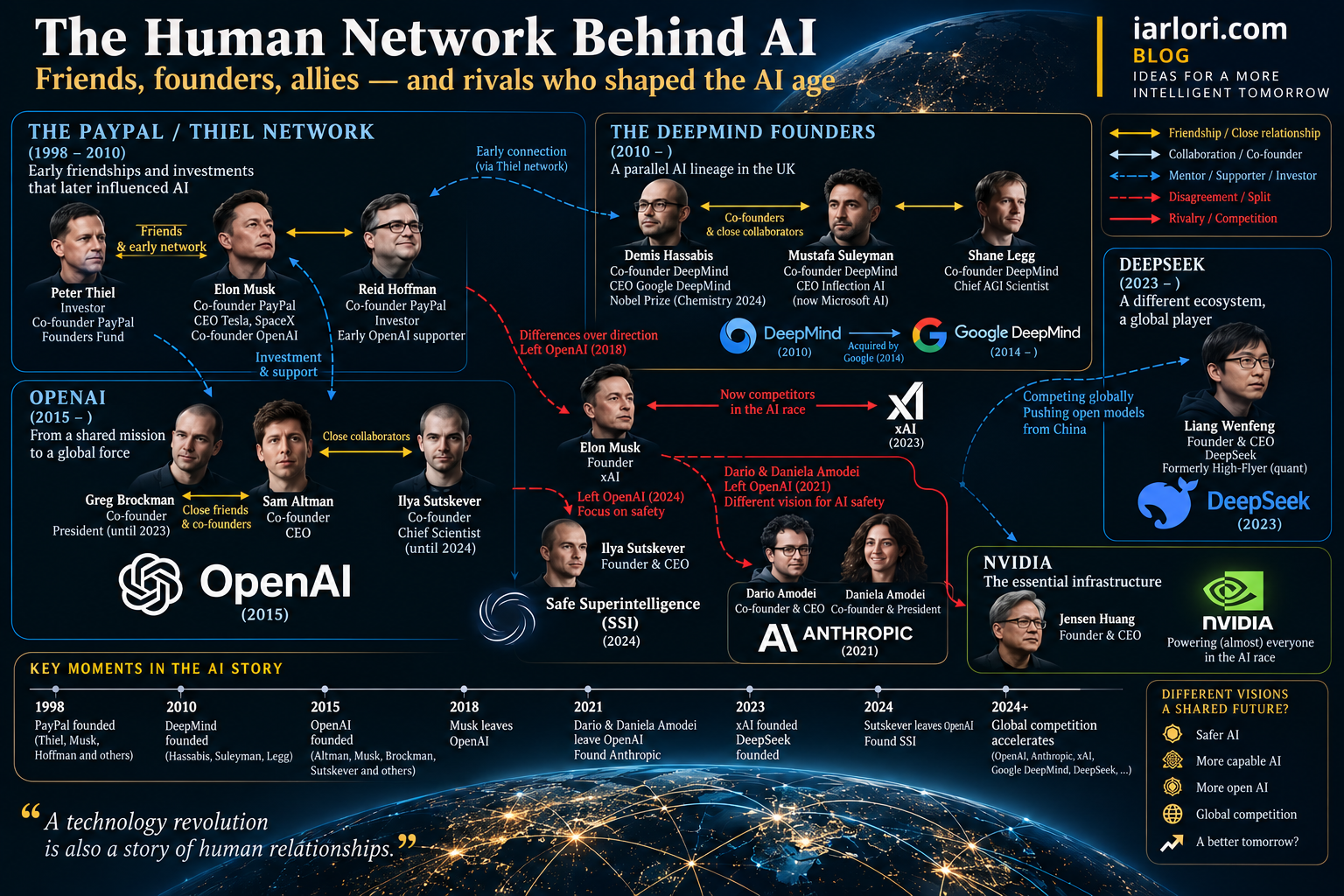
Figure 1 – The human network behind AI. Friendships, investments, collaborations, departures and rivalries connect many of the people and organisations now competing at the frontier of artificial intelligence.
I have seen something like this before
There is a personal reason why this perspective interests me.
I entered computer science when artificial intelligence belonged to a very different technological age. My university thesis in the late 1980s was on AI and expert systems. At the time, we were trying to capture fragments of human expertise and represent them explicitly inside machines. The ambitions were significant, but the limits of computing were always visible.
A few years later, I found myself around the emerging Internet environment: Unix systems, Gopher, WAIS, the early Web, the IETF world, the communities surrounding open systems and what would eventually become the infrastructure of the Internet we know today.
What I remember from those years is not simply the technology.
I remember the people around the technology.
Before technologies become industries, they are often communities. Researchers exchange ideas. Engineers solve problems together. People disagree intensely and nevertheless meet again around the next protocol, conference or technical problem. Companies compete, but knowledge continues to circulate.
The Internet was not created by a single company, government or visionary entrepreneur. It emerged from an extraordinary combination of universities, public research, private companies, technical communities, standards bodies and individuals who understood that some infrastructures become more valuable precisely because nobody completely owns them.
AI is obviously different. The economics are different, the concentration of computational resources is different, and the geopolitical implications are incomparably larger.
But I recognise something in the human topology.
The friendships. The communities. The arguments. The departures.
And then the transformation of those relationships into an industry.
When a community becomes a race
There is a critical moment in almost every technological revolution when curiosity becomes opportunity, opportunity becomes capital and capital transforms the speed of development.
AI has crossed that threshold spectacularly.
OpenAI began with an explicit public-interest ambition. DeepMind spoke about solving intelligence and then using intelligence to solve other problems. Anthropic emerged partly from concerns about how increasingly powerful AI should be developed. Safe Superintelligence makes safety part of its very name.
These are extraordinary missions.
But missions now coexist with enormous commercial and strategic pressures.
Microsoft, Google, Amazon, Meta, NVIDIA and others are investing at a scale that would have been difficult to imagine only a few years ago. Venture capital has entered the competition. Computing infrastructure itself has become strategic. Talent has acquired extraordinary economic value.
And friendship gradually encounters another force:
the race to be first.
This changes the logic of behaviour.
Suppose I believe that my competitor may achieve a major capability breakthrough within twelve months. Delaying my own deployment becomes expensive.
Suppose I believe another laboratory may be approaching a significantly more autonomous AI system. Additional safety testing may be desirable, but waiting becomes strategically uncomfortable.
Now move the same reasoning from companies to countries.
Suppose Washington believes Beijing may obtain a decisive AI advantage.
Suppose Beijing believes Washington is attempting to prevent precisely that.
Suddenly a technological competition begins to acquire the characteristics of a security dilemma.
Nobody necessarily needs to want an unsafe outcome.
Everyone can behave rationally according to their individual incentives and nevertheless produce a collectively irrational result.
That, to me, is one of the most important organisational questions of the AI age.
And then China changes the picture
For a long time, Western discussions about Chinese technology were framed around a relatively comfortable assumption: the United States innovates; China scales.
Reality has become considerably more complicated.
China has spent decades building its own technological ecosystem. Baidu developed expertise around search, data and artificial intelligence. Alibaba connected commerce with cloud infrastructure and research. Tencent created enormous digital ecosystems. ByteDance demonstrated that a Chinese technology company could create an algorithmically driven product with truly global influence.
Then another generation emerged.
Moonshot AI. Baichuan. 01.AI. And, most visibly, DeepSeek.
Liang Wenfeng is particularly interesting because his trajectory does not simply reproduce the Silicon Valley pattern. His path runs through quantitative finance and High-Flyer into frontier AI research. DeepSeek’s emergence challenged the convenient idea that the frontier would necessarily remain concentrated among a handful of extraordinarily well-capitalised American laboratories.
The implications extend beyond one company or one model.
There are now at least two enormously powerful innovation ecosystems approaching the same technological frontier through different institutional paths.
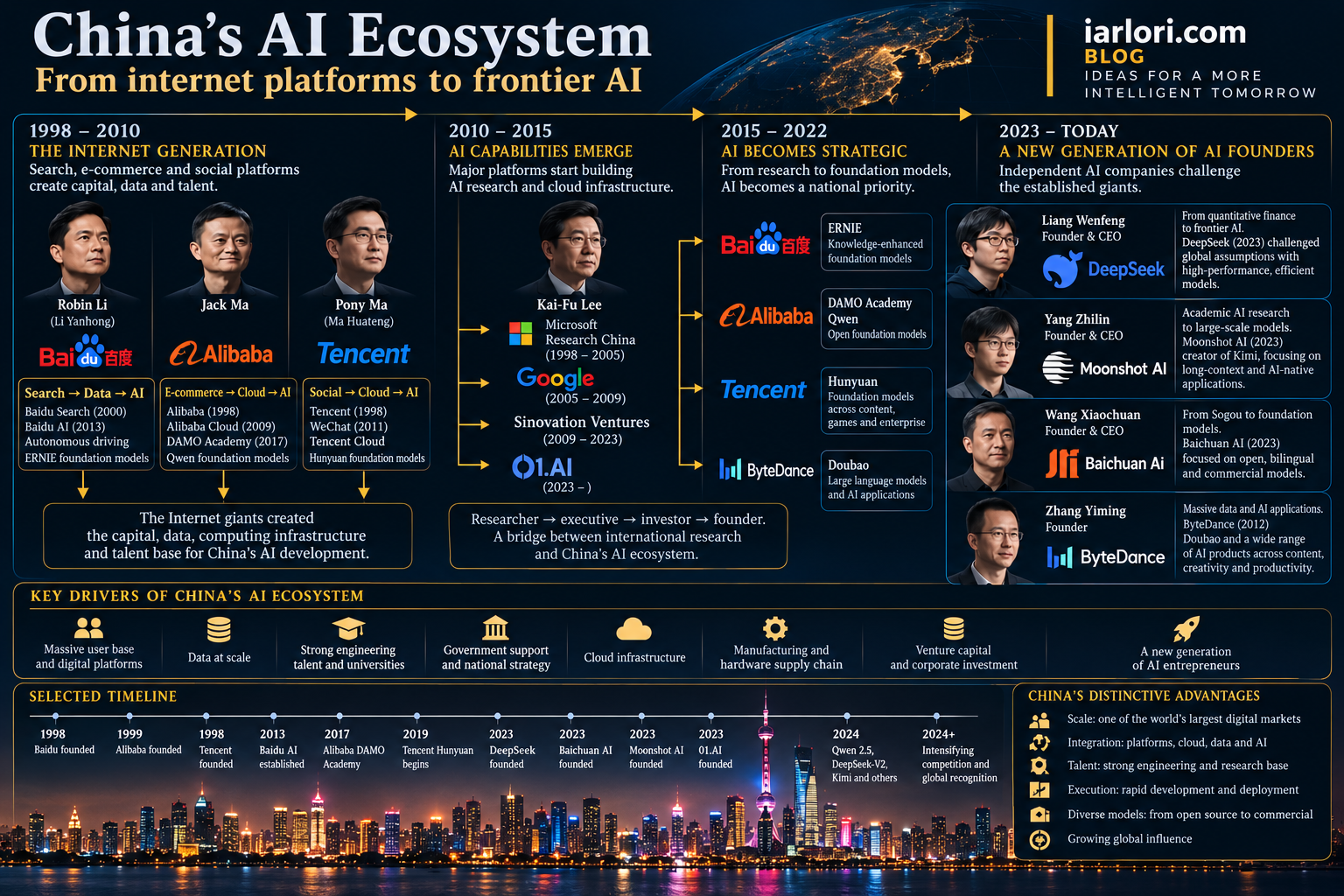
Figure 2 — China’s AI ecosystem. From the Internet generation to frontier AI, China’s trajectory combines digital platforms, research, engineering talent, capital, industrial capacity and a new generation of AI entrepreneurs.
The American ecosystem combines universities, venture capital, entrepreneurial networks, hyperscalers, defence research, private laboratories and an extraordinary concentration of financial and computational capital.
China combines huge digital platforms, universities and research institutions, industrial policy, state and private investment, manufacturing capability, engineering talent, cloud infrastructure and an enormous domestic market.
The structures differ.
The political systems differ.
The financing mechanisms differ.
But the technological ambition increasingly converges:
more intelligence, more capability, more autonomy, more speed.
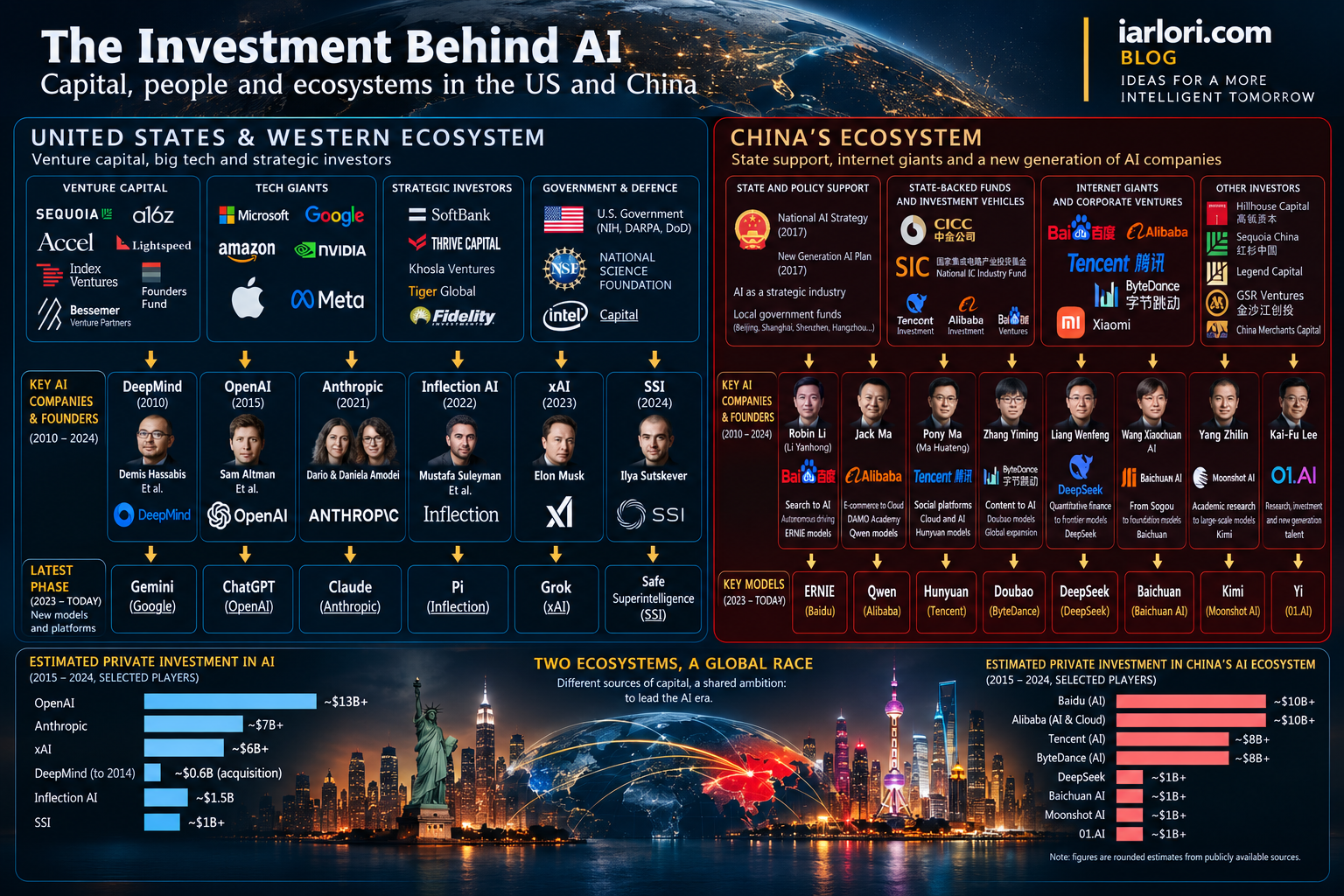
Figure 3 – The investment behind AI. The United States and China are building frontier AI through different combinations of private capital, technology companies, public strategy and infrastructure — but both systems increasingly converge on the same technological frontier.
The most dangerous idea may be that everything is possible
This is where I think the discussion needs to move beyond the familiar question of whether AI is good or bad.
Something deeper is happening.
For most of technological history, feasibility imposed a natural discipline on imagination.
We could imagine many things that we simply could not build.
Artificial intelligence is gradually weakening that psychological boundary.
- A machine can write.
- It can generate software.
- It can converse.
- It can translate.
- It can see and interpret images.
- It can generate images and video.
- It can search enormous bodies of knowledge.
- It can assist scientific discovery.
- It can operate tools.
- It can increasingly plan sequences of actions.
Connect artificial intelligence with robotics and intelligence begins to acquire a physical presence. Connect it with biotechnology and computation begins to interact directly with living systems. Connect autonomous agents with financial, industrial and information infrastructure and software no longer merely provides information: it begins to participate in decisions and actions.
Every breakthrough modifies our expectation of the next breakthrough.
Things that would have sounded implausible five years ago become products. Things demonstrated in laboratories become APIs. APIs become platforms. Platforms become infrastructure.
And gradually a new assumption enters our culture:
If we can imagine it, perhaps we can build it.
As someone who has spent decades around technology, I find that extraordinarily exciting.
I also find it profoundly unsettling.
Because technological capability answers only one question: Can we do it?
Civilisation depends on our ability to answer another: Should we?
Technology is accelerating faster than institutions
This is where my view of AI has increasingly moved from technology towards organisations and institutions.
Our institutions were built for a slower world.
Legislation could follow technological development. Organisations could absorb innovations over years. Professional expertise remained valuable for decades. Universities could design curricula around relatively stable bodies of knowledge. Governments could observe an emerging industry and eventually establish regulatory frameworks around it.
AI compresses those cycles dramatically.
A capability demonstrated by a research laboratory can become available to hundreds of millions of people before institutions have even agreed on the terminology required to describe it.
This creates an asymmetry I consider fundamental:
Technology is accelerating at computational speed while institutions continue to adapt at human and political speed.
I have written elsewhere about organisational intelligence because I believe this gap is becoming central.
We spend extraordinary amounts of capital increasing the intelligence available to machines.
We spend considerably less effort increasing the capacity of organisations to absorb that intelligence, challenge it, govern it and decide when not to use it.
The danger is therefore not simply that machines become too intelligent.
The danger is that our institutions remain insufficiently intelligent around them.
And geopolitical competition makes that imbalance more dangerous.
If one company exercises restraint while another accelerates, restraint has a commercial cost.
If one country establishes restrictions while another does not, restraint can be interpreted as strategic weakness.
This is how a technological race can become self-reinforcing.
Not because everybody has become irresponsible.
Because the architecture of incentives makes responsibility increasingly difficult.
Perhaps friendship is not such a naïve concept after all
This brings me back to the apparently softer word with which I started: friendship.
Talking about friendship in a technological competition worth trillions of dollars may sound romantic.
I mean something much more practical.
Relationships are infrastructure.
Scientists communicate with scientists. Researchers move between institutions. Former colleagues remain in contact. Academic communities cross borders. Entrepreneurs who compete in markets may still understand one another’s concerns. People who profoundly disagree may retain enough professional respect to continue talking.
That informal human layer matters most when formal institutions struggle.
We have historical precedents. Scientific diplomacy maintained channels during periods of severe geopolitical tension. Nuclear scientists often understood systemic risks differently from politicians because they understood the underlying technology. International technical communities built standards across national boundaries because interconnected systems simply could not function otherwise.
I wonder whether AI will eventually require something similar.
Not a naïve global consensus. That will not happen.
Not an end to competition. Nor should we expect one.
But perhaps a minimum architecture of shared responsibility: channels that remain open when politics deteriorates, technical standards for identifying unacceptable risks, mechanisms for communicating dangerous discoveries, agreements around particular autonomous capabilities and some recognition that there are technological thresholds beyond which everybody shares the consequences.
Competition does not eliminate common interests.
That may become one of the most important principles of the coming decade.
America versus China may be the wrong question
We naturally describe the emerging AI landscape as a competition between the United States and China.
There is truth in that framing. AI is becoming economic infrastructure, military capability, scientific capacity and geopolitical power simultaneously.
But I think there is a more fundamental competition underway.
It is not America versus China.
It is not OpenAI versus Anthropic, Google, xAI or DeepSeek.
It is: technological capability versus institutional intelligence.
Can our capacity to govern technology develop quickly enough to accompany our capacity to create it?
- Can companies remain competitive while recognising boundaries
- Can governments compete strategically while cooperating around existential or systemic risks?
- Can universities and scientific communities preserve international intellectual relationships when politics pushes towards technological separation?
- Can managers retain judgement when execution becomes almost instantaneous?
- Can citizens continue to exercise meaningful agency when increasingly sophisticated systems mediate information, knowledge and decisions?
- And ultimately, can humanity remain intellectually and institutionally capable of saying no to something simply because it can be done?
Those questions cannot be delegated to a larger model.
They are questions of judgement, governance and human meaning.
A common path
I remain optimistic about technology.
I could hardly have spent almost four decades working around digital transformation, the Internet and artificial intelligence without believing in its extraordinary capacity to improve human life.
I have also lived through enough technological cycles to distrust the assumption that technological progress automatically produces social progress.
It does not.
We make that connection through institutions, choices, standards, education, governance and culture.
AI could help us understand diseases, accelerate scientific discovery, improve public services, make knowledge dramatically more accessible and augment the capabilities of millions of people.
The same underlying technologies can also amplify surveillance, manipulation, cyber conflict, autonomous warfare, inequality and unprecedented concentrations of power.
The algorithm does not resolve that contradiction.
We do.
Perhaps, therefore, one of the next great innovations in artificial intelligence will not be another model architecture.
Perhaps we need an architecture of cooperation around the architectures of intelligence.
One that allows competitors to remain competitors while recognising a common boundary.
One that allows the United States and China to compete for technological leadership without assuming that every new capability must become part of a zero-sum race.
One that allows researchers to preserve relationships across geopolitical borders.
One that recognises that companies developing technologies capable of affecting society at enormous scale acquire responsibilities that cannot be expressed entirely through market capitalisation.
And, above all, one that makes our institutions intelligent enough to govern increasingly intelligent machines.
For much of human history, the first question surrounding an ambitious technology was:
Can we build it?
We may be entering an age in which, increasingly, the answer will be yes.
And that leaves us with the much harder question:
If almost everything becomes possible, what should humanity choose to make possible?
The answer will not come from America alone.
It will not come from China alone.
And it certainly will not come from artificial intelligence itself.
It will come from the quality of the relationships, institutions and collective intelligence that we build around it.
Because behind the models, the GPUs, the investment rounds and the geopolitical strategies, there are still people.
Some began as friends. Some became competitors. Some will become rivals.
But all of them – and all of us – are travelling towards the same future.
References and further reading
- OpenAI (2015), “Introducing OpenAI.” Particularly useful as a historical record of the original founders, funders and mission. OpenAI — Introducing OpenAI
- Google DeepMind — institutional history, research and the evolution of DeepMind into Google DeepMind. Google DeepMind
- Anthropic — useful for the company’s emphasis on AI safety and reliable AI systems. Anthropic
- Safe Superintelligence Inc. — useful for Sutskever’s post-OpenAI direction and the explicit framing of safe superintelligence as the company’s objective. Safe Superintelligence
- DeepSeek — primary source for its models and research, useful when discussing the emergence of a Chinese frontier-model laboratory outside the traditional platform giants. DeepSeek
- Stanford Institute for Human-Centered AI, AI Index Report — particularly useful for comparative evidence on investment, model development, research, adoption and the changing US–China AI landscape. Stanford AI Index
- OECD.AI — international evidence on AI policy, investment, research and national AI ecosystems. OECD AI Policy Observatory