/

October 5, 2026

Experience Is Not the Opposite of Innovation

Shares

There is a peculiar contradiction in the technology industry.

We celebrate data accumulated over decades. We train artificial intelligence on enormous bodies of historical information because we believe that patterns in the past can help us understand the present and anticipate the future.

Yet when the same accumulation happens inside a human being, we sometimes call it ageing.

This has always struck me as an interesting paradox.

Technology is perhaps one of the few industries where experience can occasionally be treated almost as a liability. New technologies arrive so quickly that knowledge acquired ten or twenty years ago can appear irrelevant. New terminology reinforces the impression that everything has changed. New generations of professionals naturally arrive with skills that did not exist when the previous generation began its career.

And some experience genuinely does become obsolete.

Knowing yesterday’s product is not necessarily useful for understanding tomorrow’s market. Twenty years in an industry do not automatically produce twenty years of insight. Experience can become dangerous when it turns into certainty, hierarchy or the belief that because something happened before, it must happen again.

But that is only one kind of experience.

There is another that becomes more valuable precisely because technology changes so quickly.

It is the ability to recognise patterns beneath technologies.

I have seen several futures arrive

My own professional life began around artificial intelligence long before today’s generative AI.

My university thesis, in the late 1980s, concerned expert systems. I worked with Lisp machines at a time when artificial intelligence belonged largely to laboratories, universities and specialised computing environments.

Then came another technological wave.

Unix, distributed systems, Gopher, WAIS and the early Web. I was fortunate enough to be close to the Internet community in those years, when much of what we now take for granted was still being invented and debated.

Then mobile.

Telecommunications became a platform for services rather than simply voice. The SIM evolved from an authentication component into something with much broader possibilities. Mobile payments emerged. Ecosystems had to be constructed among operators, banks, payment networks, handset manufacturers and public institutions.

Then smartphones changed the architecture again.

Then cloud.

Then data.

And now AI has returned—not as the expert system I encountered almost forty years ago, but as a general-purpose technology capable of operating across language, images, software, knowledge and increasingly action itself.

These technologies are radically different.

But after enough technological cycles, something interesting happens.

You begin to recognise that organisations repeat themselves much more often than technologies do.

The technology changes. The questions return.

Every major technological transition arrives with a vocabulary that makes it sound unprecedented.

And technically, it often is.

But listen carefully to the conversations around it and familiar questions begin to appear.

  • Who owns the infrastructure?
  • Who controls the standards?
  • Where does the value migrate?
  • Should we build or buy?
  • Which capabilities should remain inside the organisation?
  • How quickly should we move?
  • What happens to intermediaries?
  • What happens to existing professional roles?
  • Who becomes responsible when the technology fails?
  • How much should we trust the new entrant?
  • How much should we trust the incumbent?

And, perhaps most consistently:

Is this really transformational, or are we simply putting a new technological layer on an old organisation?

I heard versions of these questions around the early Internet.

I heard them around mobile services and payments.

I heard them during successive waves of digital transformation.

I hear them again around AI.

The answers are not the same. But the questions have history.
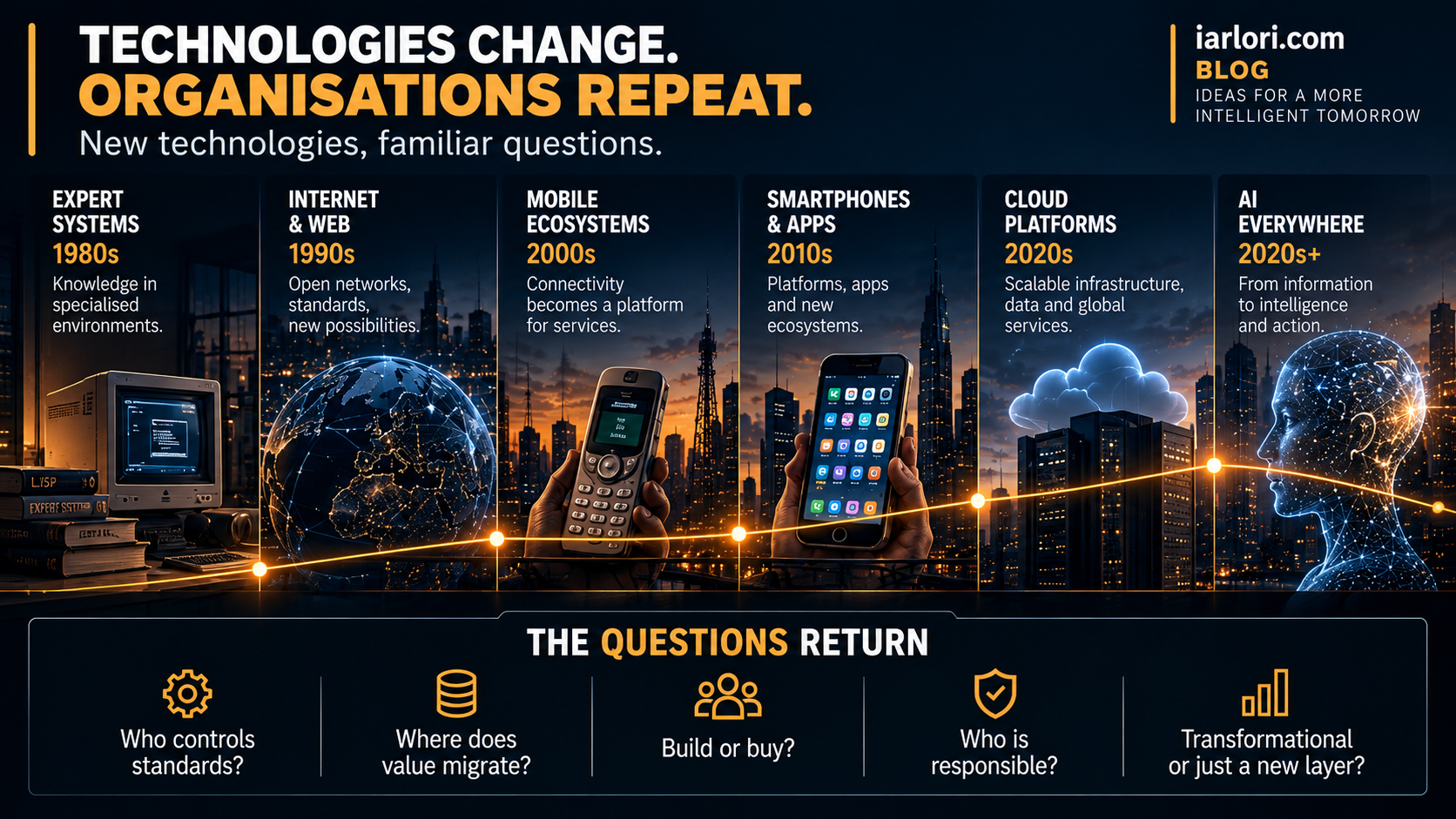
Figure 1 — Technologies change. Organisational patterns persist. Across successive technological waves, the tools and architectures change radically, while questions of control, value, standards, responsibility and organisational transformation repeatedly return.

And knowing that history changes how you listen to the present.

Experience is compressed pattern recognition

This is where I think we misunderstand professional experience.

Its highest value is not remembering what happened.

Google can retrieve what happened. AI can summarise it extraordinarily well.

The value of experience lies in having lived through enough combinations of technology, markets, organisations and human behaviour to recognise patterns before they become obvious.

An experienced professional may hear a strategy presentation about a completely new technology and recognise an old dependency problem.

Or see a supposedly disruptive business model and recognise that the real battle will be over distribution.

Or watch an organisation launch an ambitious transformation programme and realise that the technological architecture is not the principal constraint—the incentive structure is.

That does not mean experience produces the correct answer automatically.

It produces better questions earlier.

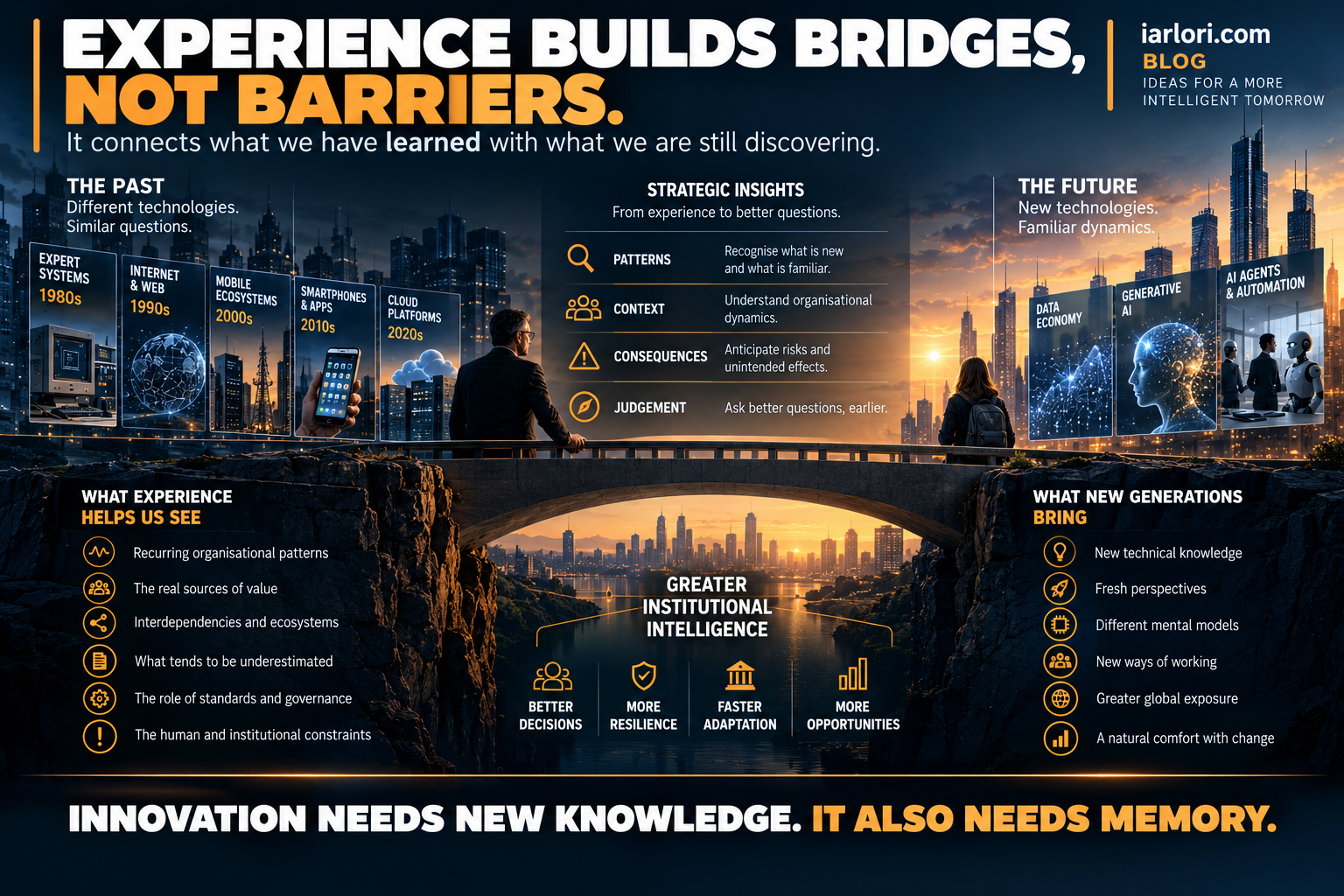
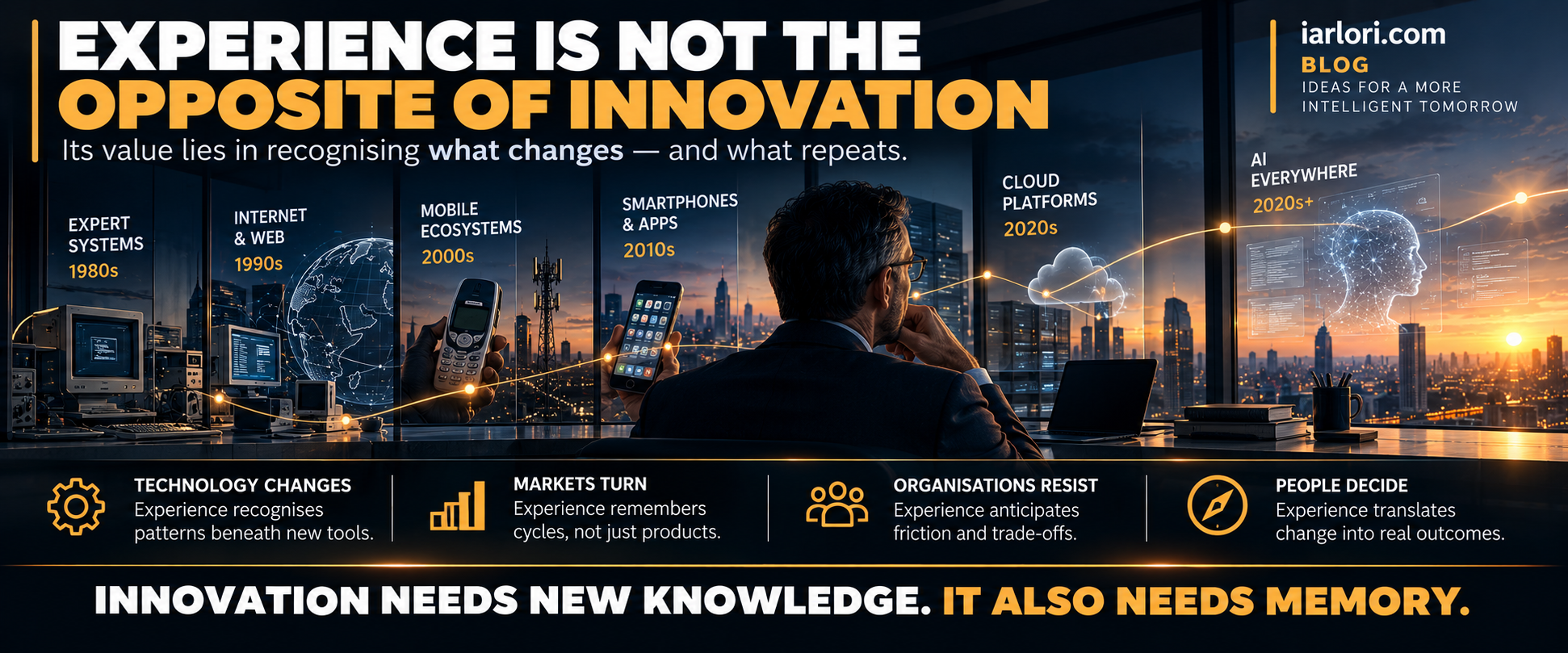
Figure 2 — Experience as a bridge between technological cycles. The value of experience is not in applying yesterday’s answers to tomorrow’s technologies, but in recognising recurring patterns, understanding context and asking better questions earlier. New knowledge and accumulated experience become more valuable when they meet.

And in periods of rapid technological change, that can be extraordinarily valuable.

But experience has an expiry condition

There is, however, an important qualification.

Experience only retains its value if it remains connected to learning.

Without curiosity, experience becomes nostalgia.

Without exposure to new technologies, it becomes analogy without understanding.

Without younger colleagues, new disciplines and unfamiliar perspectives, it can become an elegant mechanism for explaining why the future will resemble the past.

It will not.

When I encountered artificial intelligence in the 1980s, I could not have extrapolated directly from expert systems to today’s foundation models.

When we were working around the early Internet, we could not simply project the Web forward and derive today’s platform economy, social networks or AI agents.

When mobile operators controlled the customer relationship, it would have been easy to underestimate how radically the smartphone and application ecosystems would redistribute that power.

Experience therefore needs a companion:

continuous intellectual discomfort.

You need to keep encountering things you do not understand.

You need people around you who know things you do not.

You need to remain willing to discover that a model that served you well for twenty years no longer explains what is happening.

That is when experience becomes useful rather than defensive.

AI makes this question particularly interesting

There is an additional irony in the current AI revolution.

We are building machines whose extraordinary capability derives partly from exposure to enormous quantities of accumulated human knowledge.

At the same time, many organisations are facing the departure of experienced professionals carrying decades of tacit knowledge that was never adequately captured.

We talk extensively about data.

We talk less about memory.

Yet organisations have memory too.

It exists in documents and databases, certainly, but also in relationships, professional habits, informal networks, exceptions people have learned to recognise, failed projects nobody wrote about, and decisions whose real rationale never made it into the minutes.

Some of this knowledge can now be captured and made accessible through AI.

That is an extraordinary opportunity.

But AI should not encourage us to conclude that human experience therefore becomes less important.

It may make the combination of experience and AI more valuable.

The experienced professional can bring context, pattern recognition and judgement.

AI can bring breadth, retrieval, synthesis and computational scale.

Neither needs to imitate the other.

The interesting question is how we design organisations in which they complement each other.

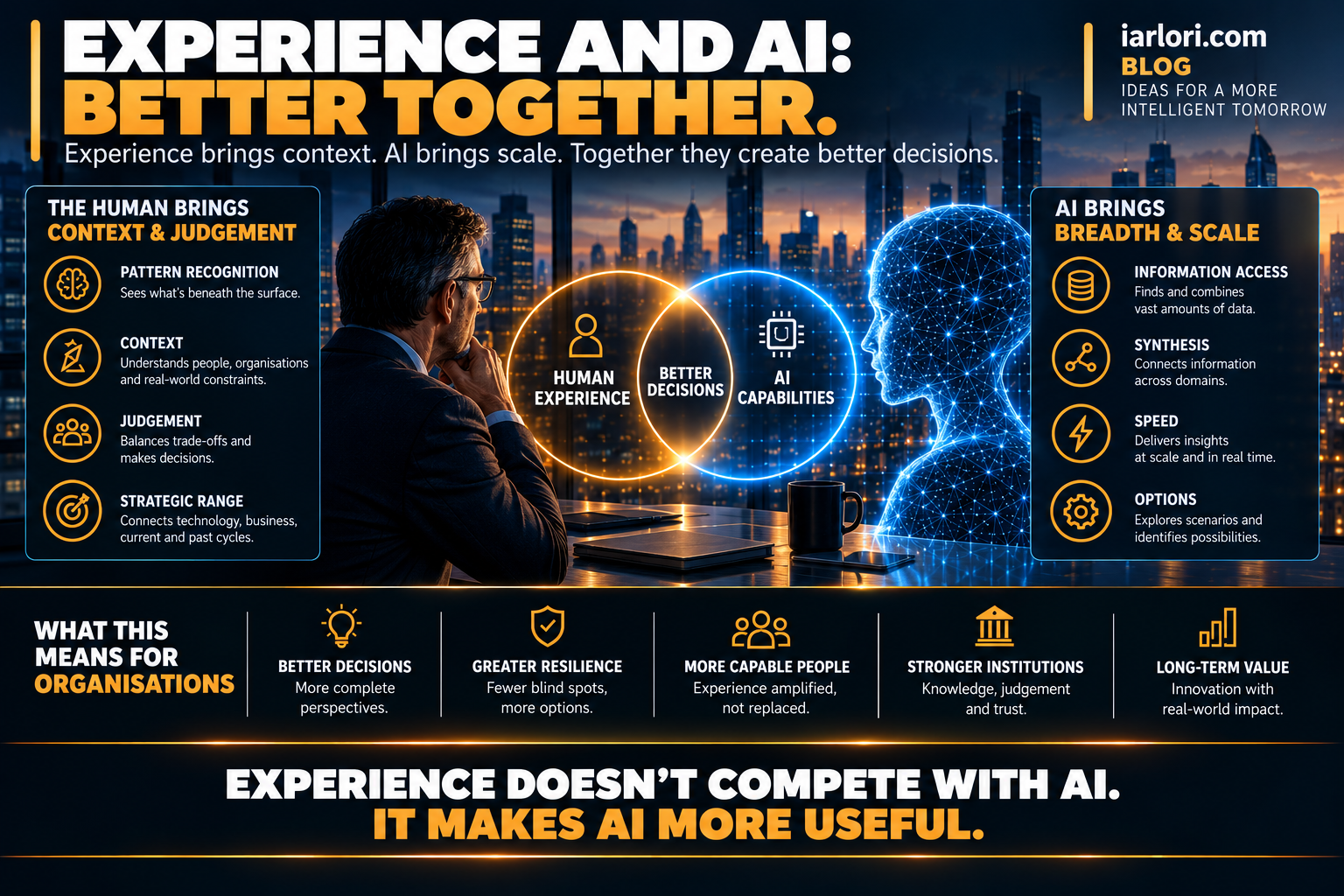
Figure 3 — Experience and AI are complementary forms of capability. Human experience contributes context, judgement, pattern recognition and strategic range; AI contributes breadth, retrieval, synthesis and computational scale. The opportunity is not to make one imitate the other, but to combine their different strengths to improve organisational decisions.

The danger of organisations without memory

There is another dimension to this.

Organisations naturally renew themselves. People retire, change jobs, move countries and change professions. New people arrive with different skills and assumptions. This renewal is necessary.

But renewal without transmission creates amnesia.

And organisational amnesia is expensive.

A company can repeat a strategy that failed fifteen years earlier because nobody remaining remembers why it failed.

A public institution can rediscover an idea that was previously tested without understanding the constraints that stopped it.

A technology team can reproduce an architectural mistake because the people who understood the original trade-off have gone.

AI may help us preserve more of this knowledge.

But only if we recognise that the knowledge exists in the first place.

The challenge is therefore not to preserve seniority.

It is to preserve useful organisational memory while allowing obsolete assumptions to disappear.

That is a much more sophisticated objective.

Universities have a role here too

I think this has consequences for education.

Universities understandably focus on preparing younger generations for technologies that are changing rapidly. But executive and lifelong education may become equally important.

A 25-year-old entering an AI-enabled workplace needs new skills.

So does the 55-year-old executive responsible for redesigning that workplace.

Their educational needs are different.

The younger professional may need exposure to organisational history and institutional complexity.

The senior professional may need exposure to technologies and conceptual frameworks that did not exist during their formal education.

The exchange should work in both directions.

This is one reason I increasingly see teaching not simply as transferring knowledge from someone experienced to someone less experienced.

At its best, teaching creates an environment in which different forms of knowledge collide productively.

Experience meets novelty.

Theory meets practice.

Technical possibility meets organisational reality.

And everybody has something to learn.

The same applies to boards

Boards and senior leadership teams face a similar problem.

AI discussions can easily become polarised between enthusiasm and caution.

One group understands the new technology and wants to move quickly.

Another understands the organisation and sees all the reasons why change is difficult.

The organisation needs both perspectives—but not as opposing camps.

The strategic advantage comes from combining them.

A board does not need every member to become an AI engineer.

It does need enough technological understanding to ask meaningful questions.

And technology leaders do not merely need to explain what AI can do.

They need enough organisational understanding to recognise why something technically possible may fail institutionally.

That interface is where much of the real work of transformation happens.

Perhaps we should redefine seniority

The traditional idea of seniority is largely hierarchical.

Years produce positions. Positions produce authority.

That model is becoming less interesting to me.

In a world where knowledge changes quickly, seniority should perhaps mean something else:

the ability to connect more contexts.

Technology with business.

The present with previous cycles.

Strategy with implementation.

Innovation with institutional constraints.

Data with human behaviour.

Possibility with consequence.

This is not guaranteed by age.

A younger professional can possess remarkable strategic range. An older professional can remain trapped inside a narrow worldview.

But strategic range can accumulate with experience—if curiosity accumulates with it.

That final condition matters.

Innovation needs memory

AI will undoubtedly make some accumulated technical knowledge less valuable.

It will allow younger professionals to perform tasks that once required years of experience.

It will democratise access to expertise.

I consider much of that progress.

But I would be careful about drawing the conclusion that experience itself is therefore becoming less valuable.

The opposite may happen.

When answers become cheap, knowing which question matters becomes more valuable.

When technical capability becomes abundant, understanding organisational consequences becomes more valuable.

When change accelerates, the ability to distinguish a genuinely new pattern from a familiar one wearing new language becomes more valuable.

And when AI gives us access to almost unlimited external knowledge, context may become one of the scarcest forms of intelligence.

So I would not place experience and innovation at opposite ends of a spectrum.

I would place something else there:

experience that has stopped learning and experience that continues to learn.

The first protects the past.

The second helps us interpret the future.

After almost four decades around successive waves of technology, perhaps that is the lesson I value most.

I do not expect the future to repeat the past.

But I have learned to listen carefully when it begins to rhyme.

Innovation needs new knowledge.

It also needs memory.

From the same category

Never miss an article (subscribe for updates)