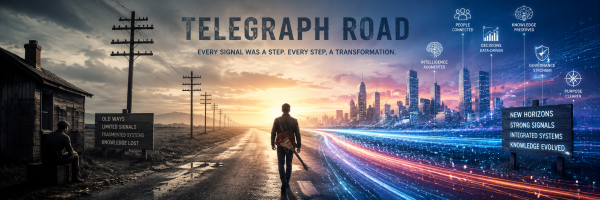
Digital Transformation Was Never Really About Technology

For years, organizations have spoken about digital transformation with the language of engineering and procurement. The discussion has often revolved around platforms, cloud migrations, workflow systems, dashboards, portals, mobile applications, and more recently, artificial intelligence. Entire strategies have been built around acquiring technologies that promised modernization, acceleration, efficiency, and innovation.

When Visibility Becomes Power: Networks, Prestige, and the Silent Exclusion of Competence

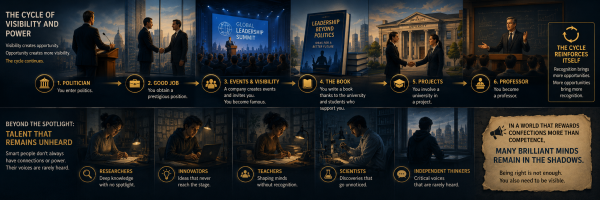
 In many modern democracies, power no longer operates only through formal institutions. It increasingly moves through networks of visibility, reputation, influence, and reciprocal legitimization. Politics, academia, media, consulting, conferences, think tanks, publishing, and corporate ecosystems often reinforce one another in ways that are subtle, socially acceptable, and sometimes almost invisible from the outside.

A Society That No Longer Values Knowledge Risks Becoming Technologically Dependent

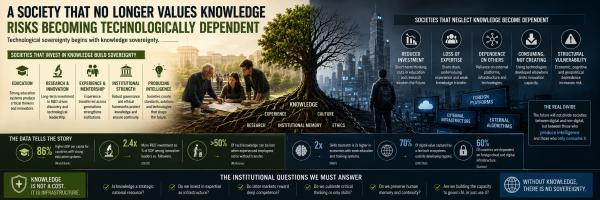
For decades, many advanced economies progressively shifted away from viewing expertise as strategic infrastructure. Specialized competencies became increasingly expensive rather than essential. Long-term research was often perceived as slower and less attractive than immediate operational efficiency. Educational systems were gradually evaluated through short-term economic metrics rather than through their ability to cultivate critical reasoning, scientific depth, historical awareness, or institutional continuity.

When Process Replaces Thinking: The Quiet Rise of Procedural Intelligence

There is a moment, subtle, almost imperceptible, that occurs in many organisations today. It happens in meetings that run flawlessly, in conferences that feel professionally orchestrated, in initiatives that follow well-established frameworks. Everything appears to function exactly as intended. Time is respected, formats are clear, outputs are produced.

And yet something is missing.

Artificial Intelligence, Labor, and the Reconfiguration of Economic Growth

Artificial intelligence is not merely a technological innovation. It represents a structural shift in how societies produce value, organize labor, and ultimately generate economic growth. In previous industrial transitions, machines replaced human physical effort while leaving cognitive work largely intact. Today, AI operates in a different domain: it targets repetitive cognition, the predictable patterns of thinking that underpin a large portion of modern economic activity.

The IT Department Is Dead. Long Live the Organization.

We treated technology as a toolset—servers, networks, applications—something to be deployed, maintained, and occasionally fixed. The IT department became the custodian of this machinery: provisioning access, patching vulnerabilities, restoring what was broken.

But something fundamental changed.

Technology stopped being infrastructure and became cognition.

Algorithms don’t just execute—they decide.
Systems don’t just store—they interpret.
Platforms don’t just connect—they shape behavior.

And yet, we are still organizing ourselves as if “thinking with machines” were a specialized function delegated to a single department.

It is not.

It never was.